
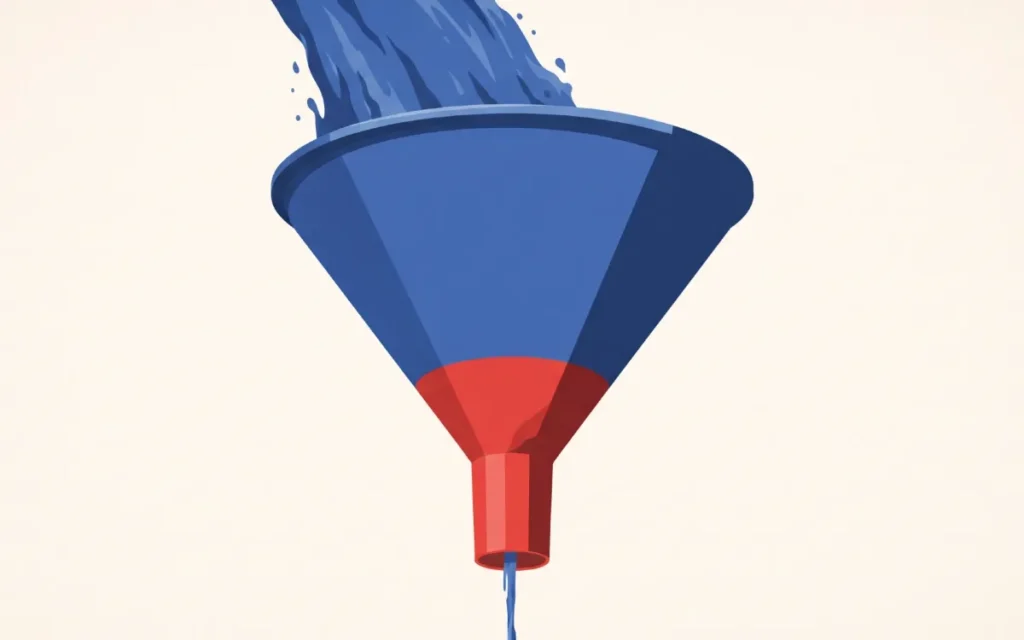
The Great Traffic Shift: How AI Search Is Rewriting the Web’s Economic Contract
A landmark study released on July 8, 2026, by researchers at Bocconi University has provided the most granular look yet at how the rise of AI-driven search is fundamentally altering the flow of traffic across the internet. The paper, titled "Answering Without Referring: How AI Search Rewrites the Web’s Economic Bargain," authored by Qiaoni Shi, Kai Zhu, and Kai Gu, confirms what many publishers have long feared: as users shift their information-seeking habits toward conversational AI, the traditional "referral economy" that sustains the open web is undergoing a rapid, and potentially permanent, contraction.
Analyzing desktop clickstream data from over 45,000 United States households, the researchers found that expanding access to ChatGPT Search resulted in a 9.4% average decline in traditional search engine queries. More concerning for the publishing industry is the trend line: that decline deepened to 17.0% after twenty weeks of exposure. By moving the analytical focus from "click-through rates" to "information-seeking occasions," the study highlights a widening chasm between the utility AI provides to users and the traffic it directs to the original sources of that information.
The Methodology: Tracking the "Information-Seeking Occasion"
Historically, discussions regarding AI traffic have been muddied by inconsistent metrics. Some platforms define success by impressions, others by individual clicks, and many rely on self-reported data that lacks external verification. The Bocconi team bypassed these limitations by using URL-level Comscore desktop clickstream records from October 2024 through July 2025.
By reconstructing individual browsing sessions from raw page loads, HTTP referrers, and timestamps, the researchers created a standardized unit of measurement: the "information-seeking occasion." In this framework, one ChatGPT conversation—regardless of length—is compared directly against one Google search query.
The results were stark. ChatGPT generated a "clean" outbound referral in only 5.2% of conversation sessions. In contrast, Google queries resulted in an outbound click 31.1% of the time. Even more telling was the household-level data: 74.4% of ChatGPT-using households went ten months without generating a single clean referral to an outside website. For Google users, that "zero-referral" rate was a mere 9.6%.
Chronology: The Staggered Rollout of AI Search
The study’s credibility rests largely on its clever use of OpenAI’s own product development timeline. Rather than merely observing early adopters—who might have different browsing habits than the general public—the researchers utilized the staggered rollout of ChatGPT Search as a natural experiment.
- October 31, 2024: OpenAI grants ChatGPT Search access to paid subscribers.
- December 16, 2024: Access is extended to logged-in free users, significantly widening the user base.
- February 5, 2025: OpenAI removes the login requirement for basic search queries, allowing anonymous users to access the tool.
- October 2024 – July 2025: The primary window for data collection, capturing the behavioral shift as these barriers to entry were removed.
By comparing households that gained access at these specific milestones against a control group that had no prior interaction with AI search tools, the researchers were able to isolate the effect of the technology itself, effectively stripping away the "selection bias" that often plagues tech-impact studies.
Supporting Data: The Composition of Lost Traffic
The study goes beyond aggregate numbers to analyze where the traffic loss is being felt. When the researchers categorized destination websites, they found that ChatGPT’s referral pool was heavily skewed toward reference sites, technical documentation, and academic resources. Conversely, traffic to e-commerce and social media platforms remained relatively stable compared to the Google baseline.
The erosion of traffic to informational categories was particularly severe. Referral visits to academic research sites fell by 32.8% among users who adopted ChatGPT, while reference and knowledge-based sites saw a 26.5% decline. These are the very sites that provide the foundational content AI models are trained on, raising critical questions about the sustainability of the "web’s economic bargain."
Furthermore, the study addressed the ongoing controversy surrounding robots.txt files and AI crawling. It found that domains actively blocking AI crawlers from training on their content actually received more referral clicks (6.48 per domain) than those that permitted crawling (4.48 per domain). This suggests that the "training-time" access (governed by robots.txt) and "runtime" traffic (governed by citation algorithms) are two distinct mechanisms. Publishers hoping that blocking crawlers will force AI companies to send more traffic may be disappointed; the two issues are not currently linked in the way many had hypothesized.
Official Responses and Industry Context
The Bocconi findings arrive at a volatile time for the digital ecosystem. Throughout 2025 and 2026, various analytics firms have tracked the plummeting click-through rates (CTR) on traditional search engines. Ahrefs, for example, reported that AI Overviews (Google’s native AI search integration) correlated with a 58% reduction in CTR for top-ranking pages as of late 2025.
While OpenAI has not released a formal rebuttal to the Bocconi study, the company has frequently maintained that its mission is to provide direct, synthesized answers to complex questions, which it views as a higher-value service for the end-user. However, the lack of an economic feedback loop has prompted action elsewhere. In mid-2025, a coalition of independent publishers filed antitrust complaints with the European Commission and the UK’s Competition and Markets Authority, arguing that the current AI search model represents a "value transfer" that threatens the viability of independent journalism and research.
In response to these industry-wide shifts, Google added a dedicated "AI Assistant" channel to Google Analytics in May 2026, finally allowing webmasters to distinguish between organic search traffic and traffic driven by LLM citations. This, however, is a diagnostic tool, not a cure for the underlying decline in traffic volume.
Implications: The Future of the "Information-Seeking" Economy
The implications of this study for marketers, publishers, and the broader digital economy are profound and multifaceted.
1. The Erosion of Top-of-Funnel Traffic
The data suggests that the "informational" layer of the internet is the primary casualty of the AI shift. Because ChatGPT excels at synthesizing facts, definitions, and technical instructions, it effectively "swallows" the initial search query. This is catastrophic for websites that rely on high-volume, top-of-funnel traffic to fuel their advertising businesses. If a user receives the answer within a chat interface, they have no reason to click through to a website, meaning ad impressions—and the revenue they generate—simply vanish.
2. Advertising and Budget Reallocation
For search marketers, the study provides a roadmap for the future of paid search. If transactional and e-commerce queries are less affected by AI search than informational ones, advertisers may need to shift their budgets away from educational content and toward bottom-of-funnel, intent-driven keywords. The study confirms that the "routing margin"—the way AI chooses to show or hide a link—is the new gatekeeper of the digital economy.
3. The Quality Content Dilemma
The most existential implication is the "long-run content investment" question posed by the researchers. If high-quality informational content (news, technical guides, academic research) no longer leads to traffic or revenue, will content creators continue to produce it? The study leaves this as an open, urgent question. The current model—where AI relies on public-interest content for its training data while siphoning away the traffic that pays for that content—appears to be a structural imbalance that the current market has yet to resolve.
4. A Shift in Analytics
The study’s methodology serves as a warning to those relying on standard analytics. With Similarweb finding that over 55% of AI-influenced site visits arrive via subsequent branded searches rather than direct links, marketers must rethink how they measure "referrals." The era of simply looking at a "referral source" in Google Analytics is effectively over; the new landscape requires a much more holistic view of the user journey.
As the authors conclude, the findings are a snapshot of a transition. Whether this represents a permanent shift toward an "answer-first" web or a temporary disruption that will eventually lead to new, compensated models for traffic remains to be seen. For now, the data is clear: the bargain that has sustained the web for three decades is being rewritten, and the result is a much quieter, less-trafficked digital landscape for the publishers who built it.
