
Beyond the Vanity Metric: Why Audience Intelligence is the New Currency of Influencer Marketing
In the high-stakes world of digital marketing, the era of "spray and pray" influencer campaigns is officially coming to a close. For years, the industry standard for success was defined by reach: follower counts, aggregate view tallies, and broad engagement percentages. However, a seismic shift is underway. The organizations currently dominating their sectors are no longer the ones with the deepest pockets; they are the ones leveraging data to ask sharper, more nuanced questions about their target demographics.
The core of this transformation is a move away from passive viewership toward active business outcomes. As detailed in the latest industry report, Redefining Influencer Value: How Audience Intelligence Transforms Reach into Revenue, the data reveals a stark reality across healthcare, gaming, and consumer packaged goods (CPG): the creators who command the most views are rarely the ones who command the most conversion.
The Evolution of Influence: From Reach to Revenue
The transition from a "reach-first" to a "value-first" strategy represents a maturation of the influencer economy. For brands, the question is no longer "How many people saw this?" but rather "Who is actually being moved to action?"
This shift is driven by the realization that audience behavior is fragmented. A user might consume high-level entertainment content from one creator while relying on a completely different source for purchasing decisions or clinical guidance. By ignoring the pathways between these creators, brands risk wasting budget on audiences that have no intention of converting.
A Deep Dive into the Healthcare Landscape
Healthcare serves as the most compelling case study for this new methodology. In a sector defined by high stakes and complex decision-making, audience intelligence—encompassing search affinity, shopping behaviors, and cultural alignment—is no longer a luxury; it is a necessity.
The Duality of Clinical and Alternative Narratives
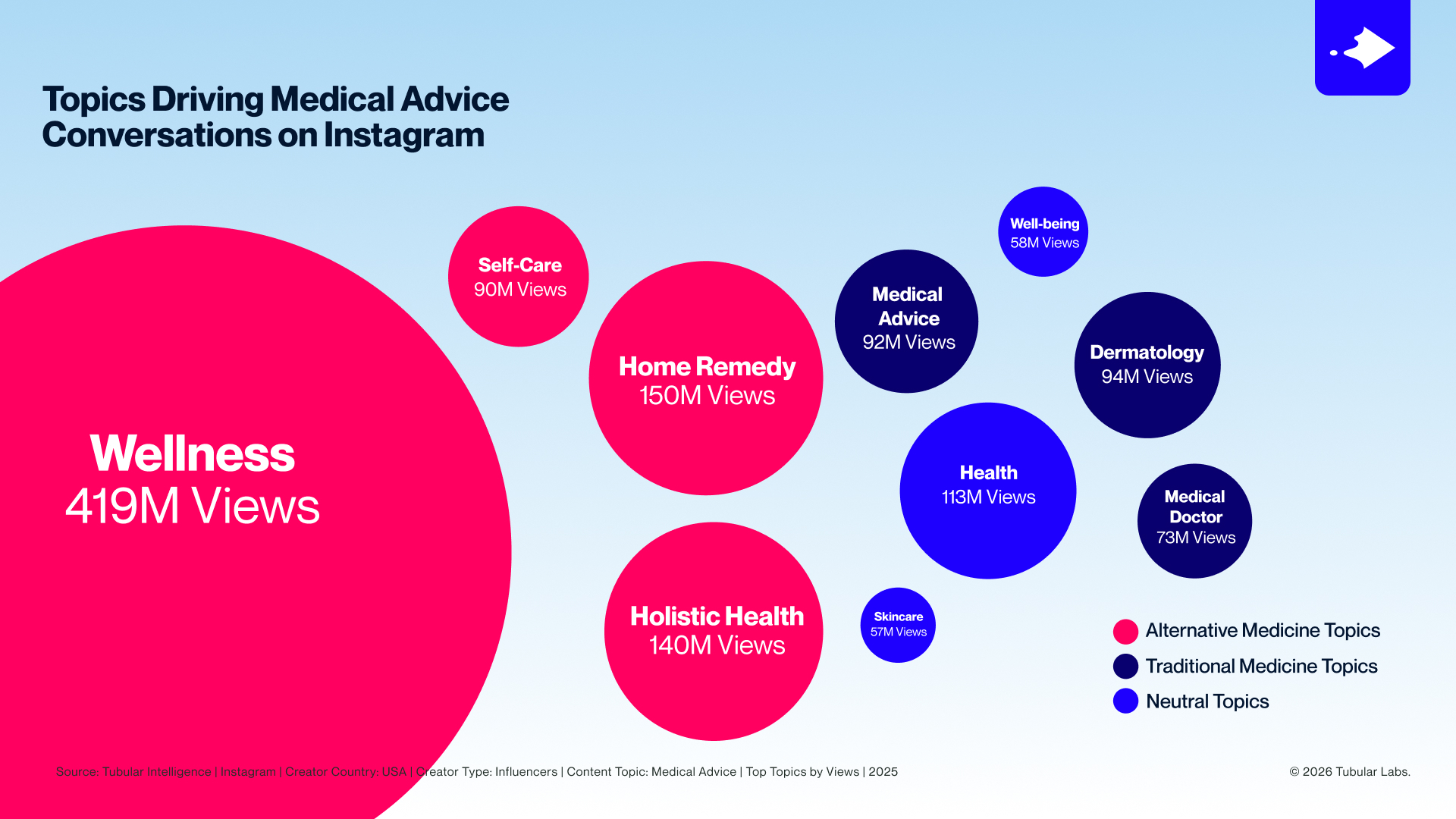
An analysis of U.S. influencer content on Instagram throughout 2025 highlights a fascinating trend: consumers are not choosing between clinical authority and alternative wellness narratives. Instead, they are consuming both simultaneously.
For pharmaceutical, skincare, and supplement brands, this creates a sophisticated strategic opportunity. The data shows that "clinical" content and "lifestyle" content often exist in a symbiotic loop. Brands that restrict their influencer strategy to purely clinical or medical-only voices are effectively leaving money on the table. By failing to appear where curiosity is high and intent is being formed—often in the "alternative" or lifestyle-centric spheres—these brands are missing out on a massive segment of the patient and consumer journey.
Case Study: Deciphering Dermatology
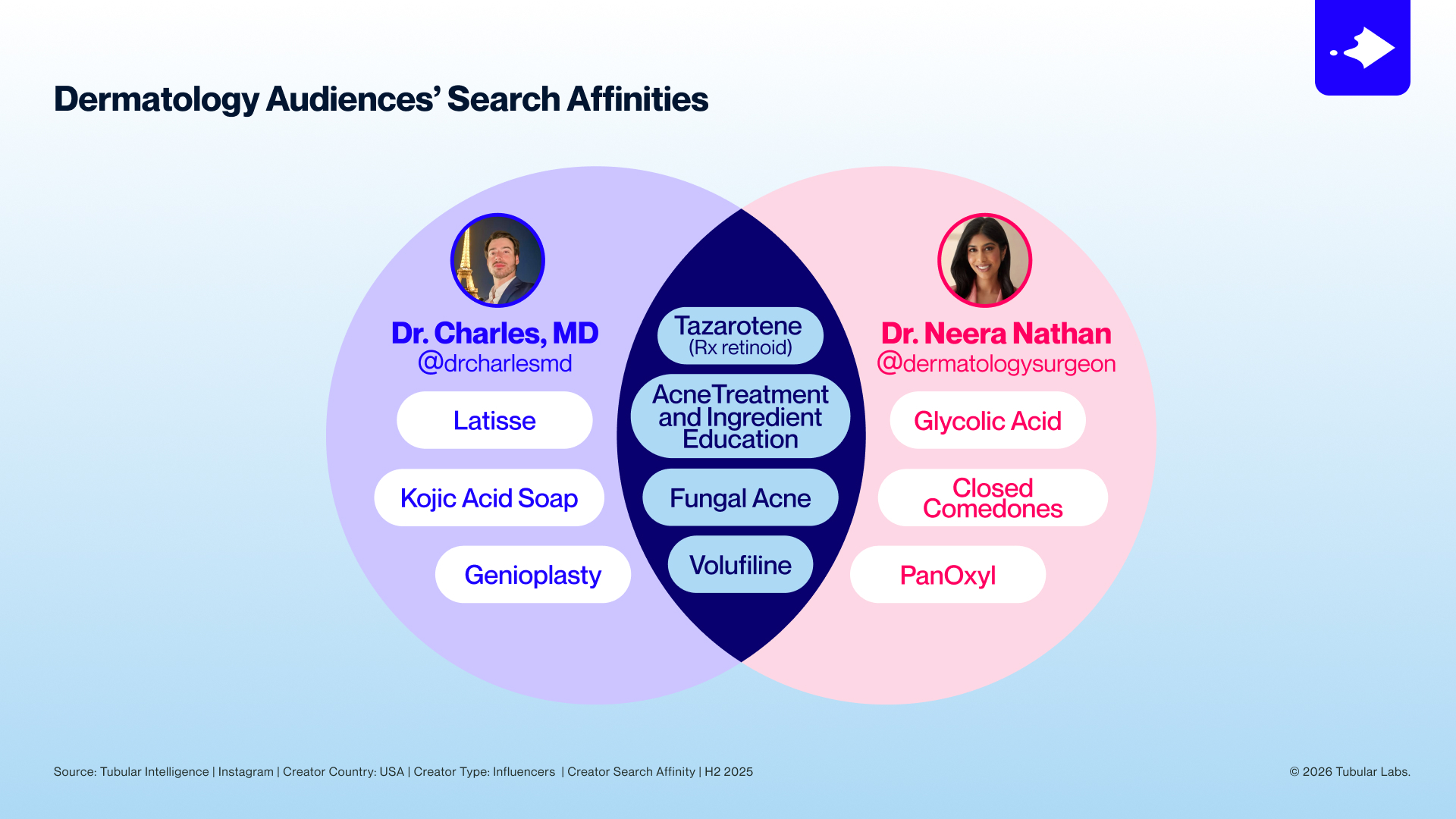
To understand how audience intelligence dismantles the myth of the "vanity metric," one need only look at the dermatology space. Consider a hypothetical marketing campaign for a product like Latisse. A traditional marketer might look solely at the 1.8 million followers of Dr. Neera Nathan and decide she is the obvious primary partner. While her reach is impressive and her content medically sound, data-driven intelligence offers a deeper layer of insight.
When we analyze the search affinities and audience overlaps between Dr. Neera Nathan and Dr. Charles, MD, the strategic picture changes:
- The Asymmetry of Influence: While 17% of Dr. Charles’s audience also consumes content from Dr. Neera Nathan, only 2% of her audience watches him.
- The Strategic Lever: This creates a specific, highly targeted opportunity. Dr. Charles serves as a bridge, providing clinical credibility to a niche, engaged audience that acts as an entry point into Dr. Neera’s broader, mainstream reach.
By strategically layering these partnerships, a brand can achieve both the depth of engagement needed for complex clinical education and the breadth of awareness needed for market penetration. This is the definition of "audience intelligence": moving past the follower count to understand how an audience actually moves between creators.
Gaming and CPG: Broadening the Scope
The principles observed in healthcare are not isolated; they are universal truths being applied across various consumer verticals.
Gaming: The Myth of Raw Volume
In East and Southeast Asia, the gaming and anime influencer space is a behemoth, generating 18 billion views on YouTube in 2025 alone. However, the report highlights that raw volume is a deceptive KPI. A massive portion of these views are transient, generated by audiences with little to no purchase intent. The creators who actually move the needle in terms of game installs or hardware sales represent a much smaller, highly specialized cohort. Identifying these "intent-drivers" requires mapping the specific overlap between gaming culture and consumer purchasing cycles.
CPG: The Power of Cultural Fit
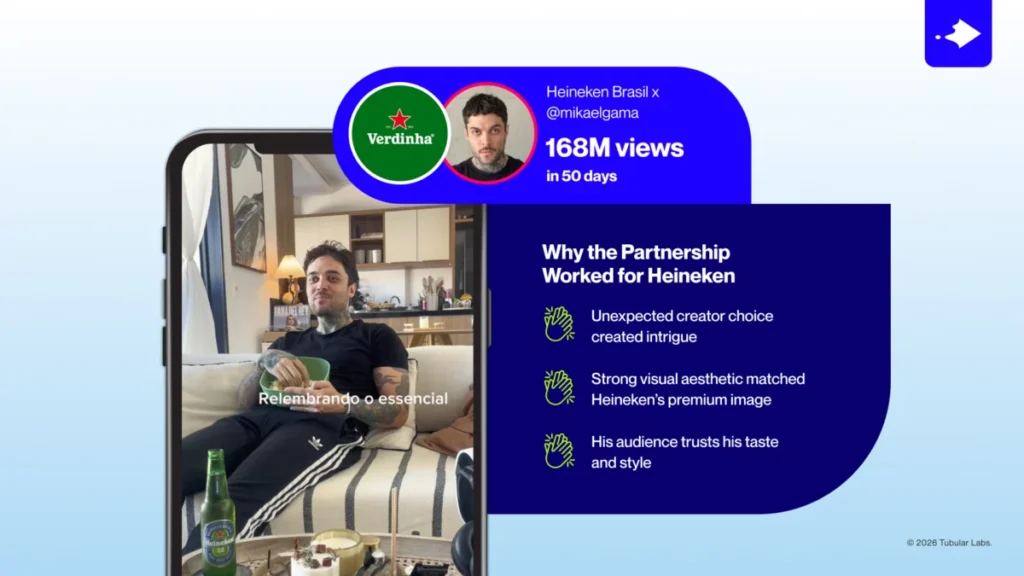
In the CPG sector, the Brazilian market offers a masterclass in the superiority of cultural fit over category fit. Brazil, currently the world’s second-largest market for influencer TikTok engagement, serves as a laboratory for high-impact campaigns. A prime example is Heineken’s partnership with a men’s fashion creator—someone who, on paper, might not seem like an obvious choice for a beer brand. Yet, with a relatively modest follower count of 136,000, the partnership generated 168 million views and 1 million engagements in just 50 days. The reason for this success was simple: the brand didn’t chase category fit; they chased cultural alignment, tapping into an audience that was already primed to value the creator’s aesthetic and lifestyle choices.
Building a Data-Driven Framework
For brands looking to move from a reactive posture to a proactive one, the path forward involves a clear, repeatable framework.
1. Identify the Intent, Not Just the Interest
Marketers must map the difference between "interest" (people who watch content) and "intent" (people who are actively searching for solutions). Using search affinity data, brands can determine which creators occupy the specific mental space of a consumer who is ready to buy.
2. Map Audience Overlaps
Stop treating influencers as individual silos. By analyzing the "audience also watches" data, brands can determine the web of influence surrounding their target demographic. This allows for the creation of "sequenced" campaigns, where one influencer warms up the audience and another drives the final conversion.
3. Prioritize Cultural Resonance Over Reach
The Brazilian CPG example proves that relevance beats volume. Before signing a contract, brands should evaluate whether a creator’s cultural cachet aligns with the brand’s identity, even if that creator falls outside the traditional category box.
The Future of Influencer Marketing
The implications of this shift are profound. As algorithms become more personalized and consumer trust continues to fragment, the reliance on high-level data will only increase. Brands that continue to focus on "vanity metrics" will find their ROI shrinking, while those that embrace audience intelligence will find themselves with a distinct competitive advantage.
The overarching lesson is clear: reach is merely a starting point—it is not a strategy. The "winners" of the coming years will be the organizations that treat their influencer partners as nodes in a complex, data-driven network. By moving beyond the surface level and digging into the behavioral patterns of their audiences, marketers can stop guessing and start investing with clinical, surgical precision.
As the industry moves toward this more analytical future, the tools to track and understand these relationships are becoming more accessible. For any brand that wants to remain relevant in 2026 and beyond, the message is simple: stop buying eyeballs and start buying influence. The data is waiting; the only question is whether you are prepared to ask the right questions of it.
For a more detailed breakdown of these strategies and to view the full data sets regarding audience overlaps and search affinities, download the complete Redefining Influencer Value report.
