

The Death of the Canonical Rank: How Hyper-Personalization and Generative AI Are Rewriting the Rules of Search Visibility
For nearly three decades, digital marketers operated under a single, comforting paradigm: the rank report. The formula was simple and highly lucrative: secure the top spot on a search engine results page (SERP) for a high-volume keyword, and your brand would reap a predictable windfall of visibility, clicks, and revenue. This mental model relied on a fundamental assumption: that search engine results were universal, and that any two users typing the same query would see the exact same digital shelf.
That world is officially dead.
Today, a convergence of real-time inventory tracking, hyper-localized logistics, deep browsing histories, and conversational AI has fragmented search into billions of individualized experiences. The concept of a single, objective "ranking" has been replaced by a dynamic, personalized assembly of product candidates. For brands, this shift represents a fundamental measurement crisis. If everyone’s search experience is unique, whose rank are you actually tracking?
1. The Death of the Universal Shelf: Main Facts
The erosion of traditional search ranking is not a gradual trend; it is an active structural shift in how digital platforms index and present information. Personalization is no longer a superficial recommendation layer applied to the top of a search result; it is baked directly into the retrieval algorithms of search engines, retail media networks, and generative AI systems.
[Traditional Search]
User Query ---> Static Algorithm ---> Universal SERP (Same for All Users)

[Modern Hyper-Personalized Search]
User Query + Geo-Location + Purchase History + Real-Time Inventory + Device Context
   ---> Dynamic AI Model ---> Bespoke Search Results (Unique to Each User)
To understand how complete this fragmentation is, consider a simple, high-intent query: “What are the most comfortable slippers?”
In the legacy search environment, this query would generate a standard list of ten blue links or a uniform carousel of Google Shopping ads. Today, on platforms like Amazon—which increasingly relies on conversational agents like Rufus and Alexa for Shopping—the query triggers a complex, real-time synthesis of the shopper’s digital footprint:
- Shopper A (The Budget-Conscious Parent in Chicago): A history of purchasing mid-tier household goods, a preference for items eligible for immediate Prime Delivery, and a recent browsing history of fleece loungewear. The algorithm reorders the search results to feature a highly rated, $25 synthetic fleece slipper available at a nearby fulfillment center for same-day delivery.
- Shopper B (The Premium Eco-Conscious Buyer in Seattle): A history of purchasing high-end, sustainable brands (such as Patagonia or Birkenstock) and a willingness to wait for shipping. The algorithm bypasses the budget options entirely, presenting a $120 shearling slipper made from ethically sourced materials.
Both shoppers entered the exact same query, yet neither saw the same products, the same brands, or the same order of results. The "most comfortable slipper" is no longer a definitive product; it is a fluid, contextual concept defined entirely by the user on the screen.

2. Chronology: The Evolution of Search from PageRank to Generative Engines
The transition from static directories to hyper-personalized AI answers did not happen overnight. It is the result of four distinct eras of search engine engineering.
  1990s-2010s              2010s-2020              2020-2023               2023-Present
┌──────────────────────┐  ┌───────────────────────┐  ┌───────────────────────┐  ┌───────────────────────┐
│  The PageRank Era    │  │ The Personalization   │  │ The Multi-Platform    │  │  The Generative AI    │
│  • Ten Blue Links    │  │  Transition           │  │  Decentralization     │  │  Era                  │
│  • Universal SERPs   │  │ • Local SEO & Mobile  │  │ • TikTok & Reddit     │  │ • Conversational AI   │
│  • Keyword Stuffing  │  │ • Search History      │  │ • Social Search       │  │ • Citation Economies  │
└──────────────────────┘  └───────────────────────┘  └───────────────────────┘  └───────────────────────┘
Phase 1: The PageRank and Keyword Era (Late 1990s – 2010s)
In the early days of search, platforms relied heavily on text matching and link equity (such as Google’s original PageRank). Search results were highly stable. If a website optimized its metadata and acquired enough backlinks, it could claim the number-one spot for a keyword and hold it globally for weeks or months.
Phase 2: The Personalization Transition (2010s – 2020)
Search engines began introducing contextual signals to improve relevance. The introduction of mobile-first indexing, real-time localization (providing different results for "coffee shop near me" based on GPS), and browser cookie tracking meant that search results began to diverge. However, marketers could still get a reliable "average position" report by using clean-browser simulations or localized IP proxies.
Phase 3: The Multi-Platform Decentralization (2020 – 2023)
The consumer path to purchase fragmented across ecosystems. Product discovery migrated away from traditional search engines. Younger demographics began using TikTok and Instagram as visual search engines, while high-intent shoppers bypassed Google entirely to search directly inside retail networks like Amazon, Walmart, and Target. At the same time, platforms like Reddit became the default destination for users seeking unbiased, human-vetted recommendations.
Phase 4: The Generative AI Era (2023 – Present)
The launch of ChatGPT, Google’s AI Overviews, and conversational retail assistants introduced a new layer of synthesis. Instead of pointing users to external websites, generative engines pull information from across the web, summarize the consensus, and present a single, cohesive answer. In this environment, traditional rankings are completely obsolete; the engine acts as an intermediary, choosing which brands to mention, synthesize, or cite based on complex conversational context.
3. Supporting Data: The Rise of AI Visibility and the Citation Economy
As static rank tracking loses its utility, new metrics are emerging to help brands measure their presence in the digital wild. Chief among these are AI Visibility Rate and Citation Share.
Rather than measuring whether a brand is "number one" for a specific keyword, AI Visibility Rate calculates how often a brand is featured, recommended, or summarized across thousands of randomized, conversational prompts.

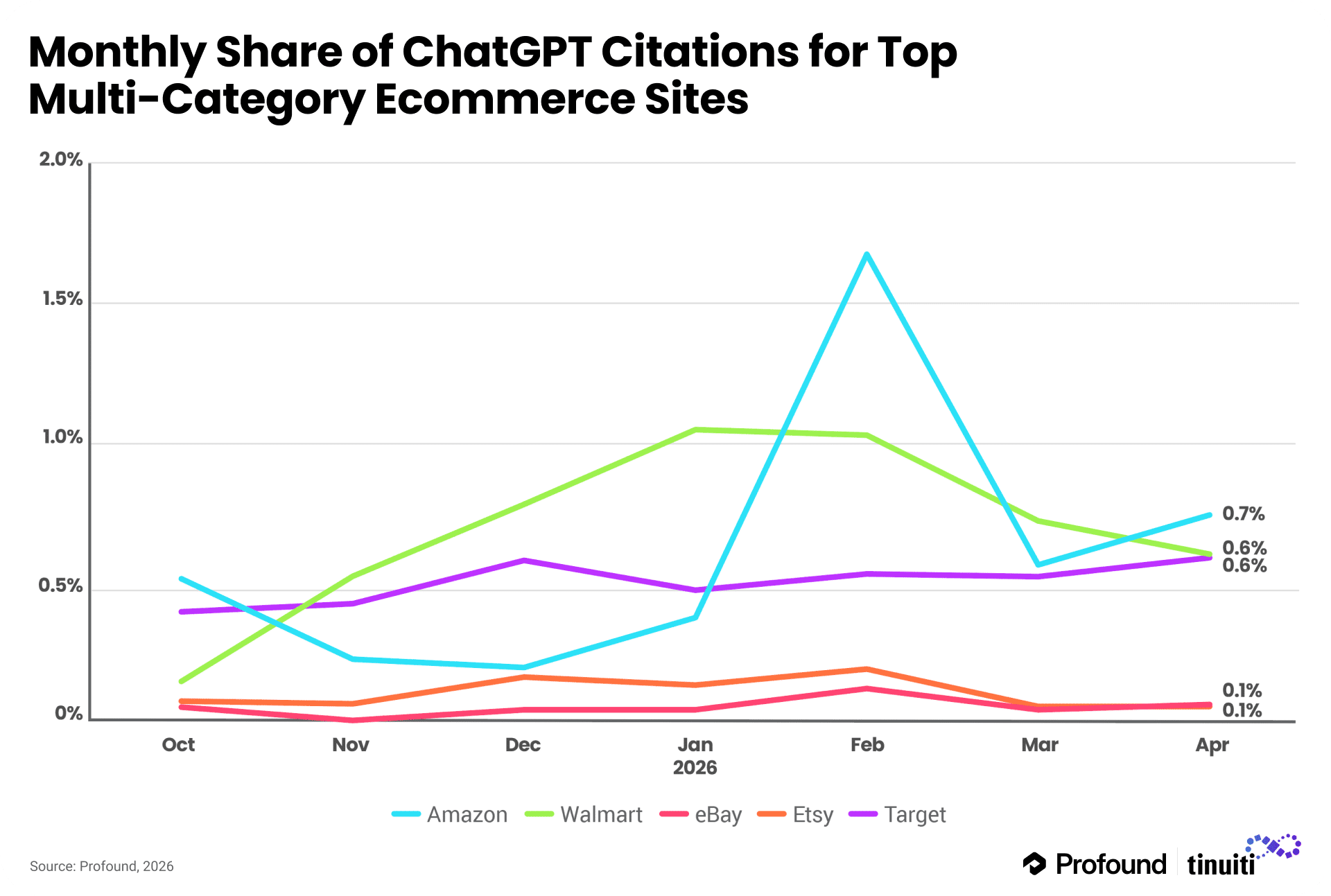
AI Visibility Rate = (Total Conversational Mentions / Total Prompt Variations) * 100Recent data compiled by search analytics firm Profound highlights the highly uneven nature of this new ecosystem. When generative AI models generate product recommendations or synthesize commercial answers, they rely heavily on a small, trusted group of domains.
| Domain Category | Industry Vertical | Average Citation Share in AI Answers | Key Drivers of Dominance |
|---|---|---|---|
| Amazon | Multi-Category E-commerce | 34.2% | Unmatched product catalog, high-density review data, robust API access. |
| Consumer Advice / Reviews | 18.5% | High conversational authenticity, user-vetted consensus ("r/BuyItForLife"). | |
| Walmart | Grocery & Mass Retail | 14.1% | Localized physical footprint, competitive pricing indices. |
| Best Buy | Consumer Electronics | 11.8% | Technical specification sheets, structured product data. |
| Specialty Retail (Ulta/Home Depot) | Beauty / Home Improvement | 9.5% | Vertical-specific authority, detailed ingredient/how-to content. |
This data reveals a critical vulnerability for brands: if your product is not actively discussed, reviewed, or sold on the platforms that AI models trust, your brand is effectively invisible in conversational search—regardless of how well your domain performs in traditional SEO rankings.
Social communities, particularly Reddit, have become a primary data source for LLMs (Large Language Models). Some AI search products draw a double-digit percentage of their citations directly from Reddit threads, valuing real-world human consensus over polished corporate copywriting.
4. Expert Viewpoints: Shifting Budgets to Match the Personalized Consumer Journey
For marketing executives, the dissolution of standard rankings requires a complete reassessment of how budgets are allocated and how success is measured.
Elizabeth Marsten, Vice President of Commerce Media at Tinuiti and a leading industry expert on retail media networks, emphasizes that product discovery is now inextricably linked to the logistics and data structures of retail platforms.
"The modern shopper does not follow a linear path, and the algorithms that serve them do not look at keywords in a vacuum," Marsten notes. "On retail media networks like Amazon or Walmart, organic visibility is heavily influenced by real-time variables: Is the product in stock in the shopper’s local micro-fulfillment center? What is their historical price sensitivity? Have they interacted with our paid media elsewhere on the platform? If you are managing organic search without a deep integration into your retail operations and paid media strategy, you are optimizing for a ghost."
Other enterprise marketing leaders are echoed this sentiment, pointing out that legacy SEO agencies often present "average ranking" dashboards that look highly encouraging but fail to correlate with actual sales.
When a brand boasts a "Page 1 Rank" for a key term, that rank is often a simulated, non-personalized average. In reality, real-world shoppers with active purchasing intent may see a completely different set of competitors prioritized by the platform’s personalization engines.
5. Implications: Building the Future Marketing Dashboard
To survive in a personalized, AI-driven search ecosystem, brands must transition from a position-first mindset to a visibility-first framework. This requires retiring legacy reporting tools and building a modern marketing dashboard centered on holistic brand presence.
┌──────────────────────────────────────────────────────────────────────────┐
│                      MODERN MARKETING DASHBOARD                          │
├──────────────────────────────────────────────────────────────────────────┤
│  [AI Visibility Rate]   [Citation Share]       [Localized Share of Voice]│
│  How often your brand  Percentage of times    Your brand's presence     │
│  appears in LLM/AI     your owned domains     across regional,          │
│  summaries & answers.  are cited as sources.  inventory-dependent SERPs.│
│         18.4%                  12.1%                     24.5%           │
└──────────────────────────────────────────────────────────────────────────┘
The New Dashboard Metrics
The modern marketing dashboard should track three core areas:
- AI Share of Voice (SoV): The percentage of conversational answers, AI Overviews, and LLM responses that include your brand or products across a broad, geo-targeted set of user prompts.
- Citation Share: The frequency with which your brand’s owned domains, retail pages, or social threads are cited as authoritative sources by generative search engines.
- Localized Share of Voice: An inventory-adjusted measure of visibility that tracks whether your products are showing up in regions where you have optimal shipping times and product availability.
How to Get Started: A Practical Roadmap for Marketers
If your organization’s quarterly goals and marketing reports are still built around static keyword lists, use this step-by-step roadmap to modernize your strategy:
Step 1: Audit Current Reporting  -->  Identify and phase out non-personalized, static rank trackers.
Step 2: Optimize Structured Data -->  Ensure clean Schema.org markup and product feeds for AI crawlers.
Step 3: Diversify Channel Presence -> Build authority on highly-cited domains (Reddit, Amazon, Walmart).
Step 4: Align Search & Operations -> Connect inventory and logistics data directly to your marketing tools.- Audit Your Legacy Tracking Tools: Review your current SEO contracts. Identify tools that rely on single-IP, non-personalized scraping to generate rank reports. Pivot those budgets toward platforms that offer localized, conversational, and synthetic share-of-voice tracking.
- Optimize for the Citation Engines: AI engines cannot cite what they cannot understand. Ensure your product listings, articles, and landing pages utilize clean, highly structured data (Schema.org markup) to make it easy for LLM web crawlers to extract specs, pricing, and availability.
- Build a Multi-Platform Content Footprint: Since AI models rely heavily on third-party validation, your marketing strategy must extend beyond your website. Invest in generating organic discussions on community platforms like Reddit, ensure your products have robust review volume on retail sites like Amazon and Walmart, and encourage user-generated content on visual platforms like TikTok.
- Connect Search directly to Operations: Work closely with your supply chain and logistics teams. If your products are frequently out of stock in key metropolitan areas, your personalized visibility will drop to zero in those regions. Aligning your digital marketing spend with your actual inventory distribution ensures you are only optimizing for visibility where you can actually fulfill demand.
The hyper-personalized web is not a future projection; it is the current operating reality. By letting go of the illusion of the single, canonical rank, brands can focus on what actually matters: showing up with the right product, in front of the right consumer, at the exact moment they are ready to buy.
