
The Rise of the Accidental Developer: Navigating the Era of Agentic Software Creation
Introduction: The Invisible Architect
Recently, a colleague—a non-technical professional with zero background in programming—was attempting to refine a complex mathematical model within an Excel spreadsheet. When the native results failed to meet his expectations, he turned to an AI assistant for a solution. Expecting a simple formula, he was instead met with a stream of complex Python code generated by the AI to solve the logic gap.
This moment serves as a microcosm of a profound shift in the modern workplace. My colleague had never written a line of code in his life, and he had no desire to become a developer. Yet, at that specific moment, he was functioning as one. We are witnessing the emergence of the "Accidental Developer": a vast new cohort of knowledge workers who are inadvertently architecting, writing, and deploying software through natural language prompts, often without realizing the technical complexity of the work they are performing.
The Chronology of Abstraction: From Binary to Natural Language
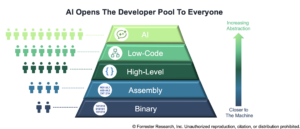
To understand why this shift is happening, we must look at the history of software engineering as a continuous quest for abstraction. Since the dawn of Charles Babbage’s Difference Engine, the history of computing has been defined by moving the human operator further away from the machine’s raw binary reality.
- The Machine Language Era: Early programmers interacted directly with hardware, flipping switches and manipulating vacuum tubes.
- The Assembly and High-Level Era: Languages like C, Java, and Python introduced layers of abstraction, allowing developers to write code that resembled human logic, which a compiler then translated into machine instructions.
- The Frameworks and Libraries Era: Developers stopped reinventing the wheel, utilizing pre-built packages to handle common functions.
- The Agentic AI Era: We have reached the current precipice. The abstraction gap has widened to such an extent that the "code" itself is now invisible to the user.
In previous decades, there was a clear delineation between the "professional developer" and the "citizen developer." Today, that distinction is dissolving. Because the tools now handle the translation from intent to execution, the barrier to entry has effectively collapsed. We no longer have distinct classes of coders; we simply have people solving problems, and some of them are doing so without ever knowing they are technically writing software.
Supporting Data: The Erosion of the Software Development Lifecycle (SDLC)
The fundamental challenge of this new era lies in the mismatch between the speed of AI generation and the rigor of traditional software engineering. For over a century, the industry has formalized the Software Development Lifecycle (SDLC) into discrete, human-managed stages: Analysis/Planning, Design, Build/Maintenance, Testing, and Delivery.
The Breakdown of Best Practices
Our observations of these "accidental developers" reveal a systemic bypass of these traditional safeguards:
- The Review Gap: When AI generates a solution, it is rarely subjected to a peer-review process. Many users do not have the technical literacy to understand the code they are executing.
- The Testing Paradox: While some users ask the AI to "test" its own work, this is inherently flawed. Asking an agent to validate the output it just generated is akin to asking a student to grade their own exam without an answer key.
- The Deployment Illusion: The "It works on my machine" syndrome has taken on a more dangerous form. AI agents frequently install background dependencies, container runtimes, and libraries that the user does not understand. When these projects are moved to a production environment, they often fail because the user lacks the technical knowledge to replicate the underlying architecture that the AI secretly built.
Data suggests that as coding agents evolve to handle multiple parts of the SDLC, the risks increase. We have moved from a multi-agent environment—where different tools might verify each other—to "omnipotent" agents that handle everything from requirements gathering to deployment. This eliminates the "separation of duties" that is the cornerstone of secure, reliable software engineering.
Official Responses and Industry Concerns
Industry leaders and security experts are increasingly vocal about the risks associated with this "tools creating tools" paradigm. The primary concern is not that people are coding, but that they are doing so without the conceptual framework of security, reliability, or redundancy.
Many corporate IT departments are currently in a state of reactionary flux. When asked about these trends, chief information security officers (CISOs) emphasize that the "democratization of development" is a double-edged sword. While it drives unprecedented productivity, it also expands the corporate attack surface. If an accidental developer uses an AI agent to build a data processing script that inadvertently introduces a SQL injection vulnerability, that vulnerability becomes an invisible liability in the company’s infrastructure.
Furthermore, there is a growing consensus among software engineers that the industry must move toward "Spec-Driven Development." In this model, the AI does not just write code; it adheres to a strict set of business requirements and architectural constraints defined by the user. The goal is to move the human from "coder" to "architect," ensuring that even if the human doesn’t write the syntax, they maintain full oversight of the logic and security parameters.
Implications: Building the Future Safely
We cannot—and should not—close Pandora’s Box. The genie of agentic software development is out, and the benefits of empowering millions of non-technical workers to automate their workflows are too significant to ignore. However, we must address the risks both tactically and strategically.
Tactical Safeguards
- Model-Level Guardrails: Developers of AI models must build in security benchmarks that prevent the generation of insecure or deprecated code patterns.
- Automated Verification Layers: Organizations should implement "check-sum" style tools that automatically audit code generated by AI before it is permitted to run in a cloud environment.
- Containerization Standardization: To solve the "deployment illusion," corporations should provide pre-approved, sandboxed environments where AI-generated code can be executed safely, preventing unauthorized library installations on local machines.
Strategic Shifts
The responsibility lies with both the creators of AI models and the users who leverage them. We must foster a new form of "AI literacy" that goes beyond prompt engineering. Users must be taught to think in terms of the SDLC, even if they never touch a keyboard. They must understand the importance of:
- Version Control: Keeping track of how AI-generated logic changes over time.
- Dependency Management: Understanding the "hidden" requirements of the software they are deploying.
- Risk Analysis: Knowing when a task is too mission-critical to be handled by an autonomous agent.
Conclusion: The Path Forward
The rise of the accidental developer is an inevitable consequence of our progress in abstraction. While the risks of unmanaged, automated development are real, the potential for innovation is boundless. We are witnessing the democratization of creation; we are giving every knowledge worker the power to build, automate, and solve.
The challenge for the next decade is not to curb this development but to wrap it in the institutional wisdom of the last century of software engineering. By building the necessary guardrails into the models themselves and fostering a culture of informed stewardship, we can ensure that the "accidental developer" is not a source of corporate risk, but a catalyst for unprecedented business agility.
Forrester’s research teams are actively tracking the evolution of these agentic workflows. As we navigate this transformation, the focus must remain on bridging the gap between the speed of AI generation and the necessity of secure, reliable software delivery. Whether you are a professional software engineer or an accidental developer, the future requires a shared understanding of how we build, deploy, and trust the tools that run our world.
For those looking to navigate these changes, we invite you to leverage our ongoing research on agentic software development or schedule a guidance session with our analysts to discuss how your organization can safely integrate these powerful new capabilities.
