
Navigating the Future: Unveiling the ‘Martech for 2026’ Industry Blueprint
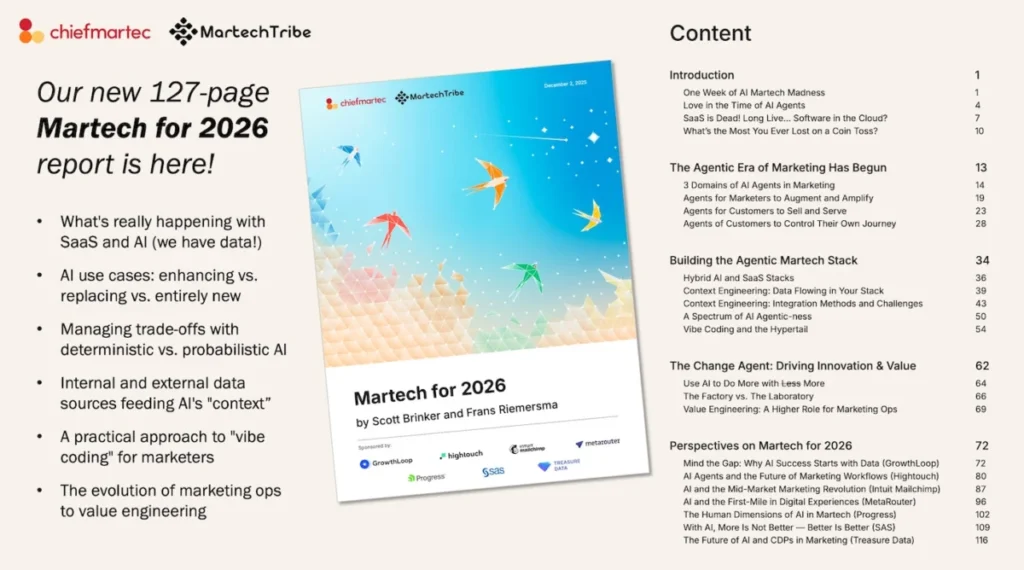
In an era defined by rapid technological displacement and the relentless evolution of artificial intelligence, marketing professionals are often left navigating a landscape that changes faster than they can adapt. To bridge this gap between speculative trend-watching and practical, data-driven strategy, the industry’s foremost authorities—Scott Brinker and Frans Riemersma—have released their highly anticipated, 127-page report: Martech for 2026.
This comprehensive resource serves as a definitive roadmap for the coming year, stripping away the hype-driven "techno-jargon" that has permeated the marketing sector. Instead, it offers a pragmatic, jargon-free exploration of the tools, strategies, and organizational shifts required to remain competitive. Most notably, the report is being distributed with a commitment to accessibility, offered as a direct download without the traditional friction of lead-generation forms or social media gatekeeping.
The Core Mandate: Why 2026 Matters
The release of Martech for 2026 is not merely an annual update; it is a critical intervention in a market saturated with conflicting narratives. As AI transitions from a "novelty" feature to the fundamental architecture of marketing operations, professionals are facing a "pivot or perish" reality.
The report focuses on seven major pillars designed to prepare organizations for the next 18 months of development. By synthesizing months of research and exhaustive data collection, Brinker and Riemersma have created a manual that balances high-level vision with the granular realities of day-to-day martech management. The emphasis throughout is on "plain language" and visual illustrations, ensuring that technical complexities are translated into actionable business logic.
Chronology of Development: From Survey to Strategy
The genesis of this report dates back to a major industry-wide undertaking: the AI & Data in Marketing survey conducted several months ago. This survey served as the foundational bedrock for the publication.
- Phase 1: Data Collection: The authors conducted an extensive survey to capture the pulse of current marketing sentiment regarding AI integration, data maturity, and operational bottlenecks.
- Phase 2: Synthesis and Analysis: Over the following months, Brinker and Riemersma distilled these findings, identifying recurring patterns and pain points across both SMBs and enterprise-level organizations.
- Phase 3: Expert Consultation: Recognizing that theoretical research must be balanced with practical application, the authors invited seven industry leaders to provide in-depth perspectives. These interviews were not editorial reviews, but rather standalone chapters that reflect the expertise of the sponsors.
- Phase 4: Publication: The culmination of this process is the 127-page PDF document, released with a transparent, non-gated distribution model to ensure maximum utility for the global martech community.
Supporting Data and The "No-Cost" Paradigm
In a digital economy where high-quality research is typically locked behind aggressive "lead-gen" paywalls or email registration forms, the creators of Martech for 2026 have taken a disruptive approach. A report of this magnitude, which would typically command a price tag of $1,000 or more in a consulting context, is provided entirely free of charge.
This financial model was made possible through a strategic partnership with seven key sponsors. Unlike traditional white papers where sponsors often dictate editorial direction, Brinker and Riemersma maintained strict creative independence. The sponsors were given no input on the core content, seeing the report only upon its completion. This ensures the integrity of the findings, allowing the report to remain a neutral, unbiased assessment of the state of the industry.
Official Perspectives: The Sponsor Chapters
The report’s strength is bolstered by the specialized insights of seven industry leaders. Each contributor addresses a specific facet of the modern martech stack, providing a multidimensional view of the AI-driven future:
1. GrowthLoop: Bridging the Data Divide
GrowthLoop explores the concept of "Mind the Gap," arguing that the efficacy of any AI tool is fundamentally capped by the quality and accessibility of the underlying data. AI success is not a software problem; it is a data architecture problem.
2. Hightouch: The Era of AI Agents
Hightouch shifts the focus toward the "Future of Marketing Workflows." They argue that we are moving beyond simple AI assistance to a world of autonomous AI agents capable of executing complex marketing sequences with minimal human intervention.
3. Intuit Mailchimp: The Mid-Market Revolution
Focusing on the mid-market, Intuit Mailchimp highlights how AI is democratizing high-end marketing capabilities. For smaller organizations, AI is no longer a luxury—it is the great equalizer that allows lean teams to compete with enterprise giants.
4. MetaRouter: The First-Mile Challenge
MetaRouter investigates the "First-Mile in Digital Experiences." Their contribution stresses the importance of data collection and privacy at the point of origin, noting that clean, compliant, and well-structured input is the only way to ensure "first-mile" success in AI processing.
5. Progress: The Human Dimension
Progress brings the conversation back to the human element, discussing the "Human Dimensions of AI in Martech." They caution that as automation increases, the need for human intuition, creativity, and ethical oversight becomes more critical than ever.
6. SAS: Prioritizing Quality Over Quantity
In a direct challenge to the "more is more" mentality, SAS posits that "With AI, More Is Not Better—Better Is Better." Their chapter serves as a masterclass in optimization, urging marketers to focus on the precision and quality of their models rather than the sheer volume of data or outputs.
7. Treasure Data: The Evolution of CDPs
Finally, Treasure Data examines the future of the Customer Data Platform (CDP). They explore how CDPs must evolve to become the "brain" of the marketing stack, effectively coordinating AI models to deliver hyper-personalized customer journeys at scale.
Implications: What This Means for 2026
The implications for the marketing profession are profound. The Martech for 2026 report suggests that we are entering a phase of "technological consolidation." The era of adding "one more tool" to the stack is coming to a close; the era of integrating and optimizing existing infrastructure through AI is beginning.
Operational Shifts
Organizations must pivot their hiring strategies. Technical proficiency, while important, is becoming secondary to "AI orchestration skills." Marketing teams will need to be capable of directing AI agents, refining data streams, and maintaining a critical eye toward algorithmic output.
Strategic Planning
The report underscores that marketing strategy can no longer be separate from data strategy. The silos between IT and Marketing—which have been shrinking for years—must now vanish entirely. The "Martech stack" is no longer a collection of software subscriptions; it is a unified, data-driven ecosystem.
The Human-AI Partnership
Perhaps the most significant takeaway is the reaffirmation of the human role. While AI handles the heavy lifting of data processing, segmentation, and automated workflow execution, the creative strategy—the "why" behind the campaign—remains firmly in the domain of the human marketer.
Conclusion: A Call to Action
The Martech for 2026 report is more than a PDF; it is a call for professional maturity. By providing this resource for free, Brinker and Riemersma are inviting the entire marketing community to engage in a higher level of discourse.
For the 42,000+ professionals currently following the Chiefmartec discourse, this document provides the necessary clarity to move forward with confidence. It is a guide for the perplexed, a tool for the ambitious, and a foundational document for anyone looking to navigate the complexities of the next two years.
As we look toward 2026, the question is no longer whether your organization will adopt AI, but how effectively you will leverage it to create genuine, human-centric value. The tools are available, the roadmap has been drafted, and the path forward is clear. The only remaining variable is how the industry chooses to implement these insights.
To access the full report and begin your preparations for 2026, download the PDF here.
