
Navigating the Acceleration: Why Gen AI in Marketing Defies the Traditional Hype Cycle
The Gartner Hype Cycle has long served as the industry-standard compass for navigating the volatile waters of emerging technology. It is a model both revered for its clarity and reviled for its perceived reductionism. However, as we move deeper into the age of generative AI (GenAI), the traditional, linear trajectory of this cycle is being pushed to its breaking point.
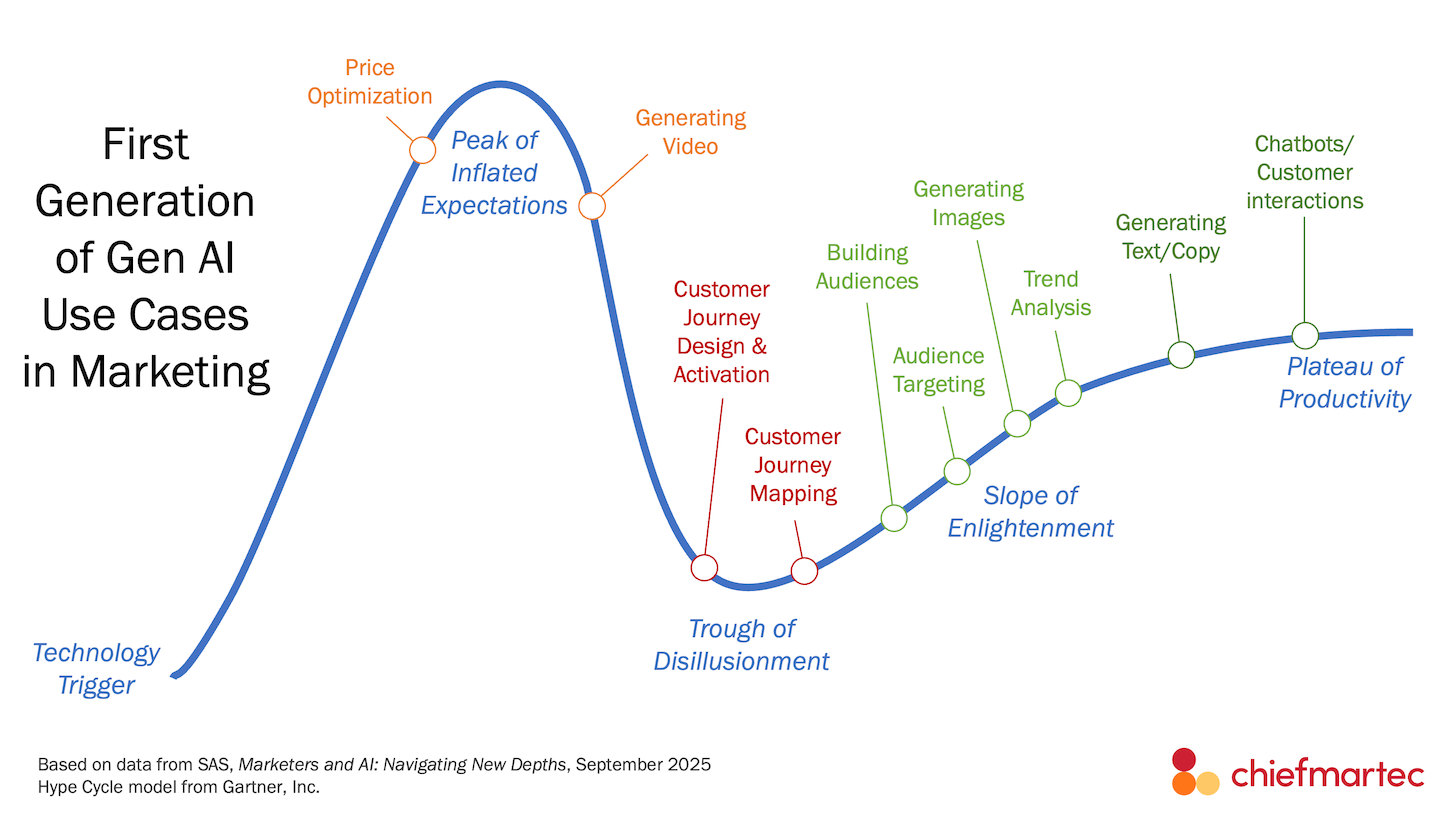
In the fast-moving landscape of marketing technology (martech), GenAI is not merely "moving along" the curve. It is manifesting as a complex, multi-layered phenomenon where different use cases occupy every stage of the cycle simultaneously. A new report from SAS, Marketers and AI: Navigating New Depths, provides the empirical evidence required to map this chaos, confirming that the speed of innovation in this sector is currently without historical precedent.
The Death of the Linear Hype Cycle
For decades, the standard narrative for new technology followed a predictable path: the "Innovation Trigger" led to a "Peak of Inflated Expectations," followed by a "Trough of Disillusionment," eventually climbing the "Slope of Enlightenment" toward a "Plateau of Productivity."
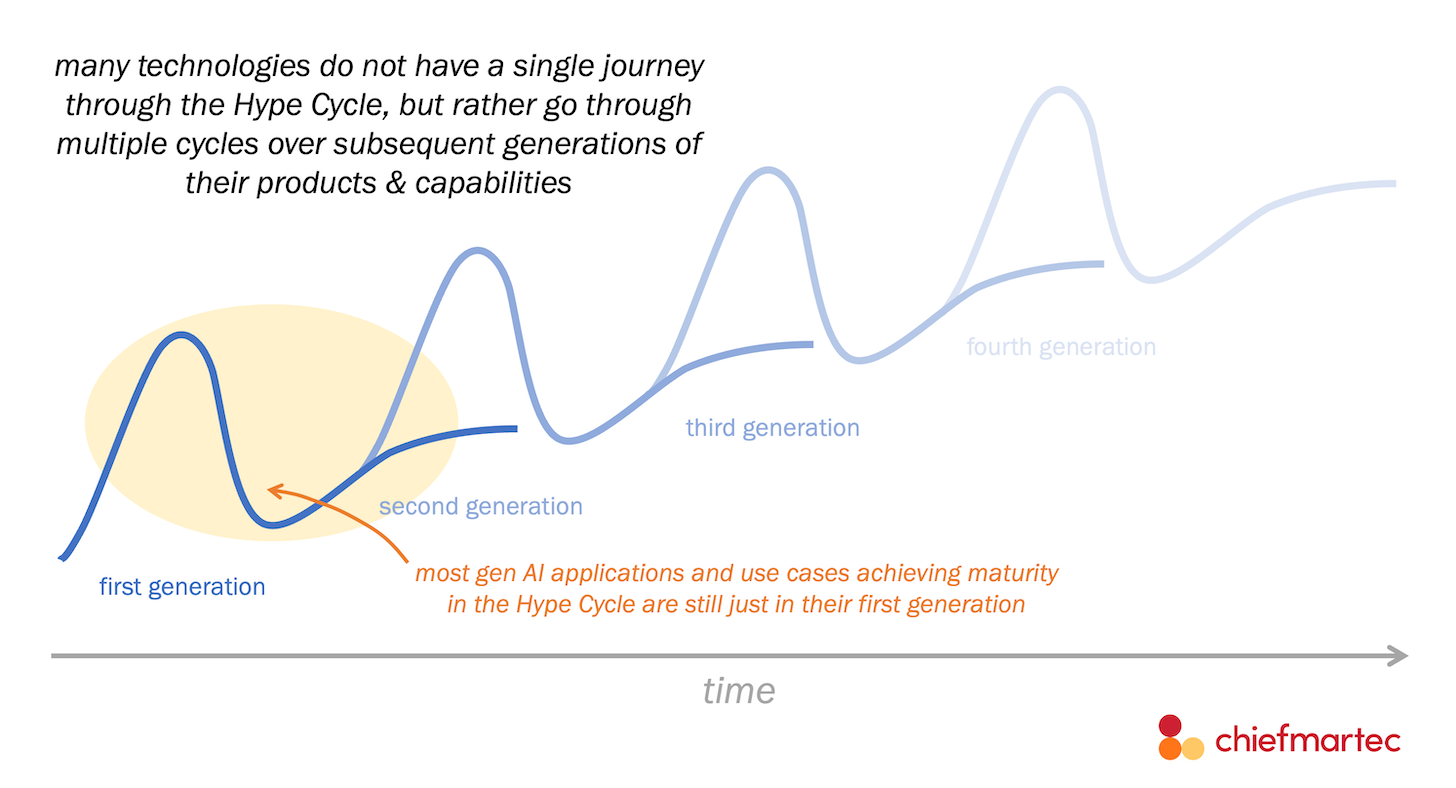
Today, this model is insufficient for GenAI. The primary reason is that "GenAI" is not a singular technology. It is a broad umbrella encompassing a myriad of applications, each currently at a different stage of maturity. Furthermore, we are witnessing the "first generation" of these tools. As these applications iterate, they don’t just move along a single curve; they initiate new cycles.
Consider the customer service chatbot. Today, a standard AI agent can handle basic, scripted inquiries with high proficiency, placing it firmly on the Plateau of Productivity. Yet, the next generation of these agents—capable of complex reasoning, autonomous cross-selling, and multi-step executive action—is already being conceptualized. We are effectively witnessing a "Plateau" for current-generation chatbots while simultaneously experiencing the "Peak of Inflated Expectations" for the next, more sophisticated iteration.
The Acceleration Factor
The velocity at which these technologies mature has compressed a process that once took a decade into a mere 18 to 24 months. For the modern marketer, this creates a feeling of constant, low-level anxiety—a "pit of the stomach" sensation born from the realization that before a technology has even finished its journey to the plateau, its successor is already off to the races.
Chronology of Adoption: 2024 vs. 2025
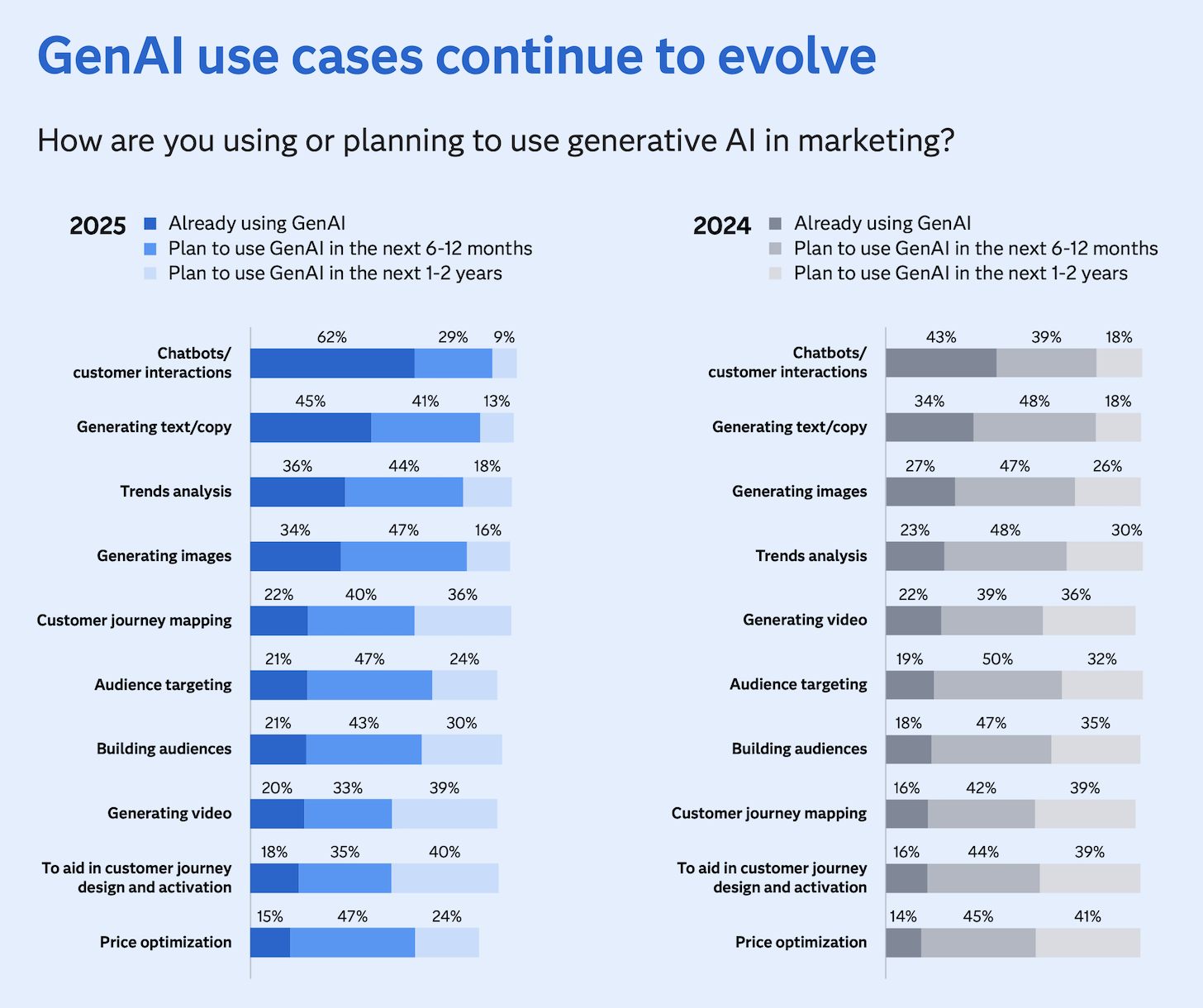
The SAS report Marketers and AI: Navigating New Depths offers a crucial snapshot of this rapid maturation. By analyzing data from 300 marketing professionals, SAS has provided a comparative look at adoption versus planning across ten distinct GenAI applications.
The 2024-2025 Shift
The data reveals an undeniable surge in adoption rates. The most accelerated use cases over the past 12 months include:
- Content Generation: Moving from experimental trials to standard operating procedure.
- Customer Insights/Persona Development: Leveraging AI to synthesize vast datasets into actionable consumer portraits.
- Personalized Email Campaigns: Automating the nuance of one-to-one communication at scale.
These three areas represent the current "productivity leaders" in the martech stack. They have transitioned from the hype-heavy phase of early discovery into the pragmatic phase of implementation.
However, the report also notes an anomaly: some use cases have seen a reduction in reported adoption. This reversal is a classic hallmark of the "Trough of Disillusionment." When organizations realize that a specific AI application—perhaps one that promised "autonomous marketing strategy"—is not yet ready for prime time or requires more human oversight than initially advertised, they pull back. This is not a failure of the technology, but a necessary recalibration of expectations.
Data-Driven Mapping: A New Framework
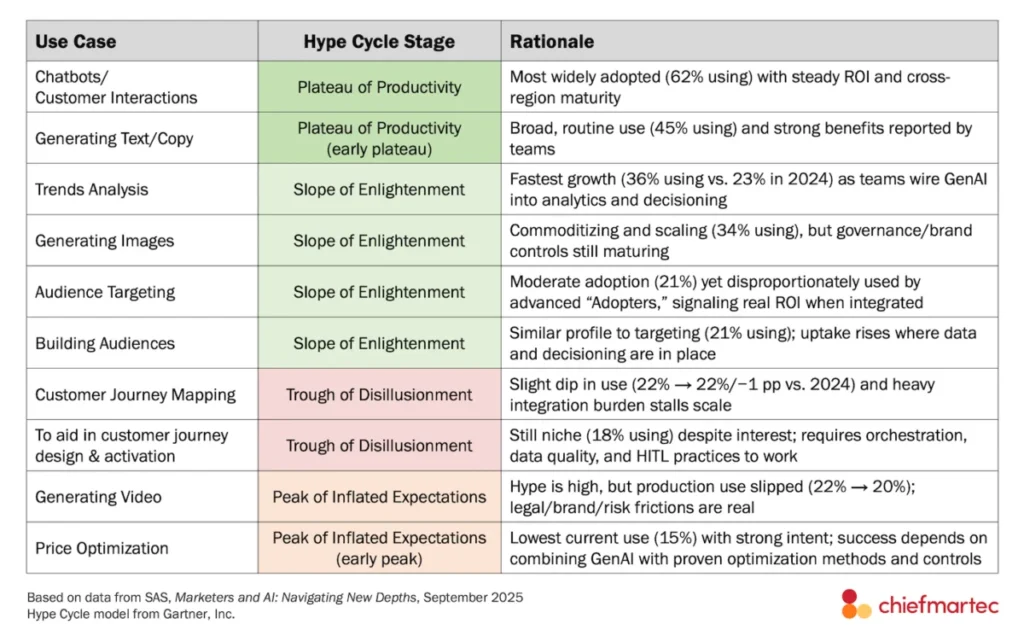
To better understand where these technologies currently reside, it is helpful to categorize them based on the recent SAS findings. While these placements are based on empirical adoption trends and industry sentiment, they offer a blueprint for the current state of the industry.
The Plateau of Productivity
These are the applications that have proven their ROI. They are no longer "magic"; they are tools.
- Automated Content Creation: Marketing teams are now using AI to draft blogs, social posts, and ad copy as a standard workflow.
- Sentiment Analysis: Leveraging GenAI to interpret customer feedback at scale has moved from a "nice-to-have" to an essential operational component.
The Trough of Disillusionment
These are the use cases that suffered from over-promise and under-delivery.
- Autonomous Campaign Management: Early iterations promised "set it and forget it" marketing, which proved technologically immature. Organizations that jumped in too early have since scaled back their usage, waiting for the technology to mature.
The Peak of Inflated Expectations
These are the emerging capabilities that dominate conference keynotes and LinkedIn feeds, yet have limited real-world deployment.
- Predictive Customer Journeys: While the theory is sound, the integration required to make these truly autonomous remains in the early, highly-hyped stages.
Official Perspectives and Industry Response
The broader implications of this data suggest that the marketing department is becoming a laboratory for corporate AI strategy. SAS, in its analysis, emphasizes that the "new depths" mentioned in their title refer to the transition from superficial, text-based AI applications to deep, data-integrated enterprise solutions.
Industry analysts are calling for a "measured agility." The consensus among experts is that organizations should stop looking for a "silver bullet" technology and instead focus on a portfolio approach. By diversifying their AI investments across different stages of the Hype Cycle—some in experimental phases, some in established productivity phases—marketers can insulate themselves from the inevitable volatility of any single technology’s journey.
Furthermore, the integration of data governance into these AI workflows is becoming the new "cost of entry." As companies move beyond the experimentation phase, they are finding that the quality of their AI output is directly proportional to the cleanliness of their historical data.
Strategic Implications: What Comes Next?
The most striking takeaway from the current climate is the inclusion of "frontier" technologies in current marketing discussions. The SAS report notes early considerations of Quantum Computing in Marketing. While this may sound like science fiction to some, the rapid compression of the Hype Cycle means that what we consider "next-gen" today will likely be a standard utility by the end of the decade.
For the modern marketer, the implications are clear:
- Adopt a "Generation" Mindset: Recognize that you are not just buying a tool; you are buying a generation of a tool. Plan for its eventual obsolescence and ensure your martech stack is modular enough to swap in the next iteration.
- Prioritize Utility Over Novelty: If a use case is currently in the "Trough of Disillusionment," don’t abandon the technology entirely. Instead, use the pause to focus on foundational data and governance, so you are ready when the technology reaches the "Slope of Enlightenment."
- Accept the "Multiple Cycle" Reality: Understand that your organization can, and should, be simultaneously adopting proven tools while testing speculative ones. Holding these two opposing strategies in your mind—as F. Scott Fitzgerald famously noted as the test of a first-rate intelligence—is the new requirement for successful marketing leadership.
Final Thoughts
We are living in an exhilarating time. The blurring of the lines between "human-led" and "machine-assisted" marketing is not just changing our job descriptions; it is changing the fundamental nature of the customer-brand relationship.
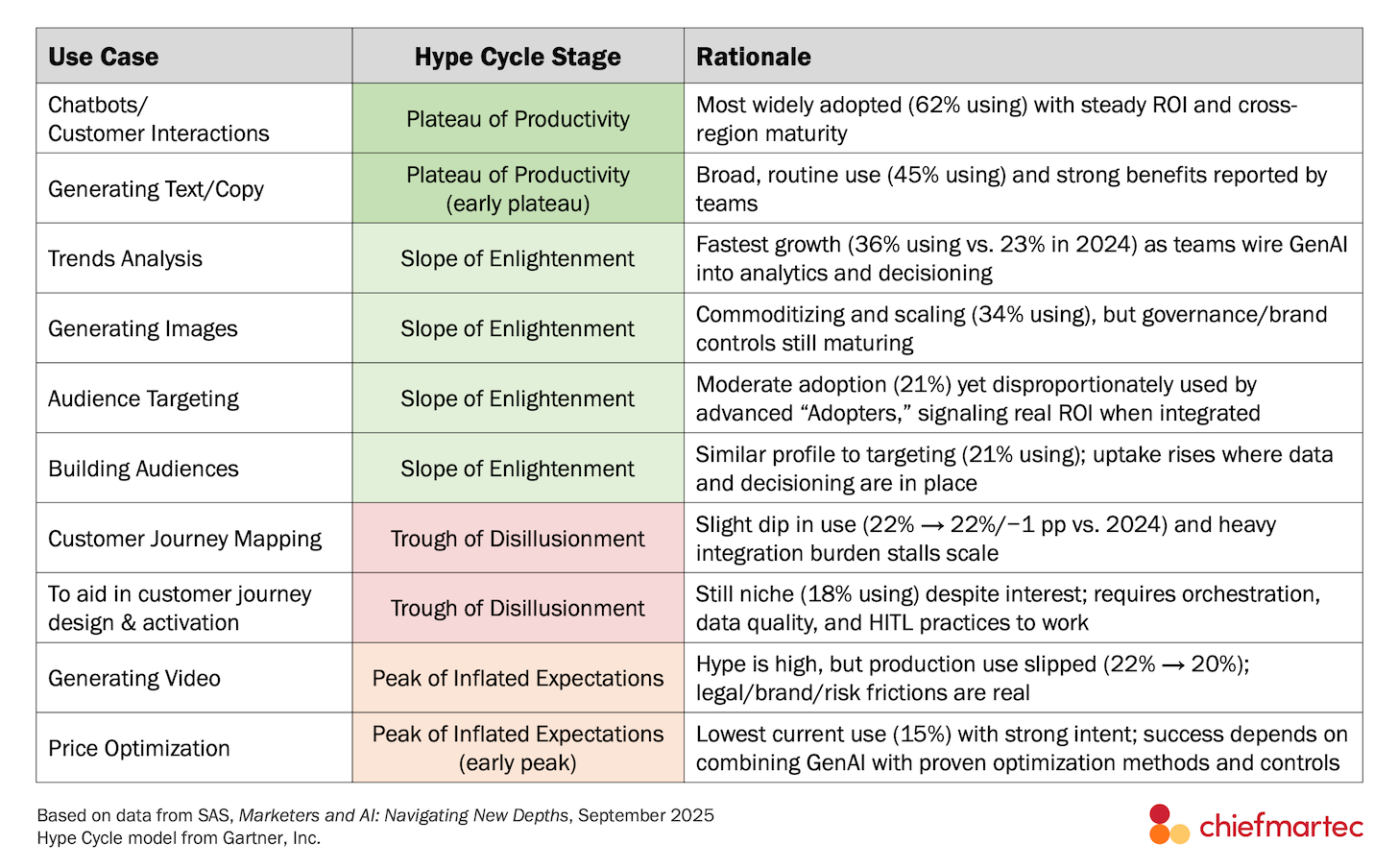
The Hype Cycle is not dead, but it has evolved into a far more complex, multi-dimensional grid. Those who can navigate this acceleration—by balancing the pragmatic adoption of today’s tools with a clear-eyed view of tomorrow’s disruptions—will define the future of the industry. The journey from "hype" to "productivity" is no longer a destination; it is a permanent state of flux. And for those equipped to handle it, that is exactly where the competitive advantage lies.
