
Beyond the Dashboard: The Rise of Causality Reporting in Modern Business Intelligence
In the high-stakes world of corporate strategy, a persistent question haunts marketing directors, product managers, and C-suite executives alike: "Did that exhibition actually move the needle?"
For years, the industry has operated on a diet of fragmented data. Marketing teams track clicks and impressions, while sales teams track revenue and conversion cycles. Occasionally, these two worlds intersect in a spreadsheet, but rarely do they speak the same language. The result is a persistent fog of uncertainty. Was that massive PR push merely expensive noise, or was it the catalyst for a fundamental shift in market penetration? Was the sudden spike in web traffic a result of a successful campaign, or simply seasonal variance?
Enter the Causality Report—a transformative visibility tool designed to bridge the chasm between real-world business actions and digital performance metrics. By mapping physical-world milestones directly onto digital data streams, the Causality Report moves beyond simple correlation to offer tangible evidence of impact.
The Anatomy of a Causality Report: What Is It?
At its core, a Causality Report is a diagnostic instrument that visualizes the "before-and-after" impact of a specific, intentional business event. Unlike traditional analytics, which often present data in a vacuum of time, the Causality Report acts as an overlay—a strategic lens through which you can view the evolution of metrics like impressions, click-through rates, and conversion costs.
The methodology is straightforward yet powerful:
- Event Annotation: A user identifies a specific date or period where a significant action occurred—such as a trade show appearance, a product launch, a celebrity endorsement, or even a sudden shift in pricing strategy.
- Metric Tracking: The system pulls the relevant digital performance indicators, spanning both the pre-event and post-event windows.
- Evidence Synthesis: The report highlights deviations in the trend line, distinguishing between standard fluctuations and genuine "signals" generated by the business action.
This is not merely about identifying trends; it is about establishing a causal narrative. When a spike in brand search volume occurs exactly 48 hours after a keynote address, the Causality Report provides the visual framework to confirm that the strategy is working.
A Chronology of Measurement Evolution
To understand why the Causality Report is necessary, one must look at the evolution of corporate intelligence.
The Era of "Hope-Based" Marketing (Pre-2010)
In the early days of digital, businesses relied on "vanity metrics." Companies celebrated the volume of traffic without understanding the quality. If a campaign launched and sales went up, leadership assumed a correlation, but there was no structural way to verify the link.
The Rise of Big Data (2010–2020)
As data collection became sophisticated, businesses were flooded with information. We moved into an era of "Dashboard Fatigue." Organizations had more data than ever, but they lacked the context to interpret it. Data scientists became the gatekeepers of truth, but they were often disconnected from the daily operational decisions being made in the boardroom.
The Emergence of Narrative Intelligence (2025 and Beyond)
Today, the paradigm is shifting toward "Narrative Intelligence." It is no longer enough to report that "traffic is up 10%." Stakeholders demand to know why. The Causality Report represents the current pinnacle of this shift, enabling teams to toggle their business annotations on or off, transforming raw, passive data into a dynamic story of organizational growth.
Supporting Data: Why Correlation Is Not Enough
In a recent analysis of mid-market tech firms, it was discovered that nearly 60% of companies fail to attribute their marketing efforts correctly. When a business action (such as a localized billboard campaign or a specific industry conference) is not annotated in the data, it is often dismissed as "background noise."
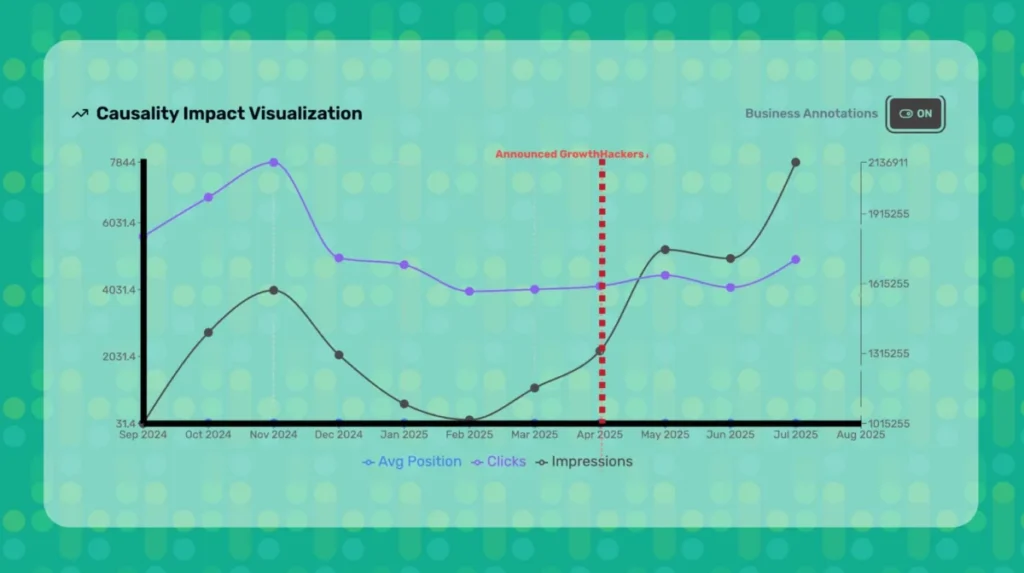
Consider the chart-based evidence from April 2025. In this scenario, a company implemented a targeted PR campaign during the first week of the month. By utilizing a Causality Report, the firm identified a distinct "step-function" increase in organic search traffic that persisted for three weeks following the event.
- Pre-April 2025: Baseline impressions hovered at 12,000 per day.
- The Catalyst: A strategic partnership announcement on April 12.
- Post-April 2025: Impressions surged to 18,500 and stabilized at that new plateau.
This is the definition of a signal. By comparing the variance against historical seasonal benchmarks, the Causality Report stripped away the "noise" of daily volatility, proving that the partnership was not just a vanity metric, but a revenue-generating asset that permanently shifted the company’s digital reach.
Official Perspectives: Bridging the Gap
Industry leaders are beginning to recognize that the traditional wall between "Marketing" and "Business Operations" is becoming a liability.
"When you isolate your data, you isolate your decision-making," says a lead analyst at a major SaaS provider. "The Causality Report is the ultimate collaborative tool. When the sales team sees a direct correlation between a product update and an uptick in demo requests, their morale increases. When the marketing team sees their PR efforts failing to move the needle, they pivot faster. It’s about creating a common language for the entire organization."
By connecting the dots, businesses move from a reactive posture to a proactive one. When the "Business Annotations ON" toggle is activated, the dashboard ceases to be a collection of charts and becomes a strategic roadmap. It allows for a culture of accountability where every investment—from a $5,000 social media spend to a $500,000 conference booth—can be subjected to the rigors of performance scrutiny.
Strategic Implications: When to Use It
The versatility of the Causality Report allows it to be deployed across various business functions:
- Trade Shows and Events: Evaluate the "long tail" of an exhibition. Did the lead generation activity spike during the event, or did the brand awareness carry over for the following month?
- Product Launches: Determine if the market reacted to the features, the pricing, or the messaging by aligning launch dates with user acquisition spikes.
- Pricing Adjustments: Track how a change in subscription tiers impacts churn rates or new sign-ups within a precise window.
- Competitor Moves: Annotate when a competitor makes a major change and monitor how your own digital footprint responds.
By utilizing these tools, organizations stop "guessing" what works. They start building a repository of institutional knowledge that informs future budget allocations.
The Future of Business Intelligence
The Causality Report is more than a UI feature; it is a fundamental shift in how we process business reality. In an economy defined by rapid change and fierce competition, the ability to rapidly distinguish between a successful strategy and a fluke is a competitive advantage.
Companies that refuse to adopt this level of precision will continue to report on vanity metrics while their competitors iterate based on hard, evidenced-based narrative intelligence. If you are not correlating your real-world actions with your digital performance, you are leaving business intelligence on the table.
As we look toward the latter half of the decade, the most successful organizations will be those that master the art of the "annotated timeline." They will be the ones who can look at a chart and explain not just what happened, but exactly why it happened—and, more importantly, how to replicate that success in the future.
In conclusion, the Causality Report is the bridge between the boardroom and the browser. It is the end of the "black box" era of marketing and the beginning of a transparent, data-driven narrative that empowers every member of the organization to contribute to the bottom line. Whether you are a small startup or a global enterprise, the power to prove your impact is the most valuable asset you can possess. The question is no longer "what happened?" but "what are we going to do with this insight?"
