
Navigating the Future: Unveiling the Comprehensive ‘Martech for 2026’ Industry Report
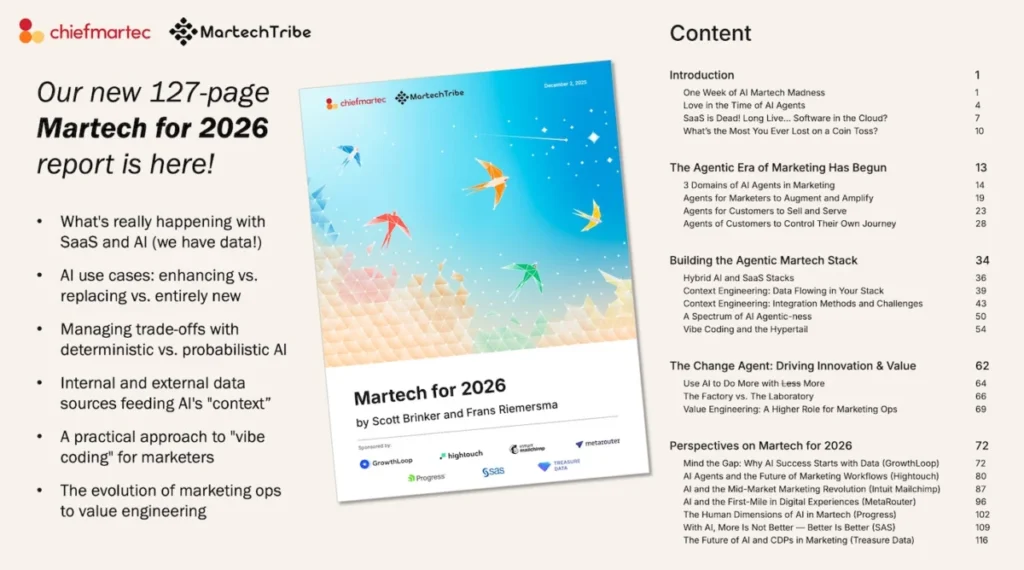
As the marketing technology landscape continues to undergo a tectonic shift driven by artificial intelligence and data democratization, industry professionals have been clamoring for a definitive roadmap. Today, that roadmap arrives. The highly anticipated Martech for 2026 report, a sprawling 127-page deep dive into the future of marketing infrastructure, is officially available for the industry at large.
Authored by industry stalwarts Frans Riemersma and Scott Brinker, this document serves as more than just a trend analysis; it is a strategic manual designed to help CMOs, marketing technologists, and operational leads navigate the complexities of an AI-first marketing ecosystem. By prioritizing accessibility, the authors have bypassed traditional "gatekeeping" tactics—there are no forms to fill, no email address harvesting, and no social media engagement mandates. The report is offered as a transparent, open-access resource, signaling a move toward greater industry collaboration.
Main Facts: A Blueprint for the Coming Year
The Martech for 2026 report is an ambitious undertaking, distilling months of rigorous research into a cohesive narrative that balances technical infrastructure with human-centric marketing strategy. At its core, the report serves to demystify the intersection of AI, data architecture, and creative execution.
The document is meticulously structured to provide clarity in a sector often clouded by buzzwords. By stripping away dense technical jargon, Riemersma and Brinker have produced a document that is as readable as it is informative. The core of the report is built upon the findings of the AI & Data in Marketing survey, conducted earlier this year, which captures the sentiments and technological readiness of thousands of professionals across the globe.
What sets this report apart from standard industry whitepapers is its rejection of the "pay-to-play" model. While the report represents a level of intellectual labor that could command a premium price tag—easily reaching $1,000 in a corporate consulting context—it has been made entirely free to the public, thanks to a unique partnership with seven industry leaders who sponsored the research without editorial oversight.
The Chronology of Research
The path to this release was not overnight. It began months ago with the initiation of the AI & Data in Marketing survey, an expansive data collection effort designed to capture the "pulse" of the martech world. Following the collection of this primary data, the editorial team spent months synthesizing findings, conducting peer interviews, and mapping out the visual illustrations that define the report’s narrative.
The final phase, completed just this week, involved the integration of seven expert perspectives. Unlike traditional sponsored content, where brands dictate the message, the authors invited leaders from GrowthLoop, Hightouch, Intuit Mailchimp, MetaRouter, Progress, SAS, and Treasure Data to participate in long-form, analytical interviews. These interviews were then refined into specific chapters that offer industry-agnostic advice on how organizations can leverage their respective technologies to survive and thrive by 2026.
Supporting Data: What the Market Tells Us
The report leverages data that is both quantitative and qualitative. The AI & Data in Marketing survey provides the backbone for the report’s assertions. While the full statistical breakdown is expansive, the recurring theme throughout the data is a move away from "experimental" AI toward "integrated" AI.
Key trends identified in the data include:
- The Shift in Data Governance: Organizations are shifting from hoarding data to prioritizing the "first-mile" of data cleanliness, recognizing that AI output is only as good as the underlying input.
- Workflow Automation: There is a measurable increase in the adoption of AI agents that manage the "busy work" of marketing, allowing human teams to focus on creative strategy.
- Mid-Market Maturation: The report highlights that AI is no longer the sole domain of enterprise-level tech giants; mid-market companies are now leveraging these tools to scale their operations with unprecedented efficiency.
These findings suggest that by 2026, the competitive advantage will no longer be determined by who has the most data, but by who can most effectively turn that data into autonomous, high-quality customer experiences.
Official Perspectives: Expert Commentary
A standout feature of the Martech for 2026 report is its inclusion of seven distinct industry voices. These chapters provide a rare look into how leading technology providers view the evolution of the landscape:
1. GrowthLoop: The Data Foundation
GrowthLoop addresses the "Mind the Gap" phenomenon, arguing that the promise of AI remains unfulfilled for many because of disconnected data silos. They emphasize that AI success is a direct result of data architecture maturity.
2. Hightouch: The Rise of AI Agents
Focusing on the mechanics of marketing, Hightouch explores how AI agents will redefine standard operating procedures. They argue that workflows will shift from human-executed tasks to human-orchestrated agent processes.
3. Intuit Mailchimp: The Mid-Market Revolution
Intuit Mailchimp provides a vital perspective on the democratization of technology, explaining how AI is lowering the barrier to entry for mid-sized firms to compete with global enterprises.
4. MetaRouter: The "First-Mile" Problem
MetaRouter tackles the critical issue of data integrity at the point of origin. Their contribution highlights that if the "first-mile" of digital experience—data collection and ingestion—is flawed, the downstream AI applications will inevitably fail.
5. Progress: The Human Element
Progress reminds readers that technology is only as good as the people who wield it. Their chapter, "The Human Dimensions of AI in Martech," explores the cultural shifts necessary to integrate AI into existing teams without eroding institutional knowledge.
6. SAS: Quality Over Quantity
In a direct rebuke to the "more is better" mindset, SAS argues that "Better is Better." They advocate for high-fidelity, high-precision AI models that prioritize outcome quality over sheer volume of content generation.
7. Treasure Data: The Evolution of CDPs
Treasure Data rounds out the expert contributions by examining the future of Customer Data Platforms (CDPs) in an AI-heavy world, positioning the CDP as the central brain of the modern marketing stack.
Implications for the Future of Marketing
The implications of the Martech for 2026 report are profound for any organization currently investing in digital infrastructure. As we look toward 2026, the industry is clearly moving toward a period of consolidation and refinement.
The End of the "Wild West"
The era of adopting AI tools simply for the sake of novelty is coming to an end. The report implies that 2026 will be the year of the "Pragmatic Martech Stack." Companies that have spent the last two years testing disparate tools will likely be forced to consolidate those into cohesive, data-integrated ecosystems.
Human-Centricity in an AI World
Perhaps the most significant takeaway is the emphasis on the "Human Dimension." As AI becomes commoditized, the human element—strategy, ethics, creative nuance, and empathy—becomes the primary differentiator. Organizations that treat AI as a replacement for human talent will likely struggle, while those that treat it as a force multiplier will thrive.
The Sustainability of Data
With privacy regulations evolving and the "cookie-less" future becoming a reality, the report underscores that first-party data is no longer just an asset—it is a survival requirement. The focus on "first-mile" data quality is a warning: those who do not have a grip on their data lineage today will be left behind by 2026.
Conclusion: A Call to Action
The Martech for 2026 report is a call to arms for those in the marketing and technology sectors. It provides the intellectual framework, the survey-backed evidence, and the expert guidance necessary to transition from the current state of flux to a future defined by efficiency and precision.
By making this report freely available, Riemersma and Brinker have done the industry a significant service, removing the financial and social barriers to accessing high-level strategic intelligence. For those tasked with shaping the future of their organizations, this 127-page document is not just required reading; it is a vital tool for navigating the next phase of the digital evolution.
As the authors noted upon release, the goal is simple: to provide a resource that is genuinely useful for the community. The report is now in the hands of the practitioners. Whether it results in a radical overhaul of marketing stacks or a subtle refinement of existing strategies, the Martech for 2026 report will undoubtedly serve as a cornerstone of industry discourse for the next several years.
