
The Ultimate Print-on-Demand Showdown: Fourthwall vs. Gelato (Comprehensive Analysis)
The print-on-demand (POD) landscape has evolved dramatically over the last few years, shifting away from generic fulfillment plug-ins toward sophisticated, brand-building ecosystems. For creators, entrepreneurs, and digital artists looking to monetize their audiences without holding inventory, choosing the right backend infrastructure can make or break a business.
Two giants frequently dominate this conversation, yet they serve fundamentally different types of sellers: Gelato and Fourthwall. While both boast stellar reputations, robust product quality, and free-to-use tiers, they approach ecommerce from opposing directions.
This deep-dive analysis breaks down how these platforms compare across architecture, pricing, product range, fulfillment efficiency, and long-term business implications.
Main Facts: Core Architecture and Platform Identity
To understand which platform fits your strategy, you first need to look at how Fourthwall and Gelato define themselves fundamentally.
- Gelato is a Production and Fulfillment Engine: Gelato does not provide an out-of-the-box ecommerce website. Instead, it acts as a high-powered, globally distributed manufacturing partner that integrates seamlessly into platforms you already use, such as Shopify, Etsy, Wix, Squarespace, and TikTok Shop. You build the storefront; Gelato handles the printing, packaging, and international shipping.
- Fourthwall is an All-in-One Brand-Building Ecosystem: Fourthwall combines a curated, retail-quality print-on-demand catalog with a fully hosted ecommerce website builder. It features its own custom domain capabilities, a drag-and-drop store editor, built-in digital download hosting, membership programs, donation systems, and multi-channel social integrations (including YouTube Shopping and TikTok Shop). Furthermore, Fourthwall acts as your Merchant of Record (MoR), handling complex sales tax collection and customer service support for catalog items.
Chronology: The Evolution of Modern POD Infrastructure
The rivalry between Gelato and Fourthwall mirrors the broader maturation of the creator economy.
- Phase 1: The Traditional Backend Era (Pre-2020): Early POD platforms functioned purely as remote factories. Creators were forced to stitch together standalone websites (Shopify, WooCommerce) with third-party print providers, dealing with fragmented customer service, high administrative burdens, and disconnected logistics.
- Phase 2: Globalized Manufacturing and Sustainability (2020–2023): Platforms like Gelato refined the model by decentralizing production. By tapping into local print hubs worldwide, they drastically slashed shipping times and carbon footprints. Features like Gelato’s Personalization Studio introduced dynamic customer-customized products to improve profit margins.
- Phase 3: The All-in-One Creator Economy (2023–Present): Companies like Fourthwall shifted paradigms by eliminating the need for a separate website builder. Recognizing that modern creators want to sell physical merchandise, digital downloads, gated memberships, and video subscriptions under a single roof, they pioneered the "storefront-first" POD model, augmented by AI assistants and designer marketplaces.
Supporting Data: Feature, Pricing, and Logistics Comparison
A direct comparison of platform specifications reveals where each service excels:
| Comparison Factor | Fourthwall | Gelato |
|---|---|---|
| Primary Classification | All-in-one brand & store builder with POD | Global print-on-demand & fulfillment partner |
| Storefront Required? | No (Provided natively with custom domain) | Yes (Must integrate with Shopify, Etsy, etc.) |
| What Can You Sell? | POD, self-sourced physical goods, digital downloads, memberships, donations | Customized print-on-demand products |
| Starting Cost | Free to sign up (5% fee on digital/memberships) | Free to sign up (Optional Pro tier at $29.99/mo) |
| Merchant of Record (MoR) | Yes (Handles sales tax and liability for catalog items) | No (You manage your own taxes and compliance) |
| Sustainability Focus | Eco-friendly options available | Core brand pillar (90% local production) |
| Global Fulfillment | Worldwide shipping (US, UK, EU, AU, JP, etc.) | 140+ production hubs across 32+ countries |
| Key AI Tools | Eli AI Assistant, ChatGPT workflow integrations | AI Mockup tools, enhanced analytics dashboards |
Pricing Dynamics: Which Platform Costs Less in Practice?
Both companies offer attractive free tiers, but the total cost of ownership depends entirely on your existing infrastructure.
Gelato’s Financial Model
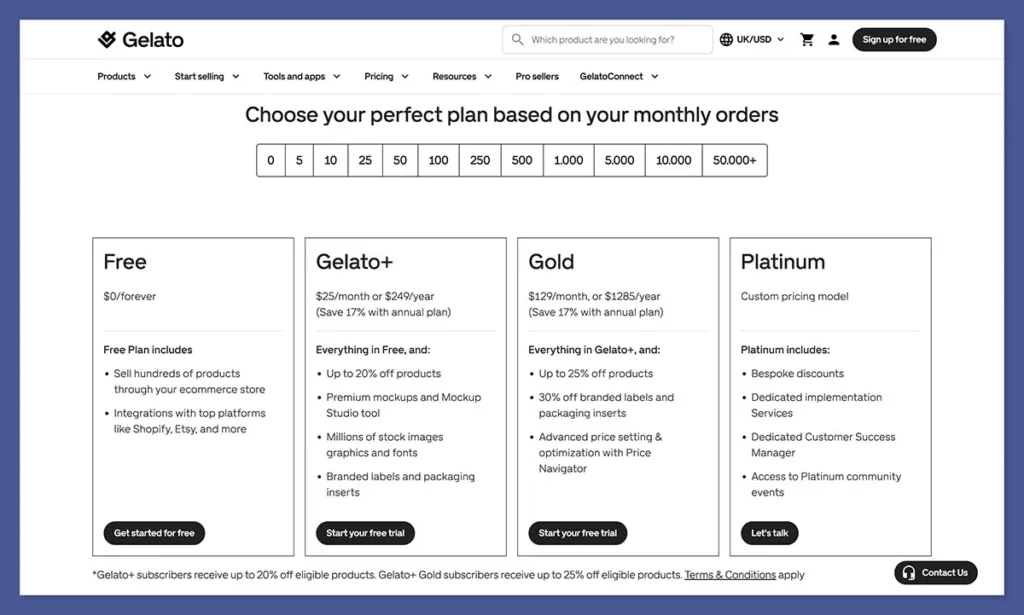
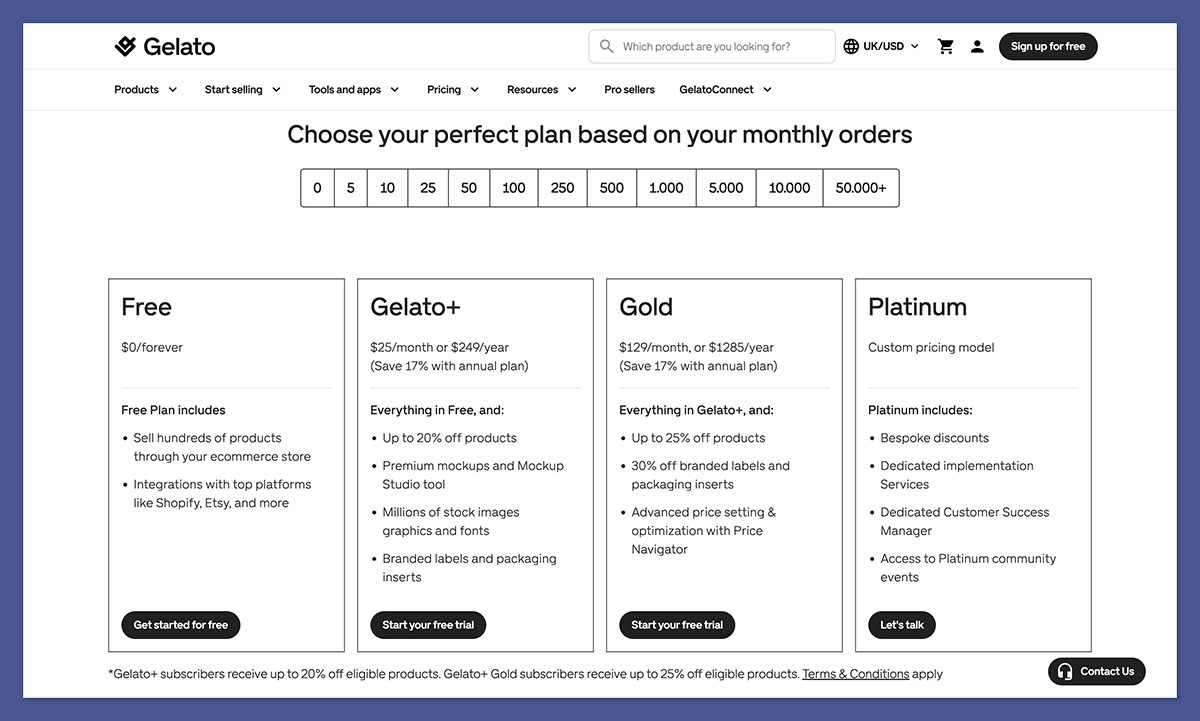
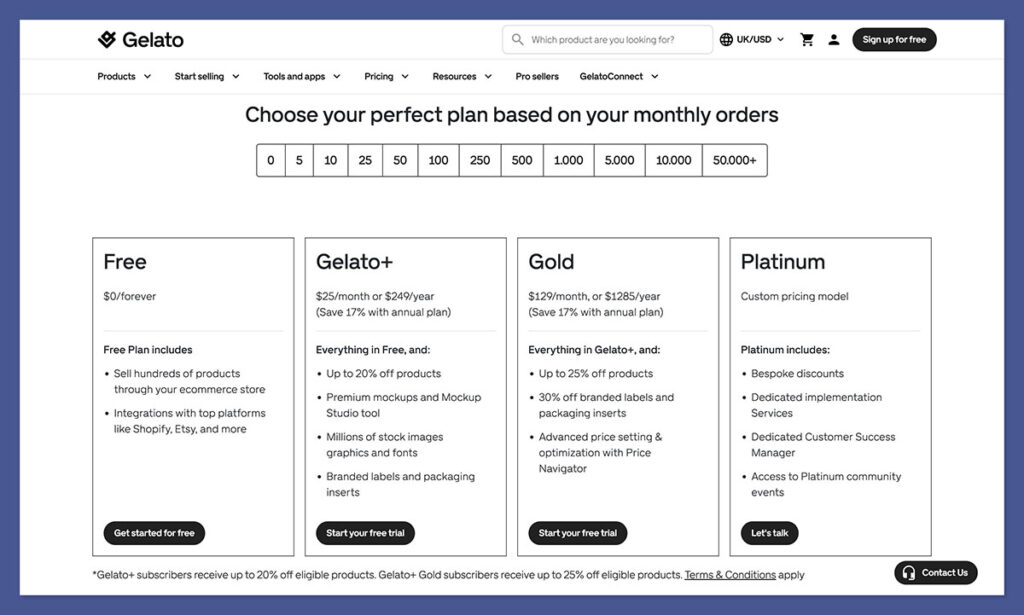
Gelato’s free plan includes access to its complete product catalog, mockups, basic design tools, and unlimited sales channel integrations. However, as your business scales, upgrading to Gelato+ ($29.99/month) becomes mathematically advantageous. It unlocks up to 33% product discounts, the Personalization Studio, Magic mockups, and product migration tools.
The hidden cost of Gelato, however, lies externally. Because Gelato is purely a fulfillment partner, you must budget separately for your chosen ecommerce platform (e.g., Shopify’s monthly subscription fee), custom domain registration, and auxiliary marketing apps.
Fourthwall’s Financial Model
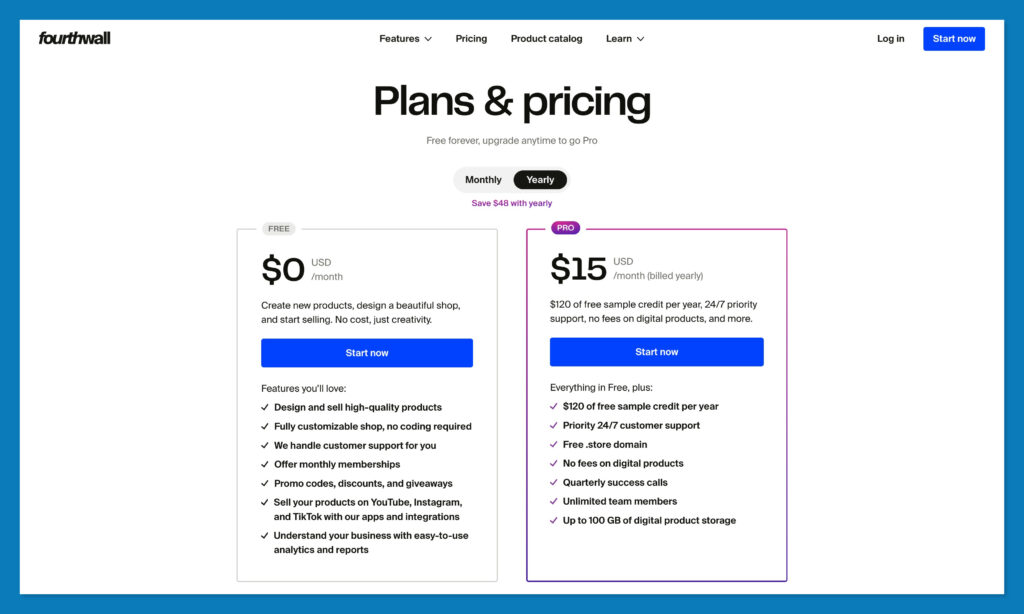
Fourthwall is frequently more cost-effective for absolute beginners because its free plan includes a fully functional, customizable storefront and domain hosting. You can sell digital and physical goods right out of the box. The catch on the free tier is a 5% transaction fee on digital downloads and memberships.
Upgrading to Fourthwall’s Pro plan ($19/month) eliminates the digital download fee, grants unlimited team members, advanced analytics, up to $10 in monthly sample credits, and priority support. Overall, if you are starting from scratch without an existing Shopify or Etsy store, Fourthwall requires significantly less initial capital layout.
Product Range and Quality: Craftsmanship Meets Customization
Gelato: Superior Wall Art and Localized Scale
Gelato’s product catalog covers all standard apparel, drinkware, and accessories, but its wall art and paper products consistently outperform industry averages. Furthermore, Gelato’s Personalization Studio empowers end-consumers to modify designs directly on your storefront—such as adding custom names or dates—which naturally justifies higher retail pricing. When benchmarked against competitors like Printful or Printify, Gelato’s base manufacturing costs remain highly competitive.
Fourthwall: Retail-Grade Aesthetics and Diversified Monetization
While Fourthwall’s POD catalog is slightly more curated than Gelato’s, its item quality is exceptionally high, featuring retail-grade apparel with advanced printing placements (such as sleeve printing) and robust eco-friendly collections.
Crucially, Fourthwall transcends traditional POD limitations. Creators are not locked exclusively into made-to-order items; they can source custom inventory independently, ship it to Fourthwall warehouses for fulfillment, and bundle physical merch with digital downloads, community memberships, and tip jars—all without installing third-party plugins.
International Shipping and Sustainability
Gelato’s Edge in Localized Production
Gelato edges ahead in logistics through its staggering network of over 140 production hubs across more than 32 countries. By producing approximately 90% of orders locally (meaning the item is printed in the same country as the customer), Gelato drastically reduces international shipping times, transit damage risks, and customs tariffs. Roughly 90% of orders arrive within five days. Sustainability is core to Gelato’s DNA, utilizing non-toxic inks and circular supply chains.
Fourthwall’s Global Reach
Fourthwall also delivers reliable worldwide shipping, with key fulfillment partners spanning the US, UK, EU, Canada, Mexico, Japan, and Australia. Standard orders generally arrive within 5 to 8 days. While Fourthwall offers eco-conscious product alternatives, sustainability is secondary to its core focus on creator brand-building.

Official Responses and Ecosystem Support
Customer support mechanics highlight a major philosophical difference between the two platforms:
- Gelato: Offers responsive email support and extensive documentation, but leaves the administrative burden entirely on the merchant. You are responsible for store maintenance, tax configurations, and handling end-customer complaints regarding shipping delays or refunds (though production errors are replaced by Gelato).
- Fourthwall: Acts as the Merchant of Record, alleviating massive administrative headaches by managing sales tax liabilities for transactions processed through its system. Furthermore, Fourthwall’s support team steps in to handle direct customer service inquiries for any items ordered out of its core product catalog, protecting creators from frontline customer support friction.
Implications: Which Platform Should You Choose?
The choice between Fourthwall and Gelato ultimately boils down to where you are in your entrepreneurial journey:
- Choose Gelato if: You already operate an established storefront on Shopify, Etsy, or TikTok Shop, and you simply require an elite, globally scaled manufacturing and fulfillment partner. It is the premier choice for merchants who want localized, sustainable printing, advanced design tools, and seamless multi-channel integration without migrating their existing web infrastructure.
- Choose Fourthwall if: You are starting from scratch, building a creator brand, or looking to consolidate multiple revenue streams (physical merch, digital products, and memberships) under one roof. By providing the storefront, the domain, the Merchant of Record framework, and robust community tools, Fourthwall minimizes administrative overhead and lets you focus purely on content and design.
