
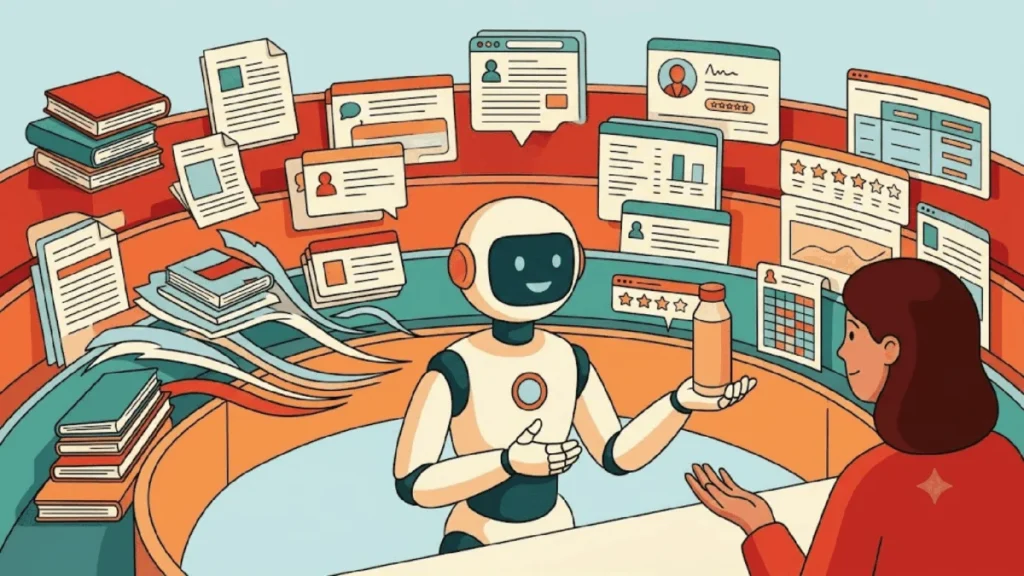
The Rise of Synthetic Competition: How AI and Zero-Click Search are Redefining Brand Authority
In the modern digital economy, the traditional buyer’s journey is undergoing its most radical transformation since the invention of the search engine. For decades, the path to purchase was linear and predictable: a customer identified a need, queried a search engine, clicked through to a brand’s website, and entered a marketing funnel.
Today, that journey is increasingly bypassed. Instead of browsing multiple vendor websites, downloading white papers, or clicking on paid search advertisements, millions of buyers are turning directly to artificial intelligence assistants like ChatGPT, Claude, and Gemini to synthesize complex purchasing decisions in seconds.
This shift has given rise to a new market dynamic: synthetic competition. In this environment, brands are no longer competing solely against direct industry rivals. Instead, they are competing against the vast ecosystem of AI-generated answers, third-party comparison sites, affiliate networks, Reddit discussions, and independent analyst reports. These external sources now shape, filter, and dictate buyer perceptions long before a customer ever visits a brand’s owned digital properties.
1. Main Facts: The Shift to AI-Synthesized Decision Making
The rise of generative AI has fundamentally altered how information is distributed and consumed. When a prospective buyer uses an AI assistant to research enterprise software, consumer electronics, or financial services, the AI does not merely present a list of blue links; it acts as an active intermediary. It analyzes dozens of sources, compares product features, weighs user reviews, and delivers a highly tailored recommendation.
Traditional Buyer Journey:
Google Search → Brand Website → Lead Capture → Product Demo / Purchase

Modern Buyer Journey:
AI Assistant → Synthesized Summary → Multi-Vendor Comparison → Selected Brand Website → Purchase
Under this new paradigm, visibility is no longer guaranteed by high search engine rankings or aggressive ad spend. Instead, digital survival depends on becoming a trusted source that LLMs (Large Language Models) actively choose to cite. This development introduces several critical realities for modern organizations:
- The Erasure of the Middle Funnel: Traditional lead-generation assets, such as gated eBooks and generic product comparison pages, are being bypassed. AI engines synthesize these materials on behalf of the user, delivering the key takeaways without requiring a site visit.
- The Rise of Zero-Click Environments: A significant portion of web searchers now receive complete answers directly on search engine results pages (SERPs) or within AI chat interfaces, eliminating the incentive to click through to external websites.
- The Authority Imperative: To remain relevant, brands must shift their focus from optimizing for search algorithms (Search Engine Optimization) to optimizing for the trust networks and data repositories that feed generative AI models (Generative Engine Optimization, or GEO).
2. Chronology: The Evolution of Search and Discovery
To understand how synthetic competition became the dominant force in digital marketing, it is helpful to trace the technological milestones that brought the industry to this point.
[2000–2018: The Click-and-Capture Era]
Brands focus on keyword density, backlinks, and driving high-volume traffic to owned websites.
       │
       ▼
[2018–2022: The Zero-Zero Search Era]
Google introduces Featured Snippets and local packs. Zero-click searches begin to rise, keeping users on the SERP.
       │
       ▼
[2023–2024: The Generative AI Boom]
ChatGPT, Claude, and Google Gemini launch. Users shift from searching for keywords to asking complex, multi-variable questions.
       │
       ▼
[2025–2026: The Commercialization of AI Discovery]
AI discovery platforms mature. Post-purchase attribution surveys reveal massive, exponential year-over-year growth in AI-driven purchases.
The Click-and-Capture Era (2000–2018)
During this period, search engines functioned as directories. Marketers focused on technical SEO, keyword density, and link-building to secure top organic positions. The primary goal was to drive traffic directly to corporate websites, where internal marketing teams could control the narrative, capture contact information, and nurture leads.
The Zero-Click Transition (2018–2022)
Google began integrating advanced natural language processing models (such as BERT and MUM) to answer user queries directly on the search page. Features like "People Also Ask," featured snippets, and local map packs grew in prominence. For the first time, brands noticed a decoupling of search volume and website traffic: users were finding answers without clicking on search results.
The Generative Era (2023–Present)
The launch of conversational AI platforms turned search engines into answering engines. Rather than visiting five different websites to compare enterprise CRM platforms, users could ask an LLM to "compare the top four CRM vendors for a mid-sized healthcare company, highlighting HIPAA compliance and integration options."
By 2026, this technology has matured into a primary commerce and discovery channel. AI search engines do not just index information; they evaluate credibility, sentiment, and peer recommendations to deliver definitive, singular answers.
3. Supporting Data: The Quantitative Reality of AI Discovery
The transition to AI-mediated commerce is backed by rapidly accelerating empirical data. According to the 2026 AI Attribution Report published by Knocommerce and GR0—which analyzed millions of post-purchase surveys across more than 6,000 Shopify brands—product discovery directly attributed to AI or ChatGPT experienced an approximate twelvefold (12x) increase over the course of 2025.
Key Market Metrics:
┌───────────────────────────────────────┬──────────────────────────────────────┐
│ Metric                                │ Value / Growth Rate                  │
├───────────────────────────────────────┼──────────────────────────────────────┤
│ AI-Driven Product Discovery (2025)     │ 12x Increase                         │
│ Shopify AI-Driven Orders (YoY)        │ 15x Increase                         │
│ Month-over-Month AI Discovery Growth  │ 25% – 30%                            │
│ Zero-Click Google Searches (2026)     │ 68% of total queries                 │
└───────────────────────────────────────┴──────────────────────────────────────┘
Furthermore, Shopify President Harley Finkelstein publicly shared that AI-driven orders on the e-commerce platform grew 15x year-over-year. While AI discovery still represents a single-digit percentage of overall digital acquisitions, its month-over-month growth rate of 25% to 30% makes it the fastest-growing customer acquisition channel in history.
Concurrently, traditional organic search channels are yielding fewer direct site visits. Research from SparkToro reveals that 68% of Google searches in 2026 now end without a click. This means that more than two-thirds of all queries are resolved directly within the search interface—via AI Overviews, interactive widgets, or structured snippets—bypassing brand websites entirely.
4. Official Responses and Industry Perspectives
The rise of synthetic competition has divided the marketing and technology sectors, prompting strategic pivots from major industry players, search experts, and digital agencies.
The Platform Perspective
Large language model developers argue that conversational search provides a vastly superior user experience. By synthesizing fragmented web content into cohesive, direct answers, AI platforms eliminate the need for consumers to navigate ad-heavy, slow-loading corporate websites.
Platforms have also responded to publisher concerns by introducing citation links within AI-generated responses. However, early CTR (click-through rate) data suggests that only a small fraction of users click these citations, typically doing so only when they are ready to finalize a transaction or verify a critical compliance document.
The Analyst and SEO Consensus
Search industry analysts emphasize that traditional SEO is not dead, but its objectives must be redefined. Rand Fishkin, founder of SparkToro, has repeatedly cautioned that relying solely on search traffic metrics is a dangerous strategy in a zero-click world.
"In an environment where nearly 70% of searches result in no click, marketers must optimize for 'influence' rather than 'traffic.' Your success is no longer measured by how many people landed on your blog, but by whether your brand name was included in the AI's final synthesized recommendation."
— Digital Marketing Analyst Consensus
Furthermore, SEO specialists note that LLMs do not scrape the web in real-time for every query; they rely on pre-trained datasets and retrieval-augmented generation (RAG). Therefore, to influence an AI’s recommendation, a brand’s authority must be deeply embedded across a diverse web footprint long before the user inputs their prompt.
5. Strategic Implications: How Brands Must Adapt
To survive and thrive in an era dominated by synthetic competition, organizations must abandon outdated traffic-acquisition playbooks and adopt a holistic authority-building framework.
H3: 1. Focus on "Information Gain" and Un-Replicable Content
Generative AI models excel at summarizing commoditized, repetitive information. If a brand’s content consists of basic definitions, listicles, or generic advice, AI can easily replace it.
To build genuine authority, brands must invest in high-value, proprietary content that AI cannot replicate. This includes:
- Original Research and Data: Conducting proprietary surveys, industry benchmarks, and data-driven studies that other publications (and subsequently, AI models) must cite.
- First-Person Case Studies: Documenting detailed, real-world implementations, complete with specific metrics, failures, and learned lessons.
- Deep Subject Matter Expertise: Publishing technical documentation, architectural blueprints, and opinion pieces written by verified industry experts.
Commoditized Content (Easily Replaced by AI):
"What is Enterprise CRM?" or "5 Benefits of Cloud Computing"

High-Information-Gain Content (AI Must Cite):
"How We Reduced Cloud Latency by 42% Using a Hybrid Edge Architecture: A Technical Case Study"
H3: 2. Cultivate a Diverse Digital Footprint
Because AI engines aggregate data from thousands of external sources, a brand’s reputation is determined by the collective consensus of the web. Marketers must build authority on platforms they do not own:
- Online Communities: Engaging genuinely on platforms like Reddit, Discord, and specialized developer forums where real users discuss product experiences.
- Third-Party Review Ecosystems: Actively managing profiles on trust directories such as G2, Capterra, Trustpilot, and Google Business Profile.
- Earned Media and Digital PR: Securing features in reputable industry trade publications, guesting on authoritative podcasts, and obtaining mentions in major analyst reports (e.g., Gartner, Forrester).
H3: 3. Modernize Marketing Measurement Frameworks
When the buyer’s journey occurs within an AI interface, traditional web analytics (such as session counts, bounce rates, and click-through rates) fail to capture the full picture. Marketing organizations must track new, qualitative metrics to measure brand health:
- Share of Model Voice (SoMV): Regularly querying popular LLMs with industry-specific prompts to determine how often a brand is recommended relative to its competitors.
- Direct and Branded Search Volume: Monitoring the number of users who search specifically for the brand name, indicating that off-site AI recommendations are successfully driving high-intent traffic.
- Qualitative Attribution Surveys: Implementing post-purchase surveys that ask open-ended questions like, "How did you first hear about us?" to capture "dark social" and AI-assisted touchpoints that attribution software misses.
Traditional Metrics vs. Synthetic Era Metrics:
┌───────────────────────────────────────┬──────────────────────────────────────┐
│ Traditional Metrics (Declining Value) │ Modern Metrics (Rising Importance)   │
├───────────────────────────────────────┼──────────────────────────────────────┤
│ Total Organic Sessions                │ Share of Model Voice (SoMV)          │
│ Keyword Rankings (SERP Positions)     │ Branded Search Volume Growth         │
│ Gated Content Form Submissions        │ Qualitative Post-Purchase Surveys    │
│ Last-Click Attribution Models         │ Referral Traffic from LLM Gateways   │
└───────────────────────────────────────┴──────────────────────────────────────┘
6. Conclusion: The Trust Imperative
The rise of synthetic competition represents a fundamental shift in the power dynamics of the internet. The digital gatekeepers are no longer just indexing the web; they are interpreting it.
In this new landscape, visibility cannot be bought through ad networks alone, nor can it be engineered solely through technical search optimization. To succeed, brands must recognize that the companies people trust will inevitably become the companies AI trusts. By focusing on authentic authority, proprietary data, and a robust presence across the broader digital ecosystem, forward-thinking organizations can ensure they remain an indispensable part of the consumer’s decision-making process—no matter what tool they use to make it.
