
The Growth Marketer’s New Superpower: Why Python is Reshaping the Industry
In the rapidly evolving landscape of digital marketing, the line between a traditional marketer and a data scientist is blurring. As data volumes explode and competition intensifies, the reliance on manual processes and rigid spreadsheets has become a bottleneck to scalability. Enter Python—a versatile, high-level programming language that is fast becoming an indispensable tool for growth marketers looking to automate, analyze, and optimize their strategies with unprecedented precision.
The Shift Toward Data-Driven Autonomy
Growth marketing is, at its core, the intersection of data, analytics, and rapid experimentation. Historically, marketers have relied on intuitive decision-making supplemented by basic reporting tools. However, modern growth requires a more surgical approach.
Alistair Allan, a prominent voice in the growth space, notes that the true value of Python lies in its ability to bridge the gap between disparate systems. "Growth is that crossover of data, analytics, and testing," Allan explains. "You can do all of that stuff manually, or you can try and figure out how to automate it, how to make decisions without having a human in the loop. Python is a way to save time, it’s a way to connect the dots between disparate systems, it’s a way to get out of Excel spreadsheets and huge formulas."
Why Python Stands Above the Rest
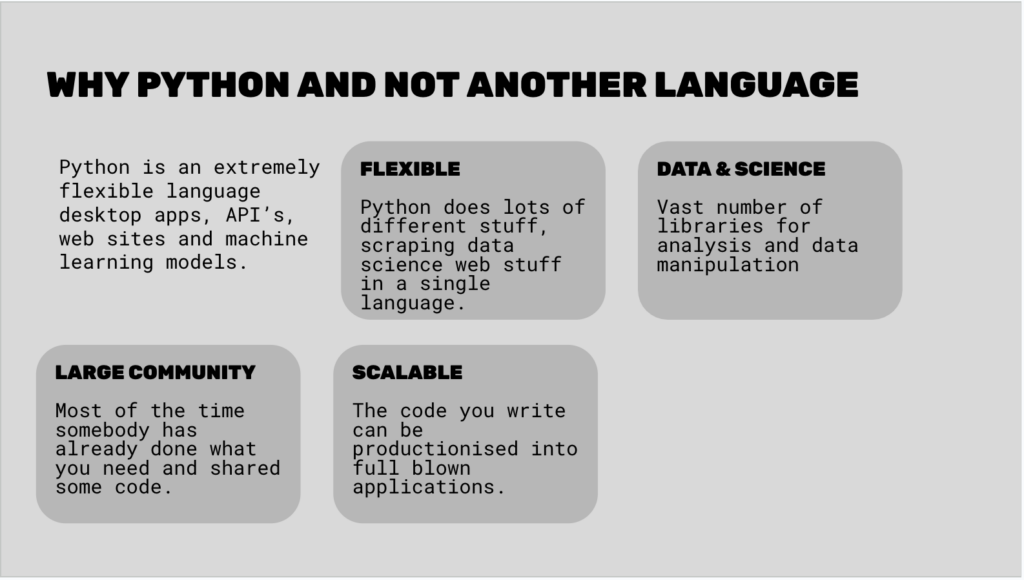
While there are numerous programming languages available, Python has emerged as the industry standard for marketing analytics. The reasons are threefold: flexibility, community support, and scalability.
1. Unrivaled Flexibility
Python is not a single-purpose tool. It can be used to build web scrapers, automate mundane reporting, run complex statistical models, or even build full-scale web applications. This versatility means a marketer can solve an entire workflow problem within a single ecosystem.
2. The Power of Community
Python boasts one of the largest and most active developer communities in the world. For almost every marketing hurdle—whether it is pulling API data from Facebook Ads or performing sentiment analysis on Twitter—someone has likely already built a solution. This allows marketers to leverage pre-existing code, accelerating the development process significantly.
3. Scalability and Synergy
From a data science perspective, Python is the lingua franca. If a growth team needs to collaborate with a dedicated data science department, using Python ensures that all teams are speaking the same language. Furthermore, code written in Python can handle millions of rows of data, far exceeding the capabilities of traditional spreadsheet software like Microsoft Excel or Google Sheets.
Practical Applications for Growth Marketers
The utility of Python in marketing extends far beyond basic data manipulation. Here is how leading growth teams are currently leveraging the language:
Automation and API Integration
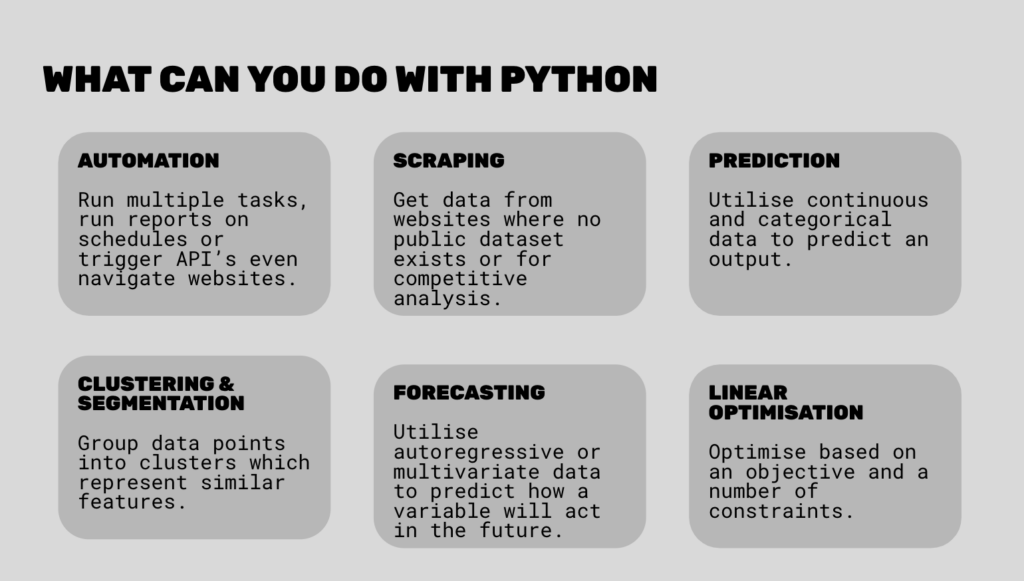
Python excels at interacting with APIs. Marketers can build scripts that automatically fetch performance data from Google Analytics, Google Search Console, or social media platforms. These scripts can even be programmed to take action—such as pausing underperforming ad campaigns or adjusting bidding strategies based on real-time ROAS (Return on Ad Spend) data.
Web Scraping for Competitive Intelligence
Data is often locked behind static web pages. With Python’s robust scraping libraries, marketers can systematically crawl competitor websites, gather public datasets, and monitor market trends. This transforms competitive research from a periodic, manual chore into a continuous, automated stream of intelligence.
Advanced Forecasting and Predictive Modeling
Using libraries like Prophet, marketers can move beyond simple year-over-year growth projections. Python enables the creation of sophisticated time-series models that account for seasonality, holidays, and external variables, providing a much more accurate forecast for future ad performance and customer acquisition costs.
Clustering and Audience Segmentation
Rather than relying on broad demographic targeting, Python allows for the use of clustering algorithms (such as K-Means) to identify granular customer segments based on behavioral data. By understanding the distinct archetypes within a customer base, marketers can tailor their messaging and ad spend for maximum conversion efficiency.
Linear Optimization and Budget Allocation
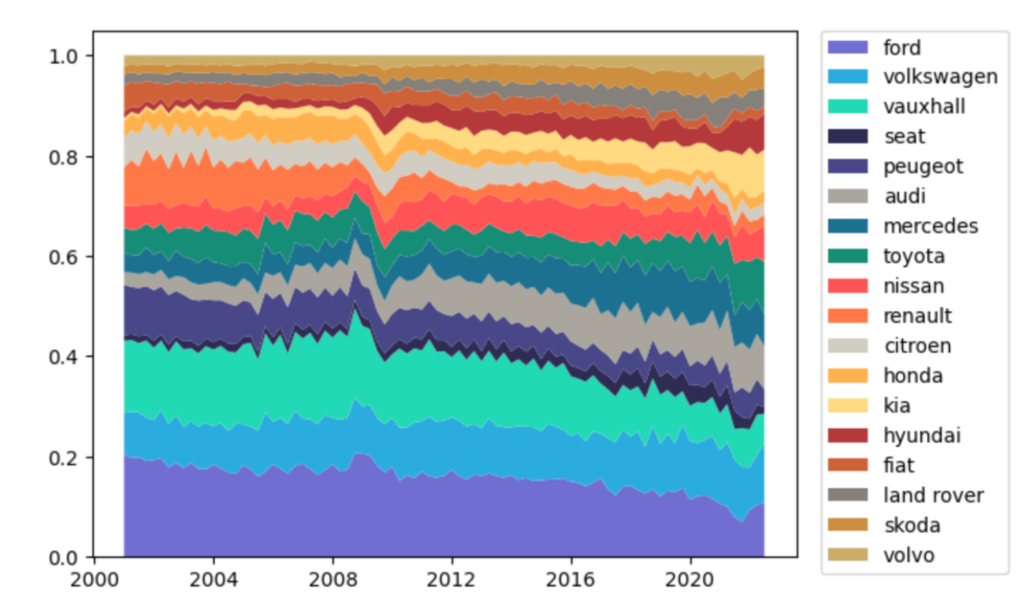
Perhaps the most high-impact application is spend optimization. Through linear optimization techniques, Python can determine the mathematically optimal way to distribute a marketing budget across various channels to maximize ROI, subject to constraints like minimum spend or target CPA (Cost Per Acquisition).
Getting Started: The Path to Proficiency
The barrier to entry for learning Python has never been lower. For those intimidated by the prospect of coding, the industry has developed several "low-code" and "no-code" bridges.
Google Colab: The Cloud-Based Sandbox
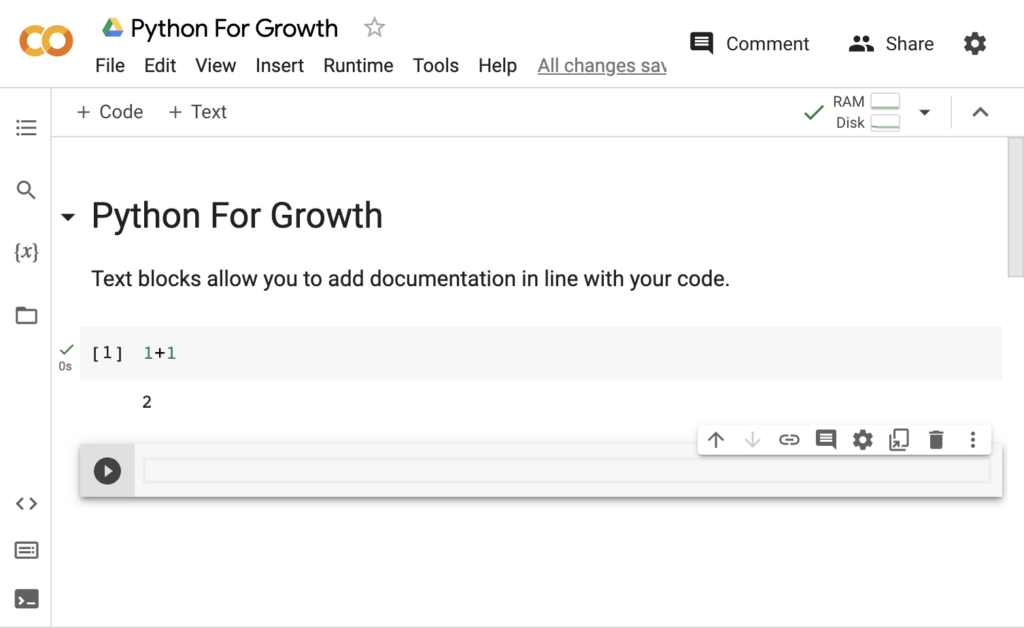
Google Colab is arguably the best starting point for marketers. It operates in the browser, requiring no installation or complex local environment setup. It functions like a digital notebook where users can combine blocks of text (for documentation) with executable code blocks.
Visual Python and AI-Assisted Coding
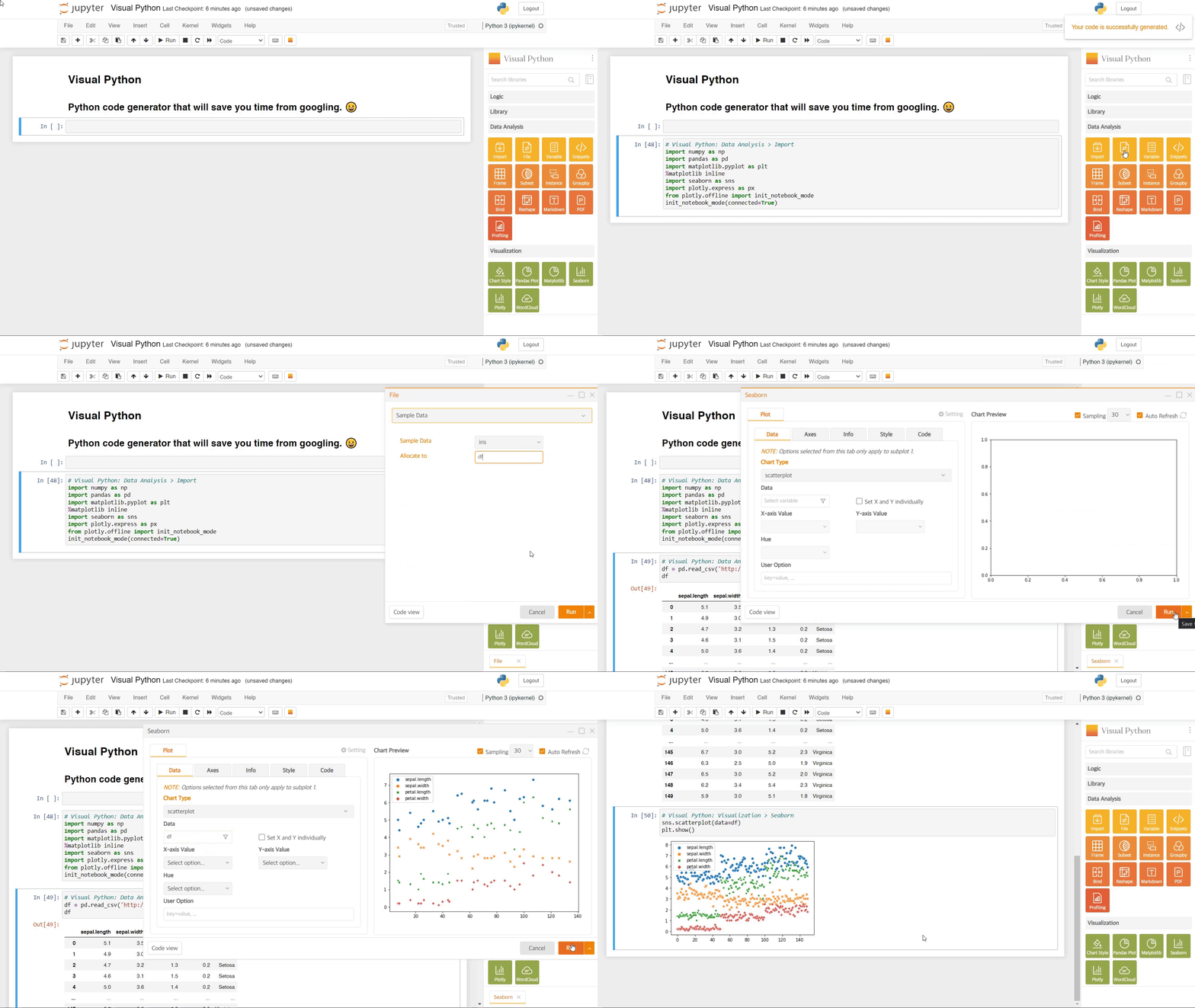
For those who prefer a more guided experience, tools like Visual Python act as an add-on for Google Colab, allowing users to generate common code blocks through a graphical interface. Additionally, the integration of advanced AI models—such as Google’s latest code-generating AI—is revolutionizing the learning curve, effectively acting as an on-demand tutor that can write, debug, and explain code in real-time.
Mito: The BI-Style Interface
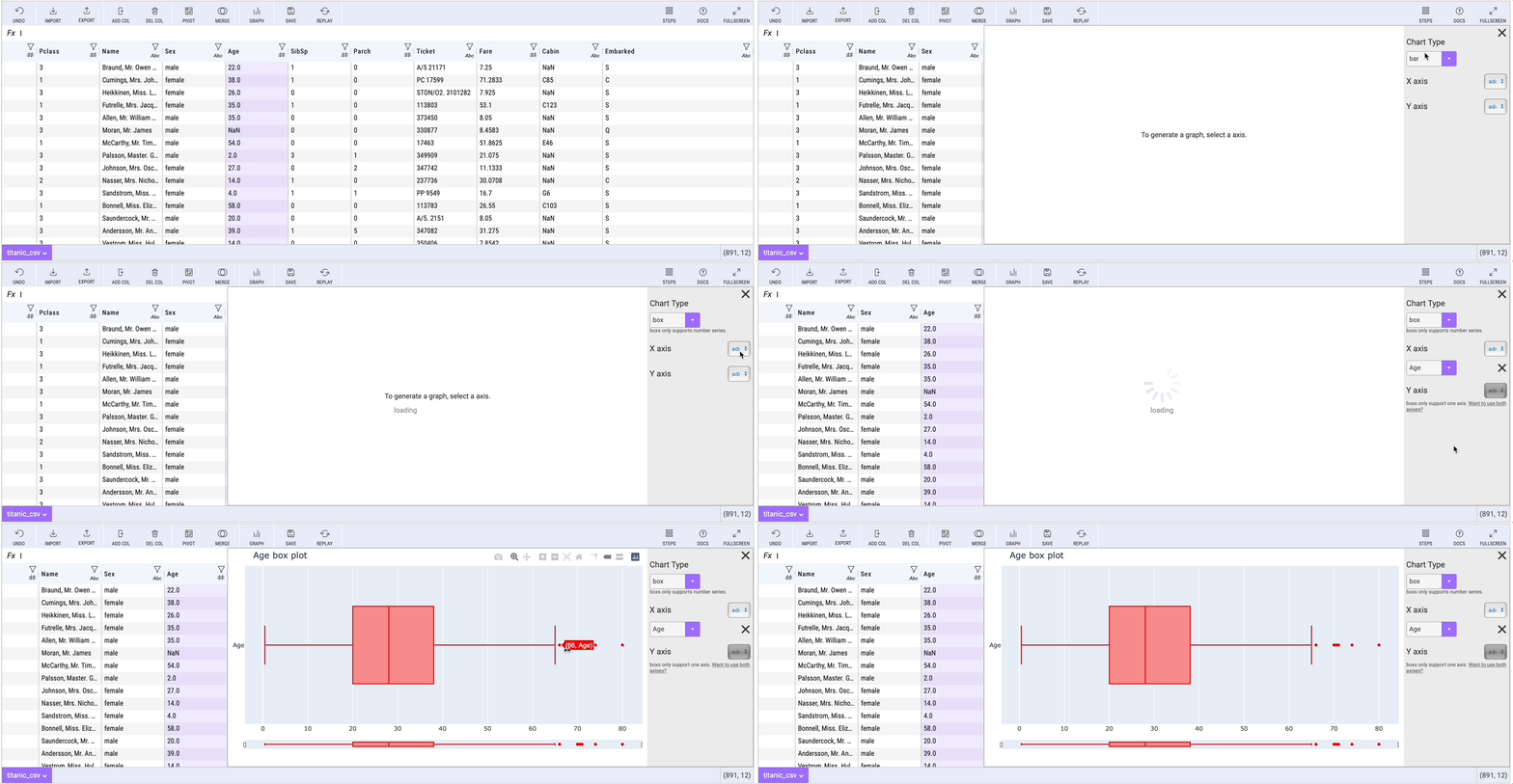
While not directly compatible with Google Colab, Mito is an excellent tool for those transitioning from BI tools like Tableau or Looker. It provides an interface that looks and feels like a spreadsheet, but as the user performs transformations and manipulations, the software automatically writes the underlying Python code. This provides a "learn-by-doing" experience that demystifies the programming aspect of data analysis.
Implications for the Future of Marketing
The integration of Python into the growth marketing stack signals a permanent shift in what is expected of a marketing professional. As the industry trends toward "Marketing Engineering," the ability to code will become a competitive advantage, much like the ability to use a CRM or a CMS was a decade ago.
The implication is clear: those who master these tools will be able to handle significantly larger volumes of data with greater speed and accuracy than their peers. They will be able to make decisions based on predictive modeling rather than reactive reporting.
Conclusion: A New Era of Growth
The journey into Python is not about becoming a software engineer; it is about reclaiming time and unlocking deeper insights. By automating the mundane, leveraging libraries to perform complex math in seconds, and using code to bridge the gap between platforms, growth marketers can move away from the screen-staring drudgery of manual data entry and toward high-level strategic planning.
The tools are ready, the community is vast, and the data is waiting. The question for the modern growth marketer is no longer "why should I learn Python?" but rather, "how much growth am I leaving on the table by not using it?"
