LOS ANGELES — As the creator economy matures from a wild-west digital frontier into a disciplined, data-driven multi-billion-dollar global industry, the rules of engagement on social video platforms are rewriting themselves almost daily. For brands, marketers, and independent creators alike, keeping pace with algorithmic shifts, changing consumer habits, and technological disruptions can feel like aiming at a moving target.
At this year’s high-profile VidCon gathering, Jill Nicholson, Chief Marketing Officer (CMO) of Tubular Labs, took the stage to pull back the curtain on these transformations. In a heavily attended presentation, Nicholson broke down key social video trends—specifically highlighting under-the-radar movements that most industry players are not yet watching—that are quietly driving the next wave of the creator economy.
Nicholson’s insights, which have now been packaged into a comprehensive research report titled “Hidden Trends & Big Moves,” dive deep into evolving patterns surrounding video duration, upload frequency, human versus AI-assisted content production, and unexpected cross-industry brand collaborations.
Main Facts: A Paradigm Shift in Social Video Strategy
The core message of Nicholson’s VidCon presentation is simple yet profound: assumptions that worked for digital video strategists even two years ago no longer apply. The modern audience’s consumption habits are fragmenting and re-aggregating based on hardware, automation, and cross-pollination between disparate niches.
Key takeaways from the report include:
Device-Driven Duration: Video length is no longer dictated solely by platform constraints (like TikTok’s former time limits or YouTube’s traditional formats), but heavily by how and where audiences are watching. Connected TVs (CTVs) are single-handedly breathing new life into long-form content well past the 20-minute mark.
The Power of Cross-Niche Collaborations: Brands are achieving exponential engagement boosts by partnering with content creators entirely outside their traditional vertical. For example, beauty giants pairing up with food and drink influencers are seeing unprecedented community response.
The AI Upload Dilemma: In sectors like gaming, the debate between human-generated content and AI-assisted output has reached a tipping point. While AI allows for a staggering volume of posts, it comes with a severe penalty in views-per-video efficiency. Creators relying on AI must output at massive scales—averaging up to four times a day—to compete with the engagement power of authentic human connection.
Chronology: How VidCon 2025 Set the Stage for the Future of Video
The unveiling of these trends at VidCon was the culmination of months of rigorous cross-platform data collection and trend analysis by the research team at Tubular Labs.
Pre-VidCon: Data Synthesis and Trend Identification
In the months leading up to the conference, Tubular Labs’ analytics engine monitored shifting viewer behaviors across YouTube, TikTok, Meta, and connected TV environments. Recognizing a disconnect between legacy marketing playbooks and the realities of 2025 consumption, Nicholson and her team began isolating anomalies—such as skincare brands exploding via food creators and massive view discrepancies among top gaming channels.
VidCon Presentation: The Unveiling
On stage in front of an audience of industry executives, creators, and platform strategists, Jill Nicholson delivered the framework that would become the “Hidden Trends & Big Moves” report. Rather than focusing on surface-level metrics like follower counts or total likes, Nicholson focused on behavioral shifts: device fragmentation, algorithmic tolerance for AI content, and the high-yield mechanics of cross-industry sponsorships.
Post-Event Release: Translating Insights into Action
Following the live session, Tubular Labs published the full research guide, opening up these under-the-radar data points to the wider marketing community. Brands and creators have since begun adopting these findings to restructure their Q4 and 2026 media plans, moving away from monolithic distribution strategies toward agile, format-agnostic campaigns.
Supporting Data: What the Numbers Tell Us
Data anchors every single trend highlighted in Nicholson’s presentation. To understand where the creator economy is heading, one must look closely at the quantitative realities behind device usage, brand partnerships, and publishing volume.
1. Length Matters: Cracking the Code to Video Duration
For years, the conventional wisdom in social video was that attention spans were shrinking, necessitating shorter, punchier clips across all channels. Nicholson’s research challenges this by proving that length matters, but device context dictates the rule.
When audiences are interacting with content via mobile devices—smartphones squeezed into vertical scrolling loops—short-form reigns supreme. However, the data reveals a massive shift when viewers transition to the living room. On connected TVs (CTVs), audiences demonstrate a distinct willingness—and eagerness—to settle in for long-form viewing experiences that extend well beyond the 20-minute mark.
The hardware dictates the psychological contract between viewer and creator. Mobile viewing is transient and interstitial; connected TV viewing is lean-back, immersive, and increasingly mirrors traditional streaming television consumption. Brands failing to tailor their video assets to the viewing screen risk misallocating budgets on formats that mismatch consumer intent.
2. Unexpected Partnerships: The Beauty and Food Convergence
One of the report’s most striking data points centers on brand sponsorships and influencer collaborations. Traditional influencer marketing relied on strict vertical alignment: a makeup brand partners with a beauty vlogger; a fitness brand partners with a gym influencer.
According to Tubular Labs’ findings, US beauty brands are breaking this mold with massive success by jumping across categories. The data shows that unexpected collaborations are consistently outperforming legacy endorsement models because they inject novelty into crowded feeds.
Real-World Case Study: Skincare and personal care giant Nivea leaned into an unexpected cross-category partnership by collaborating with food and drink TikTok creator @Onezwambola. Despite the apparent mismatch between skincare and culinary content, the partnership yielded 3X more engagements in the first seven days than traditional beauty-centric campaigns typically achieve. By tapping into an authentic, engaged community outside their silo, Nivea unlocked an entirely fresh consumer demographic.
3. Post Like a Pro: The Gaming Creator Dilemma on YouTube
In the hyper-competitive US gaming vertical on YouTube, creators face a perpetual dilemma: how often should one publish, and should they leverage artificial intelligence to scale their production?
Data analyzing the top US gaming creators paints a clear picture of the trade-offs involved in AI-assisted versus human-generated content:
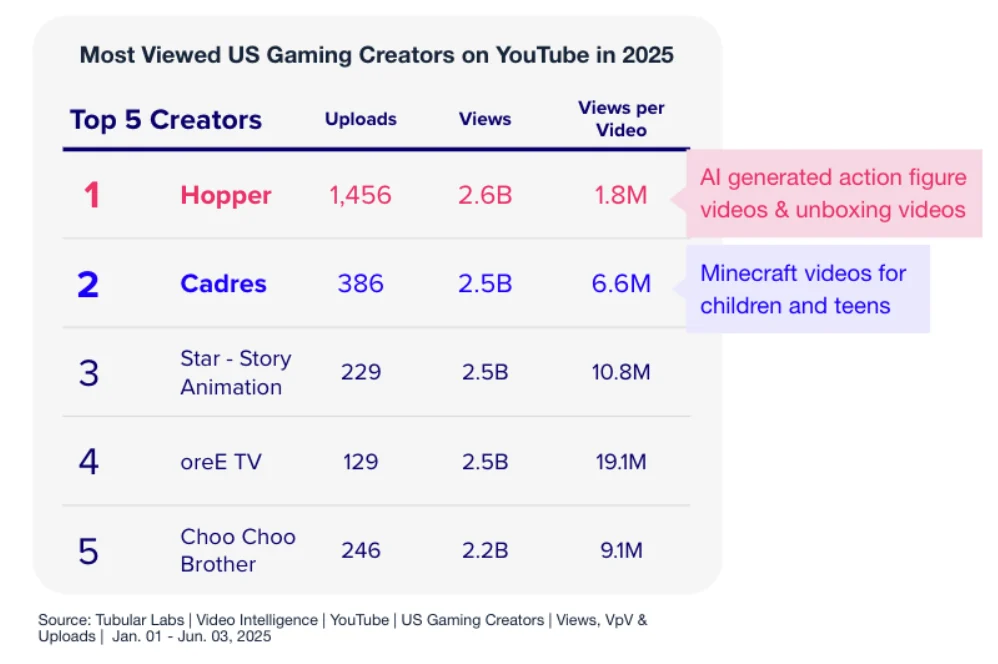
The AI Volume Play: Creators who lean heavily into AI-assisted content production can achieve astonishing aggregate view counts through sheer volume. For instance, creator Hopper leads overall views in the gaming sector largely due to an AI-accelerated upload strategy.
The Efficiency Gap: However, Hopper’s individual videos garner the lowest average views compared to his four closest competing gaming creators. The data suggests that if Hopper achieved the same average views-per-video as human-first competitor Cadres, his total view count would skyrocket from 2.6 billion to an astronomical 9.6 billion.
The Human Touch Premium: Audiences possess a sophisticated radar for authenticity. Human-generated content commands higher baseline interest, allowing creators who use it to publish less frequently without sacrificing per-video performance. Conversely, AI-assisted content suffers from lower individual engagement, forcing creators down a treadmill of high-frequency publishing to stay competitive.
The Benchmark: In the first half of 2025, the top US gaming creators—measured by both overall views and high views-per-video—averaged an astonishing 4 uploads per day to YouTube, demonstrating that scaling in the modern landscape requires either elite human stamina or aggressive technological integration.
Official Responses and Industry Perspectives
The release of the “Hidden Trends & Big Moves” report has sparked widespread discussion across the digital marketing and creator ecosystems. Industry leaders have been quick to weigh in on what Nicholson’s findings mean for the future of digital storytelling.
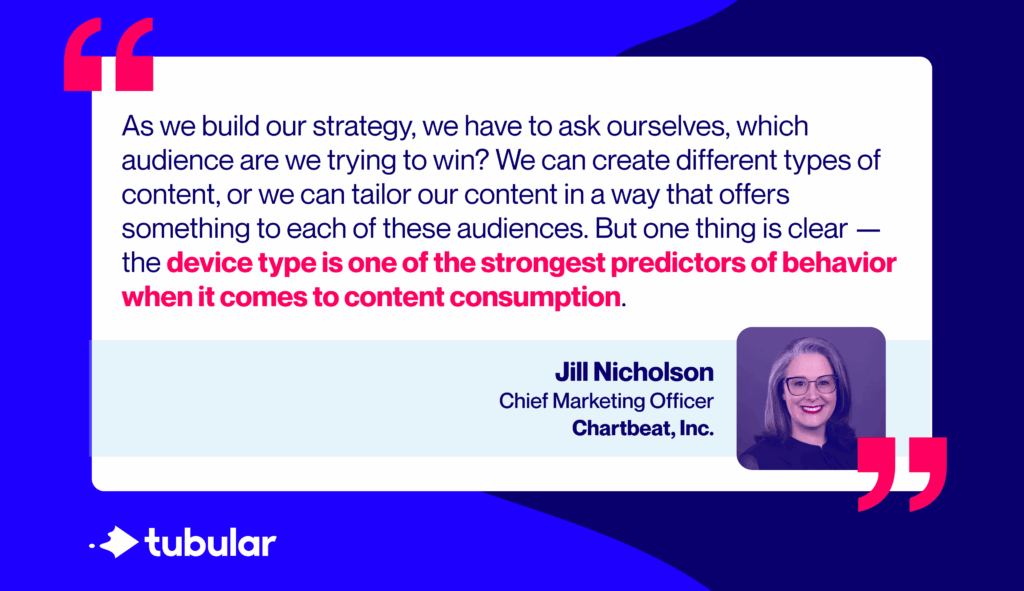
Reflecting on the motivations behind her VidCon presentation, Jill Nicholson emphasized the necessity of looking beyond vanity metrics:
"When we look at where the creator economy is heading, the biggest mistakes brands make come from treating all social video as if it lives in a single ecosystem. It doesn’t. An audience member watching a quick clip on a smartphone in a subway car is a completely different consumer than that same person kicking back on their couch watching a connected TV. If your strategy doesn’t adapt to the device, the format, and the unexpected cross-pollination of niches, you are speaking a language your audience has already tuned out."
Digital media analysts have echoed Nicholson’s sentiments, pointing out that the blurring lines between social video and traditional television are permanently altering ad spend allocations. Brand safety officers and media buyers are increasingly requesting cross-platform attribution models that account for CTV long-form viewing behavior, validating the report’s core thesis on video duration.
Implications: The Bottom Line for Brands and Creators
For brands and creators navigating the back half of the decade, the implications of Tubular Labs’ research are clear: survival and growth require moving away from guesswork and grounding strategies in verified cross-device consumer behavior.
Nicholson outlines three foundational action steps to operationalize these insights:
Format for the Screen, Not Just the Platform: Do not rely on one-size-fits-all video edits. Match short-form vertical assets to mobile scrolling habits, but aggressively invest in long-form, narrative-driven content (20+ minutes) designed specifically to capture the booming connected TV audience.
Embrace Radical Collaboration: Break out of industry silos. Seek out partnerships with creators in entirely different verticals (such as beauty meeting food, or gaming intersecting with lifestyle) to inject novelty into your campaigns and tap into unpenetrated communities.
Audit Your Production Workflow: Evaluate the true ROI of AI-assisted content. Recognize that while automation can drive volume, it often dilutes per-video engagement. If you choose the AI-scaling route, be prepared to match the publishing velocity required to sustain reach; if you focus on human-led content, prioritize depth, authenticity, and selective publishing schedules.
As the creator economy continues its relentless evolution, reports like “Hidden Trends & Big Moves” serve as vital roadmaps. For those willing to look past the obvious metrics and decode the hidden shifts in viewer behavior, the rewards will be measured in billions of views and deeper, more resilient brand loyalty.
To explore the complete data sets and read the full research guide, the complete report is available for download through Tubular Labs.