
Beyond the Speed Trap: Why the Future of Marketing is Intimacy, Not Just Automation
Saving time is not the ultimate goal of Artificial Intelligence. Spending that reclaimed time on something inherently better—something more human, more profound, and more resonant—is the real prize.
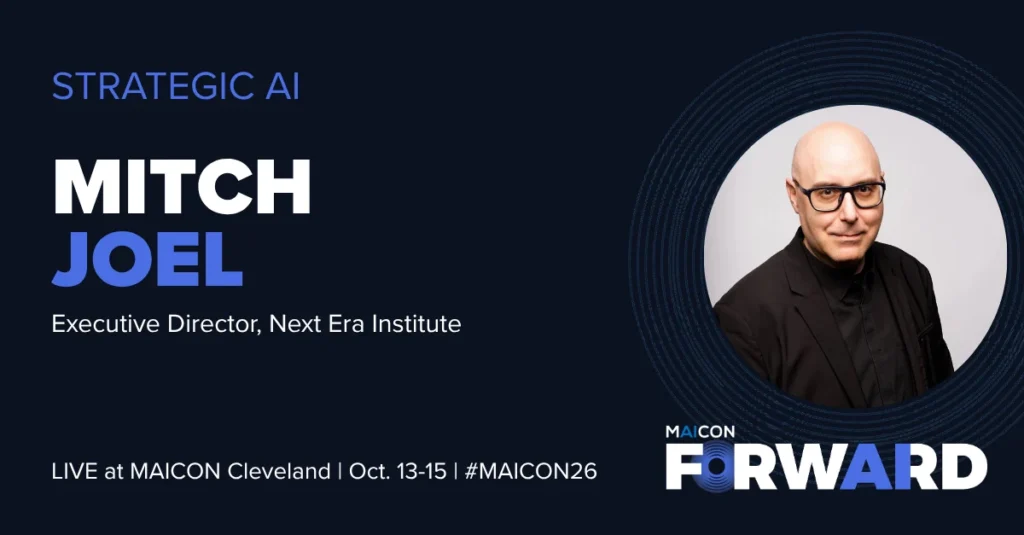
In an era where AI tools are multiplying at a dizzying pace and the corporate mandate to "adopt or perish" has become a boardroom mantra, many marketing leaders find themselves running faster than ever before. But as Mitch Joel, Executive Director of the Next Era Institute and a veteran of three decades in digital marketing, sagely warns: speed without direction is merely a faster way to get lost.
As the industry prepares for MAICON 2026, Joel is positioning himself to challenge the status quo. His upcoming keynote, "Marketing Forward," is not a technical manual for prompt engineering; it is a strategic manifesto for leaders ready to abandon the outdated rules of the Attention Economy and embrace a new, more intimate paradigm.
The Shift: From the Attention Economy to the Intimacy Economy
To understand where marketing is going, one must first diagnose where it has been. For the better part of the last three decades, the digital landscape has been defined by the "Attention Economy." It was a world of reach, noise, and volume. Success was measured by clicks, impressions, and the sheer ability to shout louder than the competitor. It was a one-to-many communication model—a broadcast era that prioritized breadth over depth.
"We are witnessing a structural transition," Joel explains. "We are moving out of the Attention Economy and into the Intimacy Economy. This new era is defined not by how many people you can reach, but by the relevance, connection, and meaning you can foster within those interactions."
AI, in this context, acts as the great disruptor of the broadcast model. It allows for a "one-to-X" world, where a brand can communicate at scale while ensuring that every single interaction feels intensely contextual, relevant, and individual. According to Joel, the greatest opportunity of the modern era is not the generation of "infinite content," but the creation of "infinite context."
The Productivity Trap: Why Most Marketers Are Doing It Wrong
A significant portion of Joel’s message centers on the "productivity trap." He observes that the most common mistake marketing leaders make today is treating AI as a mere accelerator for the status quo. They use generative AI to produce more blog posts, more social media updates, and more email campaigns at a lower cost and higher speed.
"If you use AI to do the same things you were doing before, only faster, you are simply accelerating the creation of noise," Joel argues. "The old playbook was designed for mass distribution. When you apply AI to that same playbook, you aren’t innovating; you are just scaling the volume of content that people are already tuning out."
Joel challenges leaders to move beyond the metrics of output. Instead of asking, "How many pieces of content can we produce today?" the strategic question should be: "What can we now understand, create, or deliver for the customer that was not previously possible?"
A Framework for What’s Next: The Tale of Three Cities
Recognizing that the rapid pace of technological change can lead to "innovation paralysis," Joel has developed a structured approach to navigate the landscape. He introduces the "Tale of Three Cities," a conceptual framework that categorizes how AI is fundamentally reshaping the marketing environment:
- The Intelligent City: This represents the shift toward data-driven decision-making where AI systems identify patterns and insights that were previously invisible to human analysts.
- The Intimate City: This is the heart of the new economy, where brands use AI to curate experiences that feel hyper-personalized and deeply relevant to the individual user.
- The Integrated City: This dimension focuses on the seamless connection between the brand’s backend infrastructure and the customer-facing experience, ensuring that every touchpoint is informed by the totality of the customer’s journey.
Anchoring these cities is the P.A.C.E. framework, which Joel will unveil in detail at MAICON 2026. Designed as a durable compass for marketing leaders, P.A.C.E. provides a consistent methodology for evaluating emerging technologies. Regardless of whether a new tool or platform dominates the news cycle, the P.A.C.E. framework allows leaders to assess its long-term viability and strategic alignment, ensuring that technology choices are driven by business value rather than the "shiny object" syndrome.
Implications for the Modern CMO
The implications of Joel’s philosophy are profound. For the modern Chief Marketing Officer, it necessitates a shift in talent acquisition and team structure. The marketing team of the future requires less emphasis on pure content production volume and more emphasis on data literacy, ethical AI stewardship, and experience design.
When speed is no longer the primary strategy, direction becomes the primary asset. Leaders must be willing to sacrifice short-term "hacks" in favor of building long-term, scalable intimacy. This requires a fundamental change in corporate culture, shifting the focus from "doing more" to "being more relevant."
Furthermore, the rise of the Intimacy Economy places a premium on data quality and privacy. If a brand intends to provide "infinite context," it must earn the right to know its customer through transparent and value-driven data exchanges. This is not just a technological challenge; it is a brand-trust challenge.
Preparing for MAICON 2026
As part of the MAICON 2026 lineup, Joel’s session is aimed at an audience that is past the "what is AI" stage and deep into the "how do we lead with AI" stage. His expertise is bolstered by his long-running business podcast, Thinking With Mitch Joel, and his decades of experience in digital transformation.
Attendees can expect a session that moves away from the hype and toward the granular reality of implementation. The goal is to leave the main stage with a mental model that is as useful today as it will be in five years.
"Technology will keep changing," Joel notes. "The tools we use at MAICON 2026 may be replaced by something else by 2027. That is why we don’t build our strategies around the tools. We build them around the principles of human connection and value creation. The framework I’m sharing is designed to last because it focuses on the constants of human behavior rather than the variables of software versioning."
Conclusion: Designing for Resonance
The transition to the Intimacy Economy is not optional; it is the natural evolution of a digital world that has reached the point of content saturation. Consumers have grown adept at filtering out noise. The brands that win will be those that use AI to cut through that noise not by shouting louder, but by speaking directly to the context, needs, and desires of the individual.
As marketing leaders look toward the future, the mandate is clear: Stop optimizing for the machine and start optimizing for the human. By shifting the focus from "saving time" to "investing time," leaders can transform their marketing efforts from a cycle of endless production into a cycle of genuine, sustainable connection.
For those ready to move past the noise and find true direction, MAICON 2026 serves as the definitive gathering place. Whether you are a CMO navigating the complexities of digital transformation or a strategist looking to future-proof your career, the insights shared by leaders like Mitch Joel will be essential for building a brand that is both legible to machines and resonant with humans.
Join the conversation at MAICON 2026. The future of marketing is not about doing more; it is about doing better. Registration is now open for those who are ready to redefine what "success" looks like in an AI-powered world.
