
The Erosion of the Apprentice Model: How AI is Redefining Professional Development
By [Your Name/Journalistic Staff]
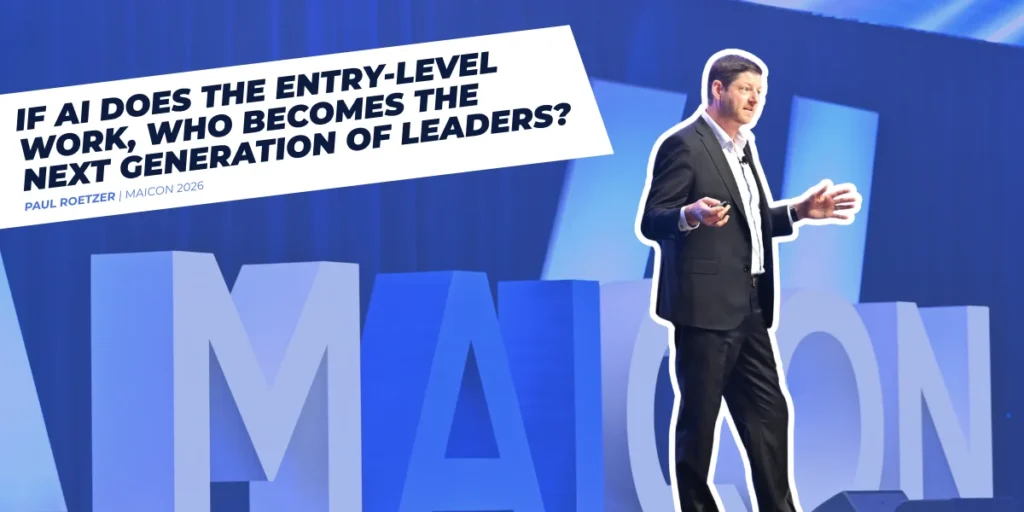
At the dawn of the 21st century, the path to professional mastery was defined by "paying one’s dues." For junior employees, this meant long nights drafting press releases, synthesizing research reports, and managing the granular, repetitive tasks that served as the bedrock of organizational knowledge. However, the keynote address at MAICON 2026, delivered by Paul Roetzer, founder and CEO of SmarterX, has effectively sounded the death knell for this traditional model of career progression.
In a candid opening statement that resonated through the halls of the conference, Roetzer offered a provocative admission: "Had ChatGPT existed in 2000, I likely never would have gotten my start in marketing." This statement was not a lament, but a stark warning. As artificial intelligence advances to perform complex cognitive tasks with superhuman speed, the foundational "grunt work" that once trained the next generation of experts is being automated away.
The central question now facing leaders across every industry is no longer "What can AI do?" but rather, "If AI performs the tasks that people once learned from, how will organizations develop future managers, experts, and executives?"
The Death of the Apprentice Model: A Chronology of Disruption
To understand the urgency of Roetzer’s message, one must look at the historical trajectory of professional development. For decades, the apprenticeship model has been the gold standard. A law firm associate spends their first three years conducting legal research and drafting motions—tasks that teach them the nuances of case law. A marketing coordinator spends their early career crafting media pitches and analyzing data sets, learning the "voice" of the industry.
The Shift Toward Automation (2022–2026)
- Late 2022: The public release of generative AI tools signaled a turning point, moving from simple predictive text to complex content generation.
- 2024: Organizations began integrating AI into middle-management workflows, focusing on productivity gains and cost-cutting.
- 2026 (The Current State): We have entered the era of the "A-player machine." AI systems now consistently produce high-level strategy, research, and creative assets that match or exceed the output of human professionals with years of experience.
The friction point today is that the "bottom of the pyramid"—the junior-level roles—is being hollowed out. If a software company can use AI to write, debug, and document code, where do the junior developers gain the "scars" and experience necessary to eventually become senior architects?
Supporting Data: The Speed of the AI Takeover
Roetzer’s argument is backed by a shift in productivity metrics that is catching many firms off guard. He posits that within the next 12 months, AI will consistently perform at an "A-player level" on tasks that previously required a qualified expert five or more hours to complete.
Consider the implications for high-stakes industries like law, consulting, and finance:
- The Time-to-Expertise Gap: If an AI can summarize 500 pages of discovery documents in 30 seconds, the junior associate who spent a week doing it loses a critical learning opportunity.
- Quality Parity: Data from early adopters suggests that AI-generated proposals and reports are now achieving a 90% "first-pass" success rate, requiring only minor human intervention.
- Economic Pressure: Firms are under immense pressure to reduce headcount to maintain margins as AI lowers the cost of production. However, this creates a "talent cliff"—if you stop hiring juniors today, you will have no senior leaders in ten years.
When a partner at a prominent law firm asked Roetzer if they should stop hiring junior associates because AI could do their work, Roetzer’s response was chillingly simple: "Who will your partners be in ten years?"
The Framework: The Architect, The Orchestrator, and The Apprentice
Roetzer’s keynote focused on a new framework designed to replace the broken traditional model. He identifies three distinct roles that will define the future of work in the AI era.
1. The Architect
The Architect is the individual who designs the systems, prompts, and workflows. They do not necessarily perform the task; they build the machine that performs the task. They are the keepers of institutional knowledge, ensuring that the AI’s output aligns with the company’s brand voice, ethical standards, and long-term strategy.
2. The Orchestrator
The Orchestrator is the manager of the AI ecosystem. They understand which tools to plug into which workflows. They are responsible for the integration of disparate AI agents and for managing the human-AI interface. Their skill lies in "AI literacy"—the ability to know when to trust the machine and when to intervene.
3. The Apprentice (Reimagined)
The third role is the most controversial. If the traditional apprenticeship is dead, how do we train the next generation? Roetzer suggests that the new apprentice must be trained in "AI-augmented critical thinking." Instead of learning through repetitive manual tasks, the apprentice must learn through reviewing and editing AI output. They will be "editors-in-chief" from day one, learning by critiquing and refining the work generated by machines.
Official Responses and Industry Implications
The reaction to Roetzer’s thesis at MAICON 2026 has been a mixture of existential dread and strategic excitement. Industry leaders are beginning to realize that the "productivity" argument is a double-edged sword.
"We have been so focused on how AI makes us faster," one attendee noted during a breakout session, "that we haven’t stopped to consider that we are cannibalizing our own bench strength."
Organizational Implications:
- Mentorship Reimagined: Senior leadership must shift from assigning tasks to facilitating simulations. If juniors aren’t doing the real work, they must be given "sandbox" environments where they can make mistakes and learn without risking client deliverables.
- The Valuation of Judgment: As the cost of production approaches zero, the value of judgment—the human ability to decide what is "good," "true," and "ethical"—skyrockets. Educational systems and corporate training must pivot toward philosophy, ethics, and strategic decision-making.
- Retention Challenges: If junior employees feel their work is being replaced by bots, they may become disengaged. Companies must communicate a clear path for growth that involves becoming an "Architect" or "Orchestrator" rather than just a "doer."
Looking Ahead: A Call to Action
Roetzer was clear during his address that his goal was not to prove his framework as an absolute, but to demonstrate that the status quo is fundamentally broken. The traditional hierarchical climb, based on years of repetitive labor, is incompatible with the exponential nature of AI advancement.
The challenge for the modern executive is to construct a new career ladder. This ladder must prioritize the acquisition of "AI-native" skills, where a junior professional’s value is measured not by how many hours they spend in a spreadsheet, but by the quality of the prompts they craft and the integrity of the results they verify.
As organizations move toward 2027, the firms that will survive are not necessarily those that adopt the most AI, but those that solve the "apprenticeship paradox." We are moving toward a future where the ability to lead, curate, and direct machines will be the most sought-after skill in the global economy.
For those who started their careers in the "old way," the transition will be painful. But for those willing to rethink the very nature of what it means to be a professional, the era of the Architect and the Orchestrator offers a chance to solve problems that were previously beyond our reach.
Further Resources
- For a deeper dive into the transition, Paul Roetzer’s full keynote from MAICON 2026 is available for viewing on the Marketing AI Institute’s YouTube channel.
- To access the full library of insights from the conference, including over 20 featured sessions, interested professionals can explore the MAICON 2026 On-Demand Package.
Cathy McPhillips, Chief Marketing Officer at SmarterX and the Marketing AI Institute, contributed to the analysis of these findings.
