

The Double-Edged Sword of AI Discovery: Why Chatbots Are Talking Consumers Out of Purchases
By Constantine von Hoffman
Senior Editor, MarTech
Artificial intelligence has officially transformed from a novelty into a powerful commercial gatekeeper. For years, digital marketers have obsessed over how to get their products recommended by algorithms, optimize their content for large language models (LLMs), and secure top-tier visibility in conversational search results.
However, a revealing new study from Semrush shifts the conversation from mere visibility to brand vulnerability. According to a survey of 2,338 U.S. adults, more than half of consumers who use AI have ultimately decided not to buy a product based on information provided by a chatbot. Among core online shoppers who actively use AI during their purchasing journeys, that rejection rate skyrockets to an astonishing 81%.
This data exposes an uncomfortable reality for modern marketers: while generative AI can successfully introduce a brand to a prospective buyer, it possesses an equal and opposite power to talk that exact same buyer right out of the sale. As shoppers increasingly bypass traditional discovery paths in favor of conversational guidance, brands must confront a complex new marketing ecosystem where visibility no longer guarantees conversion.
Main Facts: The AI Conversion Paradox
The Semrush study highlights a deep paradox at the heart of AI-driven commerce. Chatbots are undeniably effective at top-of-funnel brand discovery, but their objective, synthesized nature means they do not coddle brands.
Key takeaways from the research include:
- The High Cost of Rejection: More than 50% of general AI users—and nearly 81% of frequent AI shopping users—have chosen against making a purchase because of chatbot guidance.
- Equal Influence in Both Directions: Exactly 58% of AI users report having bought a product recommended by a chatbot, while the exact same percentage (58%) have decided against a purchase based on AI-derived insights. For heavy AI users (those engaging multiple times a week), purchase adoption jumps to over 80%, but the scrutiny increases proportionally.
- The Peril of Mixed Reviews: When a chatbot surfaces mixed or negative consumer reviews, more than 74% of all consumers are less likely to buy. Among dedicated AI users, that sensitivity climbs above 85%.
- Discovery vs. Deterrence: While nearly 59% of AI users have discovered a novel brand or product through chatbot recommendations, roughly 71% simultaneously believe that chatbots are capable of pinpointing the absolute best brands and products on the market.
In short, AI acts as a revolving door for modern retail: it can effortlessly pull your product onto a consumer’s shortlist, only to hand them the precise critical data that knocks it right back off.
Chronology: How Conversational Search Entered the Buyer’s Journey
To understand how we arrived at this precarious juncture, it is helpful to trace the rapid evolution of consumer research habits over the past several years.
Phase 1: The Monopolization of Traditional Search
For decades, the consumer purchase journey followed a predictable, linear path anchored by search engines (predominantly Google), e-commerce marketplaces (like Amazon), and peer reviews. Brands spent billions mastering Search Engine Optimization (SEO) and Pay-Per-Click (PPC) advertising to capture intent at the exact moment of search. Search was transactional, keyword-driven, and heavily reliant on user navigation across multiple browser tabs.
Phase 2: The GenAI Explosion and Chatbot Adoption
With the explosive public rollout of generative AI tools and conversational assistants, consumer behavior underwent a seismic shift. Rather than sifting through pages of blue links, consumers began asking complex, contextual questions: “What is the best mid-range laptop for video editing that won’t overheat?” or “Compare brand X and brand Y for durability.”
According to the Semrush data, 29% of all consumers now use AI chatbots specifically for product research. Among weekly or daily AI power users, that figure jumps to 55%. Among this highly engaged demographic, chatbots have officially surpassed friends, family, social media platforms, retail websites, and YouTube as a preferred product research tool.
Phase 3: The Multi-Channel Reality
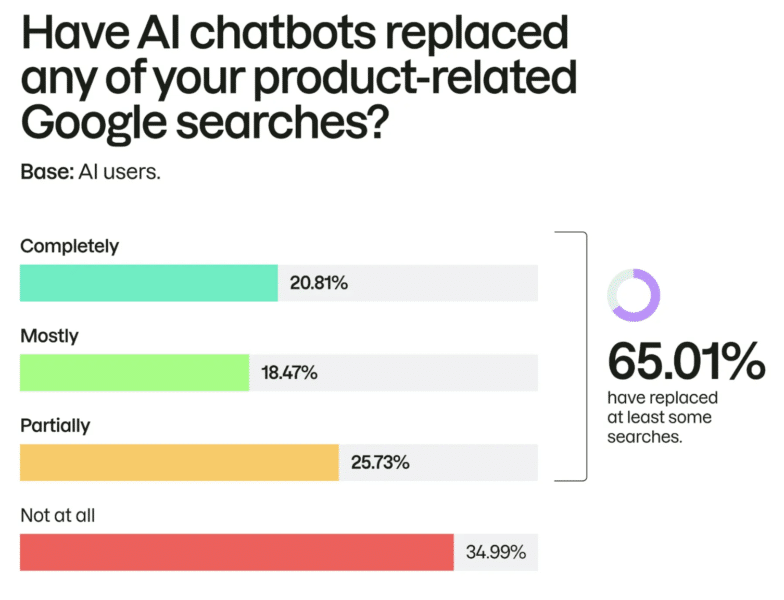
Crucially, the rise of AI has not meant the immediate death of traditional Google searches. While 65% of AI users claim chatbots have replaced at least some of their product-related Google searches, nearly half report that their overall Google usage for purchase research hasn’t changed over the past year.

Marketers are not witnessing a zero-sum channel replacement; rather, they are navigating a bloated, multi-channel discovery matrix. Today’s shopper dynamically bounces between Google, specialized review forums, brand websites, and AI assistants during a single purchase cycle, creating countless new micro-moments where a brand can either win consideration or lose it forever.
Supporting Data: The Anatomy of Consumer Trust and Skepticism
The mechanics behind why consumers abandon purchases after consulting AI point directly to the nature of algorithmic synthesis. Chatbots do not have brand loyalty; they aggregate web data, specifications, pricing matrices, and—most importantly—user sentiment.
The Amplification of Negative Sentiment
Consumers trust AI to be impartial, which makes negative information hit harder. When a user asks a chatbot about product flaws, the AI compiles complaints from Reddit threads, review sites, and forums in seconds.
- 74% of all consumers are deterred by mixed or negative reviews surfaced by AI.
- 85% of AI users share this hesitation, indicating that high-frequency AI users are even more reliant on aggregated sentiment analysis to vet purchases.
The Ad-Trust Dilemma
Faced with this loss of control, some marketers have gravitated toward an obvious solution: buying advertising space directly inside AI chatbot interfaces. However, the data suggests this strategy is fraught with risk.
- 42% of consumers actively dislike chatbot advertisements.
- Only 20% view them favorably, while 38% remain neutral.
- Most alarmingly, 66% of consumers who dislike chatbot ads report that the presence of advertising actively makes them question the integrity and objectivity of the AI’s underlying responses.
Marketers can pay for top-of-funnel visibility through sponsored AI placements, but they cannot buy their way past the chatbot’s algorithmic evaluation when a user asks a nuanced comparison question.
Official Responses and Expert Insights
Industry analysts and search experts have been quick to weigh in on the implications of the Semrush findings, emphasizing that standard SEO playbooks are no longer sufficient in an AI-dominated search landscape.
"You can pay to put your brand in front of someone, but you can’t buy the answer they get when they ask how your product compares with a competitor, whether customers have had problems with it, or whether it’s worth the price," notes the Semrush study analysis. Consumers are no longer just asking AI what to buy; they are conducting deep character assassinations on brands to decide whether they should buy from them at all.
MarTech experts point out that the traditional metrics of campaign measurement are lagging far behind actual media consumption. As highlighted in related industry studies by organizations like the IAB, advertisers are spending heavily to adapt to AI-driven discovery, yet their ability to measure and attribute value across these fragmented, non-linear customer journeys remains severely impaired. Furthermore, internal corporate data hygiene—such as messy CRM data and inconsistent product descriptions—frequently feeds bad information to LLMs, compounding the problem from the inside out.
Implications for Marketers: Surviving the Age of Generative Scrutiny
The reality revealed by Semrush’s research demands a fundamental paradigm shift in digital marketing strategies. To thrive in an environment where AI can talk customers out of purchases with a single synthesized paragraph, brands must adapt across several critical fronts:
1. Shift from "Keyword Visibility" to "Reputation Engineering"
Ranking first in a traditional search engine results page (SERP) is no longer the ultimate finish line. Because AI synthesizes the collective web consensus, brand reputation across third-party review sites, forums, and Reddit carries more weight than ever. Marketers must actively monitor, manage, and remediate customer friction points across the entire digital ecosystem, knowing that a poorly handled customer service complaint online will eventually be fed directly to a high-intent buyer by an AI assistant.
2. Radical Product Transparency
AI excels at uncovering specifications, pricing discrepancies, and comparative weaknesses. Trying to hide product limitations or relying on vague marketing fluff is a losing strategy, as LLMs are explicitly designed to cut through marketing language to find objective truths. Brands must lean into radical transparency, clearly communicating use cases, limitations, and honest value propositions so that when an AI evaluates the product, it does so against accurate, favorable parameters.
3. Rethinking Paid Media in Conversational Spaces
Because intrusive ads inside chatbots trigger skepticism and degrade trust in AI responses, brands must approach conversational advertising with extreme caution. Instead of heavy-handed promotional banners, the focus must shift toward native, helpful integration—ensuring that sponsored or recommended content genuinely aligns with the user’s explicit intent rather than feeling like an aggressive interruption.

4. Fixing the Data Foundation
Marketers cannot successfully influence AI perception if their own internal data is flawed. Disconnected reporting, outdated product catalogs, and poor CRM data hygiene directly feed inaccurate or incomplete information into the public domain where LLMs gather their training data. Ensuring pristine, structured data across all digital touchpoints is now a core requirement for brand survival.
Conclusion
The rise of generative AI in retail has created a high-stakes arena where the rules of engagement are rewritten daily. Semrush’s data makes it unequivocally clear: AI is not just a new channel for driving traffic; it is an independent, highly influential advisor sitting between the consumer and the brand.
For marketers, the challenge ahead is clear. Success no longer belongs solely to those who make the loudest noise or secure the highest ad placement. It belongs to the brands that can withstand rigorous algorithmic scrutiny, maintain stellar public reputations, and prove their true value when a consumer asks an AI assistant the ultimate question: “Is this brand actually worth my money?”
