
The Agentic Enterprise Unveiled: Inside Salesforce’s Grand Vision at Dreamforce 2026
At Dreamforce 2026, enterprise software giant Salesforce delivered its most cohesive and ambitious roadmap to date: the blueprint for the “agentic enterprise.” Moving away from the siloed, application-centric paradigms of the past—where sales, service, and marketing operated as distinct software islands—Salesforce has unified its entire portfolio under a single, data-driven architecture centered on logic and autonomous AI agents.
This transformation marks a profound evolution in how businesses interact with software. Rather than forcing human users to manually click through traditional graphical user interfaces (GUIs), Salesforce’s new paradigm empowers autonomous digital workers to execute complex, cross-functional workflows seamlessly. As the enterprise technology landscape pivots aggressively toward artificial intelligence, Dreamforce 2026 served as Salesforce’s definitive statement that the future of enterprise software is not about managing applications; it is about orchestrating outcomes through intelligent agents.
Main Facts: The Four-Layer Architecture of the Future
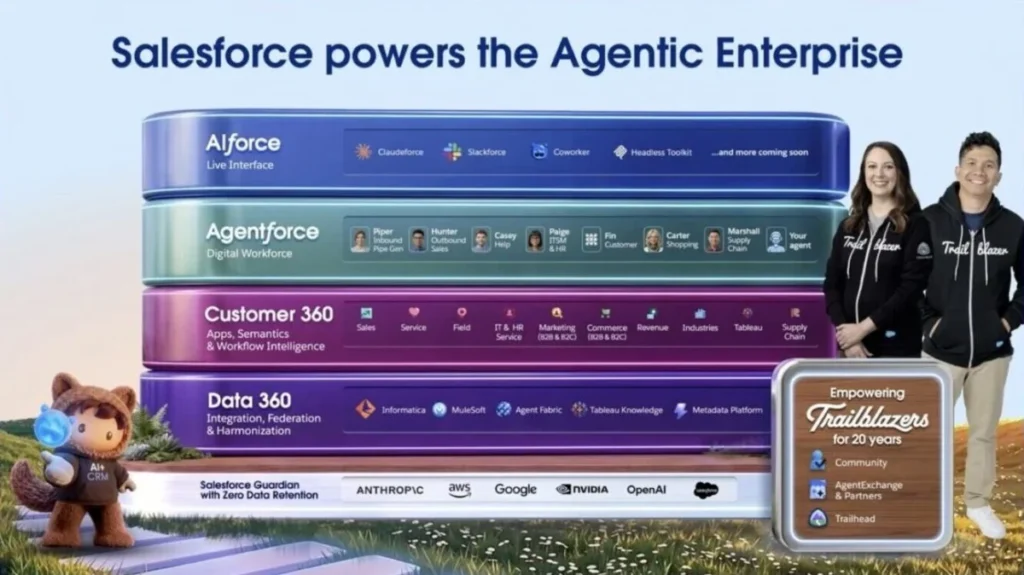
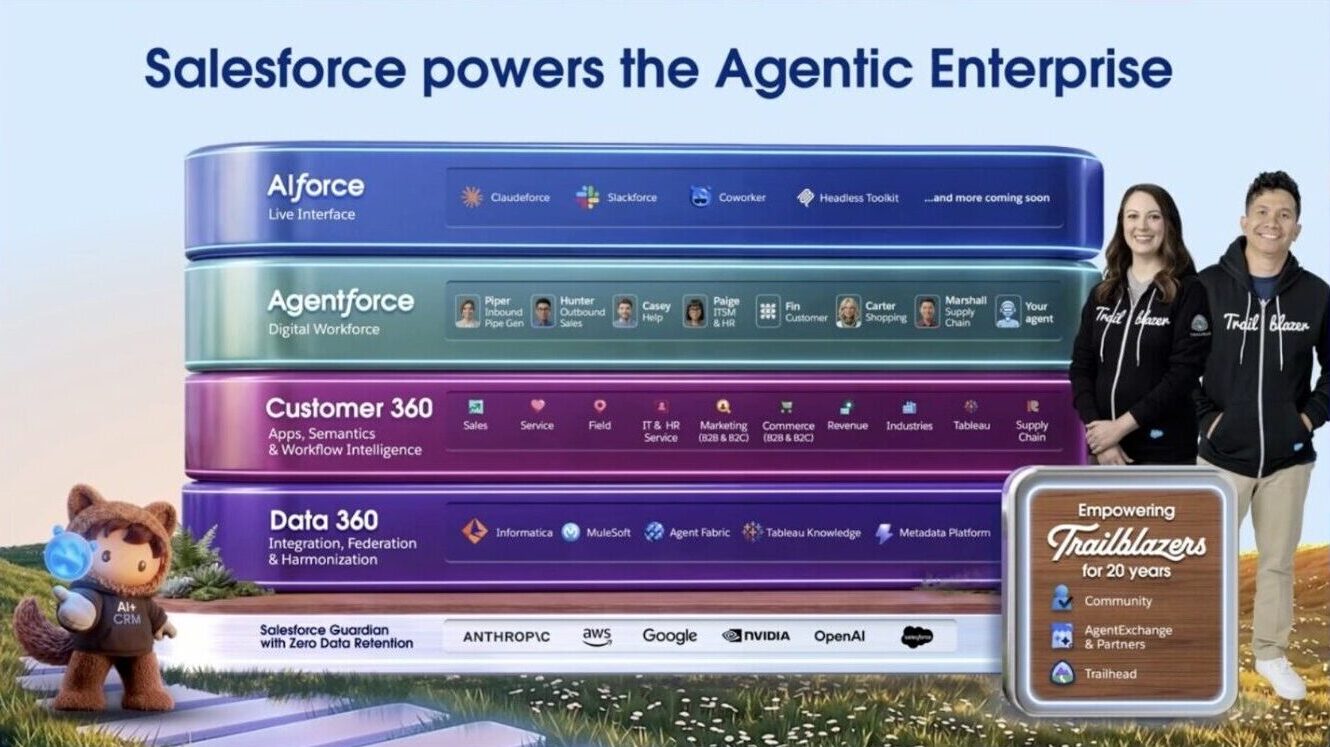
At the core of Salesforce’s announcements is a complete restructuring of its technology stack into four integrated layers, designed to bridge legacy CRM infrastructure with next-generation artificial intelligence:
- AIforce (The User Experience Layer): Expanding far beyond the traditional Salesforce GUI and its native Lightning experience, AIforce introduces a headless architecture that exposes Salesforce capabilities via APIs, Model Context Protocol (MCP) tools, and command-line interfaces. It allows enterprise data and business logic to be surfaced directly inside external environments like Slack and Anthropic’s Claude.
- Agentforce (The Agentic Layer): Featuring autonomous digital agents such as Hunter for sales and Casey for service, Agentforce enables organizations to deploy task-oriented AI entities capable of completing complex, multi-step workflows across traditional application boundaries.
- Customer 360 (The Workflow Layer): The foundational suite of familiar CRM applications spanning sales, service, marketing, and commerce, now heavily refactored to interface directly with autonomous agents and unified data streams.
- Data 360 (The Data Layer): A robust integration layer that unifies structured and unstructured enterprise data, ensuring that both human workers and AI agents operate from a single, trusted source of truth.
Furthermore, Salesforce introduced Koa, its first CRM-specific reasoning model developed in partnership with NVIDIA. Tailored specifically for complex enterprise logic—such as opportunity management, automated case routing, and policy-guided decision-making—Koa proves that the future of enterprise AI will rely on domain-specific reasoning models alongside general-purpose foundation models.
Chronology: From Isolated Apps to Autonomous Ecosystems
To understand the magnitude of Salesforce’s 2026 announcement, one must look at the strategic timeline that paved the way for the agentic enterprise.
- The Application Era (Pre-2020s): Salesforce grew into a dominant market force by acquiring and scaling specialized cloud applications for sales, marketing, and customer service. While highly successful, these apps often functioned as independent data silos.
- The Integration and Collaboration Foundation (2020–2024): Recognizing the need for unified data and team communication, Salesforce made monumental acquisitions—most notably acquiring integration powerhouse MuleSoft and workplace collaboration hub Slack. During this period, the company also laid the groundwork for advanced data virtualization.
- The GenAI Gold Rush (2023–2025): As generative AI disrupted the tech sector, initial corporate responses focused on basic chatbots and writing assistants. Salesforce introduced early iterations of Einstein AI, experimenting with prompt engineering embedded inside traditional CRM workflows.
- Dreamforce 2025 (The Agentic Pivot): Salesforce began previewing early concepts of autonomous agents, signaling a transition from human-driven software navigation to goal-driven agentic orchestration.
- Dreamforce 2026 (The Unified Vision): Salesforce formally unveiled its comprehensive four-layer architecture (AIforce, Agentforce, Customer 360, and Data 360), bundled new pricing tiers, integrated specialized reasoning models like Koa, and elevated Slack into a multiplayer AI workspace.
Supporting Data, Acquisitions, and Ecosystem Expansion
Salesforce’s grand vision is heavily backed by an aggressive mergers-and-acquisitions strategy designed to plug critical capability gaps in its core CRM footprint. Recent acquisitions highlighted at Dreamforce include:
- Fin: Strengthening automated customer self-service capabilities.
- Qualified: Enhancing conversational marketing and automated sales pipeline generation.
- Contentful: Bringing advanced content management systems into the fold.
- Momentum: Fortifying revenue orchestration workflows.
While these acquired technologies will remain standalone products for the foreseeable future, they add immense technical depth to Salesforce’s overarching platform.
Concurrently, the partner and consultancy ecosystem played a starring role at Dreamforce 2026. Global system integrators and consultancies shared the main stage to emphasize that technology deployment is only half the battle. Creating genuine customer value requires a radical redesign of enterprise work processes, proving that the human partner ecosystem remains an indispensable catalyst for agentic transformation.
On the financial front, Salesforce rolled out simplified pricing structures through its new Core, Advanced, and Max editions. These bundles integrate AI capabilities, Slack workspaces, analytics, security, and Flex Credits into unified purchasing frameworks designed to eliminate adoption friction and accelerate experimentation.
Official Responses and Industry Perspectives
Salesforce executives positioned the 2026 announcements as a fundamental liberation of enterprise data from rigid user interfaces. By decoupling business logic from the traditional Salesforce UI, the company aims to meet users wherever they work—whether that is inside native Lightning, via command-line interfaces, or deeply embedded in collaborative platforms.
The strategic elevation of Slack as a "multiplayer" AI environment was a major talking point. During the Slack keynote, Boris Cherny, creator and head of Claude Code, shared a striking metric: approximately 90% of his daily coding occurs directly inside Slack. By utilizing collaborative channels, multiple human users and AI agents can work simultaneously within a shared, persistent context—a concept Salesforce calls "multiplayer AI."
Industry analysts and advisory firms, such as Forrester, have praised Salesforce for developing one of the most coherent and comprehensive architectural visions in the enterprise software space. By combining past investments in MuleSoft, Slack, and data management frameworks, Salesforce has assembled the foundational building blocks required for a true agentic platform. However, industry experts also sound notes of caution, urging enterprise buyers to look closely beneath the glossy surface of keynote presentations.
Implications and Strategic Challenges for Enterprise Buyers
Despite the technical brilliance of Salesforce’s vision, the transition to an agentic enterprise introduces complex challenges that IT leaders, Chief Information Security Officers (CISOs), and procurement teams must navigate carefully.
1. Integration and Architectural Legacy
Organizations must carefully evaluate how their existing investments in legacy applications map onto Salesforce’s new architecture. For instance, enterprises utilizing legacy Marketing Cloud modules—such as Personalization (Evergage), Marketing Cloud Intelligence (Datorama), and Loyalty Management—face lingering questions regarding how smoothly these disparate tools will transition into the unified Data 360 and Agentforce framework. Early adopters must construct tactical transition roadmaps to avoid getting stranded in technical debt.
2. The Complexities of Multiplayer AI Governance
While multiplayer AI in Slack offers unprecedented levels of team collaboration and efficiency, it also shatters traditional perimeter controls. When multiple human users and autonomous AI agents interact concurrently within shared channels, data governance becomes exceedingly complex. Who has authorization to trigger an agent that executes financial transactions? What happens when conflicting permissions collide? IT administrators are strongly advised to test these environments rigorously in sandbox settings before granting organization-wide access.
3. Financial Realities: Choice Does Not Equal Cost Reduction
Salesforce’s new Core, Advanced, and Max pricing tiers simplify software procurement by bundling AI, analytics, and Flex Credits together. However, enterprise technology buyers must recognize that bundled convenience does not automatically translate to lower overall expenditures. Organizations must closely scrutinize usage-based licensing terms, conversions from legacy contracts, price protections, and exact definitions of billable agent actions before deploying autonomous workflows at scale.
4. Cohesion vs. Fragmented Product Suites
A lingering concern across the analyst community is whether Salesforce can successfully deliver a truly unified agentic platform, or if the vision will risk devolving into a loose collection of acquired products. With core orchestration managed by Agentforce, governance managed by Agent Fabric, and human oversight mediated by Slack, the pieces are present—but flawless synchronization across all modules remains the ultimate test.
The Bottom Line
Salesforce deserves immense credit for outlining a bold, forward-thinking strategy at Dreamforce 2026 that redefines enterprise software around intelligence and autonomy rather than static application menus. For organizations willing to invest in governance, workflow redesign, and careful architectural planning, the agentic enterprise offers a transformative competitive advantage. Yet, success will ultimately belong to those buyers who look past the marketing hype, negotiate rigorous usage terms, and rigorously test their autonomous systems before handing the keys of the enterprise over to the machines.
