
Digital Gold on Ice: How 2025 Social Video Data Predicts the Breakout Stars of the Milano-Cortina 2026 Olympic Winter Games
MILAN, ITALY — As the globe prepares to turn its collective gaze toward the snow-draped peaks and ice arenas of Northern Italy for the Milano-Cortina 2026 Olympic Winter Games, the traditional playbook for sports broadcasting is undergoing a radical transformation. While legacy broadcasters like NBC hold tight to exclusive live-broadcast rights for the Games themselves, a secondary, highly lucrative battleground is already being fought—and won—on digital screens across the globe.
Olympic years invariably trigger a massive, cyclical surge in public enthusiasm for athletics, shining a temporary spotlight on niche disciplines that rarely occupy prime-time television slots during the rest of the quadrennial. However, an analysis of 2025 viewership data compiled by digital intelligence platform Tubular Labs reveals that the anticipation for Milano-Cortina is not arriving as a sudden wave. Rather, it represents the cresting of a multi-year digital tidal wave.
By dissecting how audiences consumed winter sports content throughout 2025—even in a non-Olympic year—marketers, media publishers, and content creators can uncover precise clues regarding which sports will capture the cultural zeitgeist, dominate algorithmic feeds, and yield the highest returns on digital engagement during the upcoming Winter Games.
Main Facts: The Digital Landscape of Winter Sports Ahead of 2026
The convergence of social media video consumption and winter sports has created a multi-billion-view ecosystem. Far from being restricted to winter months or the physical presence of snow and ice, digital content related to disciplines like figure skating, freestyle skiing, and bobsledding has proven to be a year-round powerhouse.
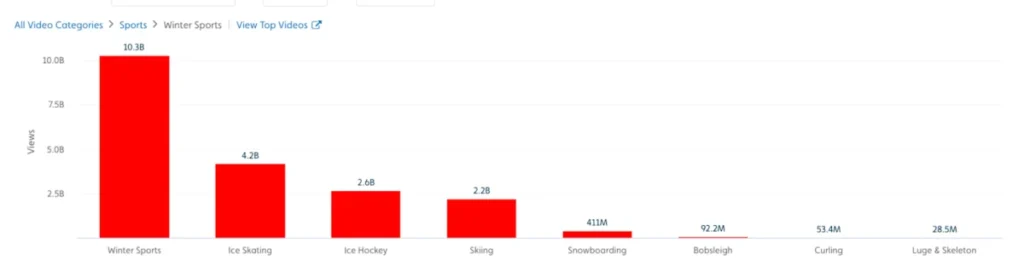
According to Tubular Labs data, ice skating videos alone generated a staggering 4.2 billion views across major social platforms throughout 2025, easily outpacing nearly all other winter sports categories. Within that ecosystem, figure skating reigned supreme, single-handedly driving 2.2 billion views and an astonishing 36.8 million total engagements (comprising likes, shares, comments, and saves).
Simultaneously, skiing—encompassing more than 20 distinct competitive disciplines scheduled for Milano-Cortina—amassed 2.2 billion views on YouTube alone in 2025. Freestyle and alpine skiing combined to account for roughly one-third of that total, maintaining a consistent velocity with over 6,000 individual uploads averaging 128,000 views per video. Meanwhile, hyper-niche disciplines like ski jumping and bobsleigh proved that smaller video inventories do not equate to smaller audiences; bobsleigh content pulled in an impressive average of 317,000 views per video, while ski jumping dominated with a massive 426,000 views per video.
These metrics signal a fundamental shift in how modern audiences consume sports: they no longer wait for the opening ceremony to engage with Olympic content. They are actively seeking out tutorials, behind-the-scenes access, aesthetic inspirations, and narrative-driven documentaries months and years in advance.
Chronology: From 1990s Cult Classics to 2025’s Algorithmic Boom
To understand how winter sports achieved such dominant social media traction by 2025, it is vital to trace the historical and digital evolution that brought these niche disciplines into the algorithmic mainstream.
- 1993: Disney releases Cool Runnings, a cinematic retelling of the Jamaican bobsled team’s underdog run at the 1988 Calgary Winter Olympics. The film permanently etches bobsledding into global pop culture, establishing the "sprinters-turned-bobsledders" narrative trope that social media storytellers would lean on decades later.
- Early 2010s – 2020s: As platforms like YouTube, Instagram, and eventually TikTok mature, sports federations realize that broadcast television alone cannot sustain youth engagement. Athletes begin taking content creation into their own hands, posting training montages, bloopers, and lifestyle vlogs.
- 2022 (Beijing Winter Olympics): The Beijing Games prove to be a watershed moment for digital engagement, but high production costs and broadcasting restrictions leave independent creators hungry for more accessible, year-round content formats.
- Throughout 2025: A non-Olympic year unexpectedly shatters expectations. Ice skating videos cross the 4.2 billion-view threshold. Independent creators like French skier Anthony Robert discover that skiing content can maintain high engagement even during the sweltering summer months. National squads, such as the Great Britain bobsled team, pivot to aggressive behind-the-scenes social video strategies, netting hundreds of thousands of views per upload.
- February 2026: As the Milano-Cortina Winter Games officially commence, the brands, creators, and publishers who capitalized on these pre-established 2025 audience funnels are positioned to dominate advertising revenues and audience attention.
Supporting Data: Breaking Down the Numbers
A granular look at the Tubular Labs data highlights specific areas of high performance across platforms, proving that certain winter sports possess unique structural advantages in the digital attention economy.
Ice Skating’s Aesthetic and Educational Economy
Figure skating’s dominance—accounting for more than half of the 4.2 billion ice skating views in 2025—is rooted in its unique intersection of elite athleticism and high-fashion aesthetics.
- Total 2025 Ice Skating Views: 4.2 billion across platforms.
- Figure Skating Share: 2.2 billion views.
- Figure Skating Total Engagements: 36.8 million.
Beyond traditional sports commentary, the aesthetic elements of ice skating have opened lucrative avenues for non-sports creators. Hair, beauty, and fashion influencers regularly leverage ice skating themes for makeup tutorials, costume breakdowns, and trend forecasts. Furthermore, "how-to" content teaching the absolute basics of ice skating has resonated powerfully, particularly among digital communities located in warmer climates who lack easy access to local ice rinks or specialized equipment.
The Skiing Spectrum: Volume Meets High-Value Niche Appeal
With more than 20 distinct skiing events on the official Milano-Cortina 2026 program, skiing represents the most heavily represented sport group at the Winter Games.
- Total 2025 YouTube Skiing Views: 2.2 billion.
- Freestyle & Alpine Output: Roughly 6,000 uploads averaging 128,000 views each.
- Ski Jumping Outperformer: Fewer total uploads, but a staggering average of 426,000 views per video.
Individual creators have masterfully decoded the skiing algorithm. For instance, French creator Anthony Robert built a massive following in 2025 by treating skiing as a broad content lens rather than a seasonal obligation—with his viewership metrics surprisingly peaking during the summer months. This strategy demonstrates that lifestyle integration outperforms pure competition footage for independent digital publishers.
Bobsledding and the Power of Human Narrative
Despite not possessing the daily broadcast frequency of soccer or basketball, niche sports rely heavily on compelling human narratives. Bobsledding’s enduring appeal on social media stems directly from the dramatic juxtaposition of explosive track-and-field sprinters launching heavy fiberglass sleds down icy chutes at 90 miles per hour.
- Bobsledding Performance: Averaged 317,000 views per video throughout 2025.
- Key Drivers: Accounts like Rome Music and, crucially, the Great Britain bobsled team, which utilized platforms like YouTube to offer unfiltered, behind-the-scenes access to grueling physical preparations.
Official Responses and Industry Insights
Industry analysts and sports marketing executives are taking aggressive note of these shifting digital consumption patterns as the countdown to Italy continues.
Speaking on the integration of sports and social intelligence, data strategists emphasize that traditional linear television ratings no longer paint a complete picture of Olympic audience intent. "When we look at pre-Olympic data, we aren’t just measuring passive sports fans; we are measuring active digital communities," notes research compiled by Tubular Labs. "Sports like curling, snowboarding, bobsledding, and figure skating punch far above their weight classes because their respective communities have built self-sustaining content ecosystems long before the opening torch is lit."
Meanwhile, sports federations have increasingly embraced athlete-led content strategies. By encouraging competitors to pull back the curtain on training regimens, diet routines, and mental health preparations, teams have successfully humanized athletes who were previously viewed only once every four years.
"The modern sports fan wants intimacy and authenticity," notes a digital media strategist specializing in Olympic properties. "When an athlete like a British bobsledder or a freestyle skier posts raw, unpolished training footage, it builds an emotional bridge. When February 2026 arrives, viewers aren’t just watching a random flag on a screen—they are rooting for someone whose digital journey they’ve followed for twelve months."
Implications for Creators, Publishers, and Brands
The 2025 viewership data serves as a clear roadmap for how stakeholders across the media and marketing landscapes should navigate the Milano-Cortina 2026 Olympic Winter Games and beyond.
1. For Content Creators and Independent Publishers
Creators do not need to be accredited sports journalists to capitalize on Olympic fervor.
- Cross-Niche Collaboration: Beauty and fashion creators can lean into the aesthetic, makeup, and costume designs of figure skating and snowboarding.
- Educational Accessibility: "How-to" and beginner-focused content lowers the barrier to entry for fans who love the idea of winter sports but have never stepped foot on ice or snow.
- Year-Round Relevance: As demonstrated by creators like Anthony Robert, treating winter sports through a lifestyle or adventure lens can sustain high audience retention well outside the winter season.
2. For Brands and Advertisers
With NBC and other traditional networks retaining exclusive broadcast rights for the live competitions, brands that lack multi-million-dollar broadcast sponsorship packages might feel locked out of the Olympic gold rush. However, the social video ecosystem provides a workaround.
- Micro-Influencer Partnerships: Brands are increasingly shifting ad spend toward the individual athletes and niche creators dominating platforms like YouTube and TikTok—particularly in high-engagement categories like freestyle skiing, ski jumping, and bobsledding.
- Narrative Alignment: Sponsoring behind-the-scenes training vlogs allows brands to associate themselves with perseverance, grit, and authenticity at a fraction of the cost of traditional broadcast spots.
3. The Broader Future of Sports Media
Ultimately, the data leading into Milano-Cortina 2026 proves that the Olympics are no longer just a two-week television event. They are an ongoing, year-round digital conversation. Publishers who fail to recognize the algorithmic appetite for niche sports risk missing out on billions of engaged impressions. For those ready to decode the data, the ice-cold peaks of Italy represent a digital gold mine waiting to be claimed.
