
Decoding the Global Newsroom: How Algorithms, Timing, and Audience Psychology are Reshaping Social Video Strategy
By Global Media Desk
Published: March 2026
Main Facts: The Algorithmic Battleground of Modern Journalism
In the contemporary media landscape, news publishers no longer compete solely against rival outlets for the fleeting attention of audiences. Instead, they navigate an intricate, unforgiving ecosystem dictated by algorithmic gatekeepers. Factors such as contextual relevance, precise timing, and format precision dictate whether a piece of journalism reaches millions or vanishes into the digital ether.
Recent cross-platform performance patterns reveal a stark reality: audience behavior within the News and Politics genre on social video is deeply nuanced. Success is no longer a matter of simply breaking a story first; it relies fundamentally on aligning content strategy with the granular mechanics of how viewers actually consume media.
Drawing from extensive Tubular Intelligence data spanning November 2025 through February 2026, researchers have analyzed core performance metrics—including video length, publishing schedules, trending hashtags, and top-performing narratives across the Asia-Pacific (APAC), Latin America (LATAM), Europe, Middle East, and Africa (EMEA), and North America. The findings offer a definitive blueprint for how modern newsrooms can maximize both reach and engagement in an era of hyper-competition.
Chronology and Scope: Tracking the Shift in Viewer Habits
To understand how modern news consumption has evolved, one must examine the shifting priorities of digital newsrooms over the past several years, culminating in the late 2025 and early 2026 data cycles.

- Late 2023 – 2024: News publishers heavily prioritized volume, flooding platforms like YouTube, Instagram, and TikTok with mid-length content (typically 2 to 5 minutes) in an effort to feed the constant demand of recommendation engines.
- Mid 2025: Data began to signal audience fatigue. Viewers increasingly split their attention between hyper-concise, bite-sized vertical video and deeply immersive, long-form documentary-style reporting. Mid-length content began to suffer from diminishing returns in per-video engagement.
- November 11, 2025 – February 8, 2026: The definitive analytical window captured by Tubular Intelligence. During this peak period, global news events—ranging from major geopolitical shifts to high-profile international incidents—provided a stress test for how different regions process and interact with political and social media content.
- Present Day: Publishers are actively pivoting away from a "post more" philosophy toward a smarter, data-informed strategy focused on regional nuances, unconventional posting schedules, and psychological triggers.
Supporting Data: Regional Insights and Content Mechanics
The Tubular Intelligence data uncovers distinct behavioral trends across different global territories, proving that a one-size-fits-all distribution model is obsolete.
1. The Video Length Paradox in APAC
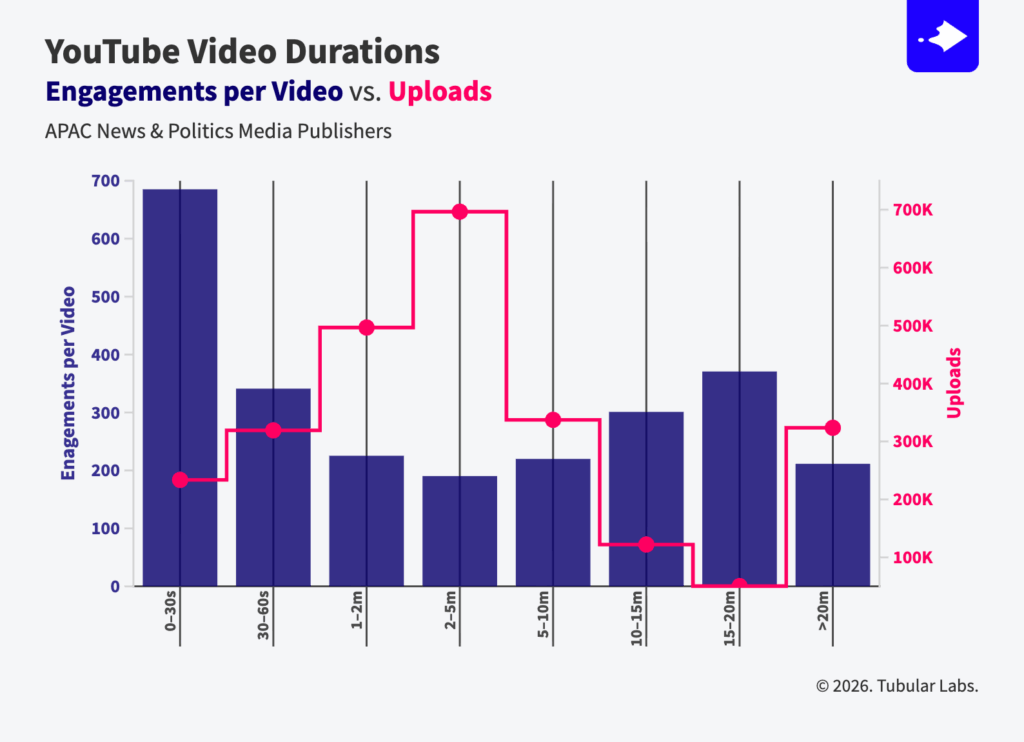
When examining News and Politics publishers in the Asia-Pacific region, a clear polarization in audience preference emerges. Viewers engage most intensely with two distinct formats:
- Ultra-short updates (0–30 seconds): Rapid, punchy summaries designed for immediate consumption.
- Deep-dive, long-form updates (15–20 minutes): Comprehensive, analytical breakdowns that command sustained attention.
Paradoxically, mid-length videos (2–5 minutes) continue to dominate upload volume for APAC publishers, yet they consistently underperform when it comes to maximizing engagement per video. This reveals a critical operational flaw: many newsrooms are optimizing for sheer output at the expense of high-impact storytelling.
2. The Latin American Timing Mismatch
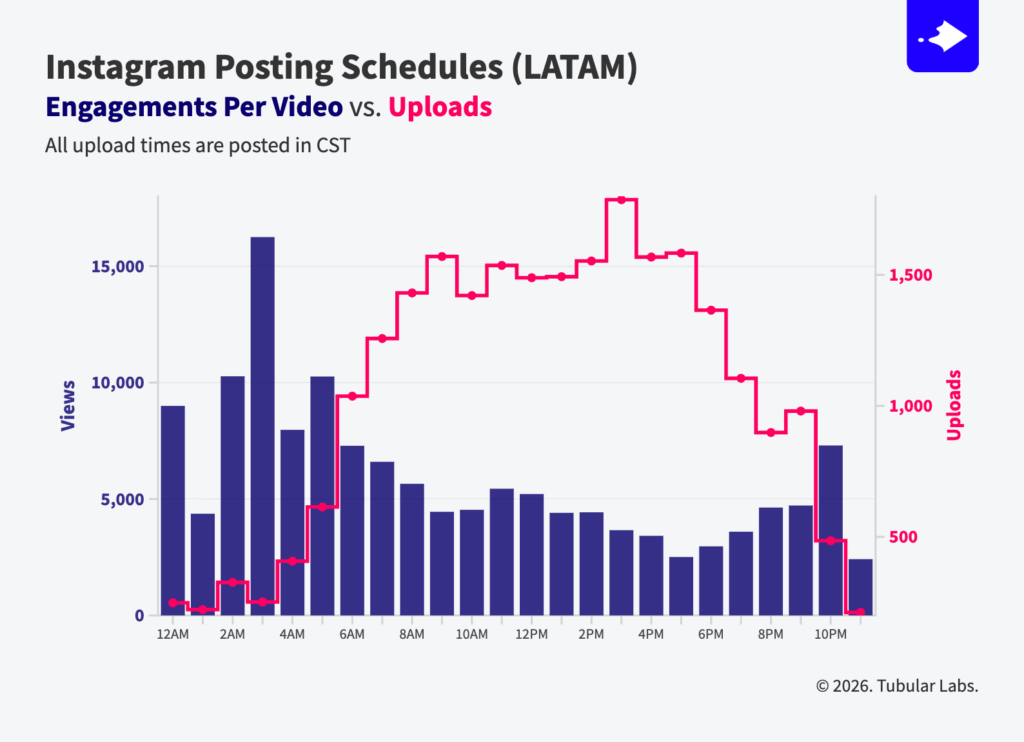
In LATAM, a fascinating temporal disconnect exists between publishing habits and user engagement. Data shows that regional publishers post most frequently during the evening hours (around 3:00 PM to 3:59 PM CST). However, audience engagement per video actually peaks much earlier in the day, specifically between 3:00 AM and 3:59 AM CST.
This timing mismatch highlights a major strategic opportunity. Publishers willing to adjust their automated distribution pipelines or shift scheduling windows toward the early morning can capture high-value per-video engagement while facing significantly lower competition from rival outlets.
3. Hashtag Utility in EMEA
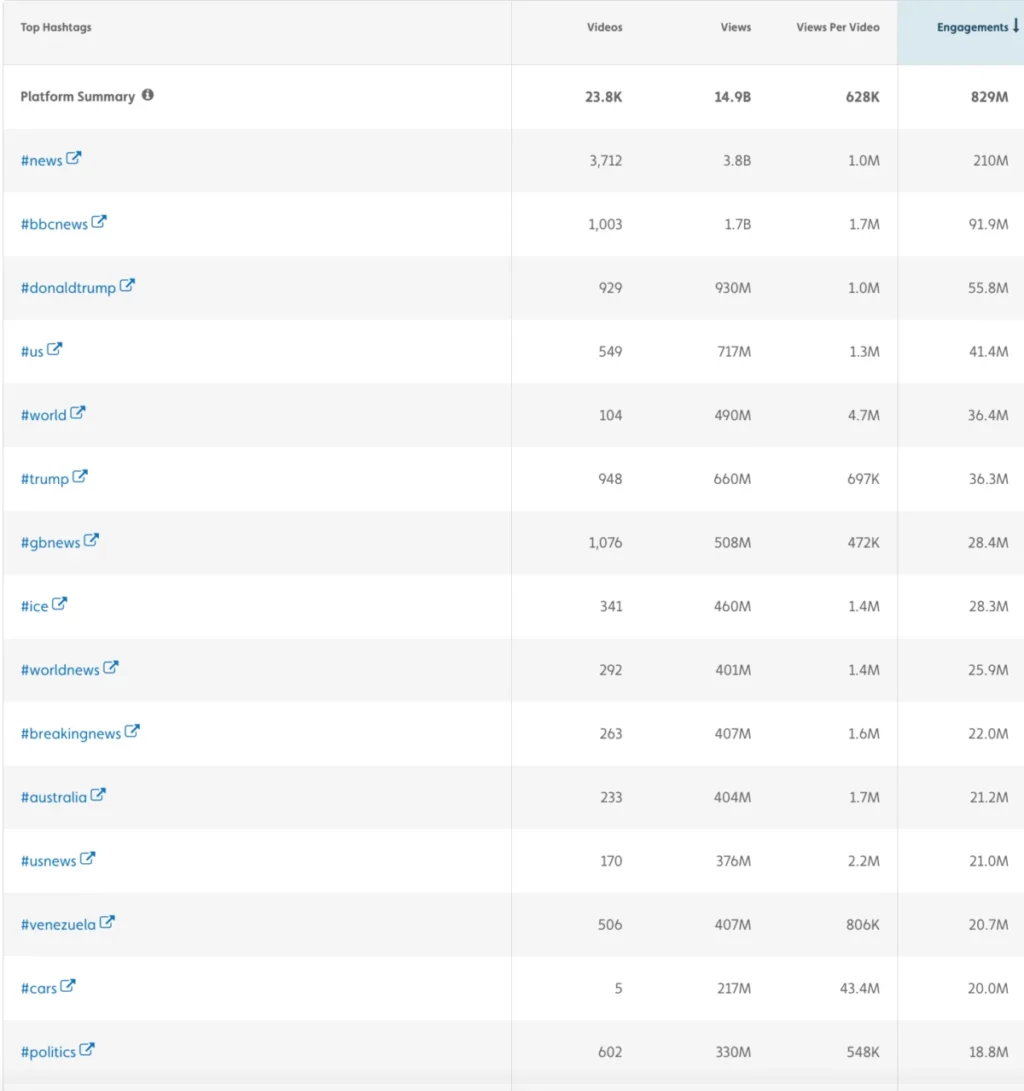
In Europe, the Middle East, and Africa, hashtags function as sophisticated tools for discovery and brand authority rather than mere organizational labels. The most-viewed News and Politics hashtags on Instagram during the study window reflect a strategic blend of:
- Global political flashpoints (e.g.,
#trump,#ICE,#venezuela) - Major broadcaster branding (e.g.,
#bbcnews) - Country-specific identifiers designed to expand international discoverability and cross-border audience tracking
4. Viral Realities in North America: Views vs. Engagements
TikTok data from U.S. publishers demonstrates a sharp divergence between passive viewership and active engagement.
- Mass Reach via Breaking News: Traditional, high-profile breaking stories capture staggering view counts. For example, coverage surrounding British heavyweight boxing champion Anthony Joshua following a fatal car crash in Nigeria generated over 180 million views in 30 days.
- Explosive Engagement via Cultural Reaction: Conversely, engagement figures skyrocket when content sparks unexpected emotional or humorous reactions—even amidst serious subject matter. A notable instance involved crowd interviews at an immigration policy protest, where unintended humor and irony in a participant’s statements drove 63.5 million engagements in just seven days as online users mocked and riffed on the footage.
Official Responses and Industry Perspectives
Media executives and digital strategists are increasingly vocal about the necessity of adapting to these algorithmic and behavioral realities.
"Publishers can no longer afford to treat social video as a simple dumping ground for broadcast clips," notes a senior digital strategy consultant specializing in EMEA media markets. "The data proves that audiences possess distinct appetites depending on the hour of the day and the geographical region. If you publish a mid-length explainer into a saturated evening feed in Latin America or ignore the polarized demand for micro-shorts versus long-form deep dives in APAC, you are fighting the algorithm rather than leveraging it."
Data analysts at Tubular Labs emphasize that the modern newsroom must evolve from a reactive broadcasting unit into a proactive, data-driven content engine. "The opportunity in 2026 is not about publishing more content," industry researchers state. "It is about understanding the exact friction points and engagement triggers of your audience. Whether it is capitalizing on early-morning white space or recognizing that TikTok users engage deeply with cultural irony over dry hard news, strategy must follow data."
Implications for the Future of Digital Newsrooms
The empirical evidence compiled between late 2025 and early 2026 carries profound implications for media organizations, independent journalists, and digital content creators alike.
- Re-evaluating Production Budgets: The underperformance of mid-length (2–5 minute) videos forces a strategic reallocation of resources. Newsrooms must decide whether to invest in rapid-fire vertical production teams for quick hits or dedicated investigative units capable of sustaining a 15-to-20-minute deep dive that commands high audience loyalty.
- Algorithmic Timing Optimization: Publishers must move past traditional 9-to-5 publishing mindsets. By analyzing regional audience activity curves—such as LATAM’s predawn engagement spikes—smart newsrooms can claim unclaimed digital real estate.
- The Psychology of Engagement: Hard news remains vital for establishing baseline awareness, but publishers must master the art of narrative framing to generate community conversation. Recognizing when a serious news item carries an unintended cultural or humorous angle is becoming a core competency for social video editors.
Ultimately, performance in the modern News and Politics sector is dictated by a holistic alignment of content type, delivery format, and temporal precision. Publishers who adapt to these measurable patterns will secure enduring audience loyalty, while those clinging to legacy output models risk being left behind in an increasingly crowded digital ecosystem.
