
Decoding the Algorithm: How Global News and Politics Publishers Can Master Social Video in 2026
GLOBAL — In the modern digital media ecosystem, news publishers are no longer just competing against one another for the fleeting attention of the public. Instead, they find themselves locked in a complex, relentless contest against algorithmic gatekeepers that dictate visibility based on relevance, timing, format precision, and platform-specific mechanics.
Across international borders and digital platforms, recent performance patterns reveal a definitive truth: audience behavior within the News & Politics genre on social video is deeply nuanced. Long-term success is no longer a byproduct of publishing volume; rather, it depends entirely on aligning content strategy with how modern viewers actually consume, digest, and react to information.
Drawing from comprehensive Tubular Intelligence data spanning November 2025 through February 2026, media analysts have examined critical performance metrics—including video length, optimal posting times, trending hashtags, and top-performing viral stories across APAC, LATAM, EMEA, and North America. The findings offer a rare, data-driven blueprint for what is currently driving audience engagement across the globe.
Main Facts: The Anatomy of Modern Social Video Consumption
The core revelation of the recent data analysis is that generic, one-size-fits-all distribution models are officially obsolete. News organizations attempting to blanket every social network with the same video format, length, and scheduling schedule are seeing diminishing returns.
Key metrics highlight profound behavioral divides across different geographic markets:
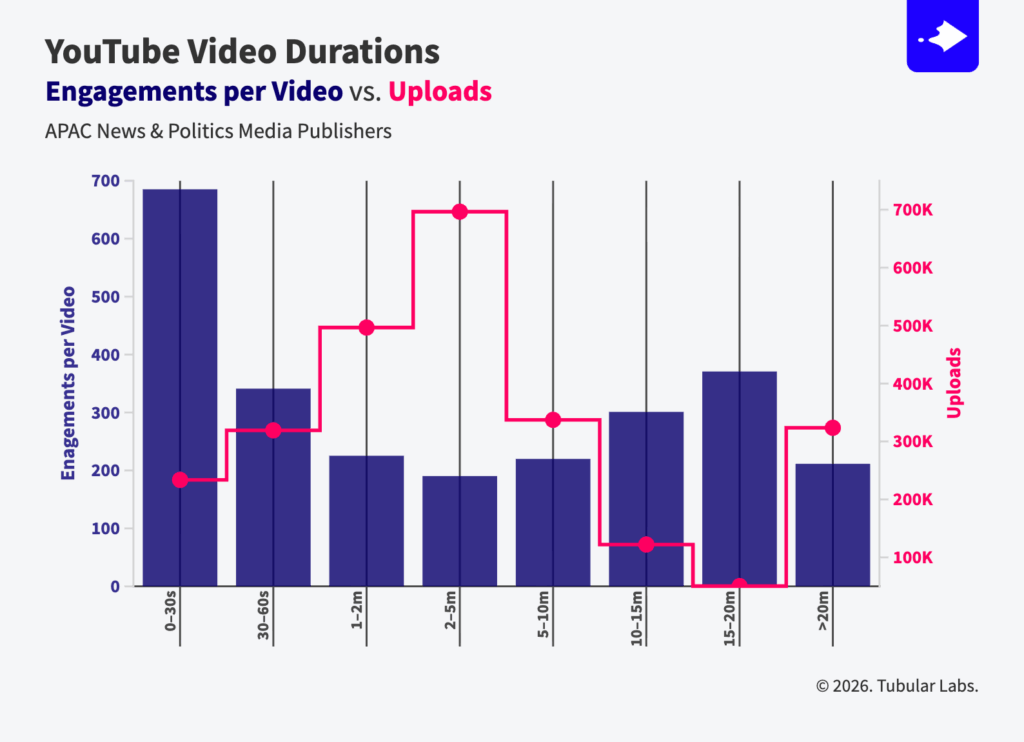
- The Polarization of Video Length: In regions like the Asia-Pacific (APAC), audiences are split into two distinct camps. They lean heavily toward ultra-short updates (0–30 seconds) for rapid information consumption or deep-dive, long-form explainers (15–20 minutes) for immersive context. Paradoxically, mid-length videos (2–5 minutes) dominate upload volume despite failing to maximize per-video engagement.
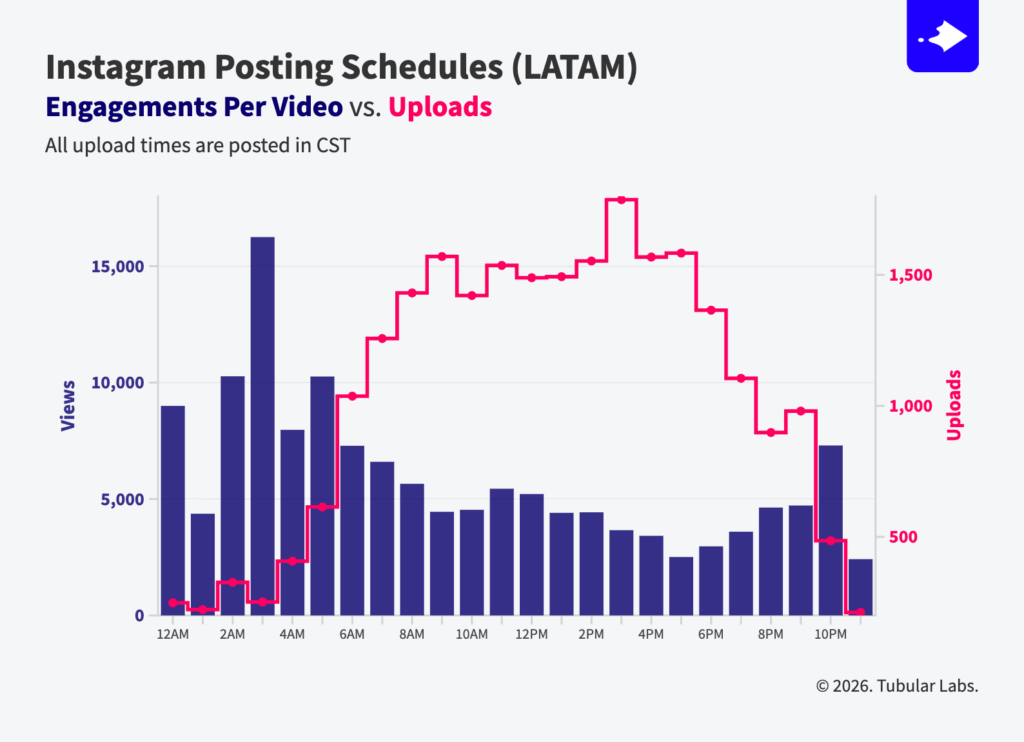
- The Timing Disconnect: In Latin America (LATAM), publishers overwhelmingly upload content during the evening hours, yet peak user engagement occurs in the early morning. This timing mismatch leaves significant engagement potential on the table.
- Strategic Hashtag Utilization: Across Europe, the Middle East, and Africa (EMEA), newsrooms are utilizing hashtags not merely as categorical markers, but as sophisticated tools for brand authority, global discovery, and geopolitical tracking.
- The Humor Multiplier: On platforms like TikTok in the United States, breaking hard news guarantees mass views, but unexpected emotional reactions and humor—even within serious political contexts—spark unprecedented engagement explosions.
Chronology and Evolution: How the Landscape Shifted Heading into 2026
To understand how newsrooms arrived at these strategic crossroads, it is necessary to examine the evolution of social video algorithms over the past several years.
Late 2024 to Early 2025: The Push for Short-Form Dominance
Following the meteoric rise of TikTok and the aggressive rollout of Instagram Reels and YouTube Shorts, news publishers initially reacted by force-fitting all journalistic content into vertical, bite-sized packages. Newsrooms restructured their workflows to chop complex geopolitical conflicts, economic reports, and legislative breakdowns into sub-60-second clips. While this brute-force approach successfully generated top-of-funnel impressions, audience retention metrics began to plateau by mid-2025. Viewers expressed digital fatigue regarding hyper-condensed news that lacked analytical depth.
Mid-2025 to Late 2025: The Multi-Format Reckoning
Recognizing the limitations of short-form saturation, leading media outlets began experimenting with hybrid models. YouTube channels started pairing daily shorts with exhaustive live streams and long-form video essays. Simultaneously, social algorithms evolved to heavily reward watch time and completion rates over mere view counts. This algorithmic shift penalized low-effort mid-length videos—content long enough to bore short-form scrollers, yet too short to satisfy deep-dive seekers.
November 2025 – February 2026: The Data-Driven Era
The current analytical window captured by Tubular Intelligence marks a mature phase in social video publishing. Newsrooms are no longer guessing what works; they are adapting to regional viewing habits shaped by local commuting patterns, cultural attitudes toward media trust, and platform-specific algorithmic preferences. Publishers are discovering that success requires hyper-localization of format, timing, and metadata.

Supporting Data: Regional Insights and Analytical Breakdowns
1. APAC: Solving the Video Duration Dilemma
When evaluating News & Politics publishers in the Asia-Pacific region, the data presents a striking operational inefficiency. Mid-length videos (ranging from 2 to 5 minutes) account for the largest share of total upload volume. However, these videos routinely underperform in terms of engagement per video.
Conversely, APAC audiences display an overwhelming preference for two extremes:
- Ultra-short updates (0–30 seconds): Highly effective for breaking developments, snapshot policy announcements, and rapid global alerts.
- Long-form deep dives (15–20 minutes): Hugely successful at commanding attention spans for investigative journalism, macroeconomic breakdowns, and comprehensive political analyses.
The Strategic Takeaway: Publishers relying heavily on mid-length content are optimizing purely for internal output quotas at the direct expense of cultural impact and viewer loyalty. Restructuring editorial calendars to favor either rapid-fire vertical clips or comprehensive long-form explainers yields significantly higher returns on production investment.
2. LATAM: Capitalizing on the Early-Morning Engagement Window
An analysis of Instagram posting schedules among Latin American News & Politics publishers uncovers a classic operational blind spot.
The data reveals that regional media publishers post most frequently during the evening hours—clustering their upload schedules around 3:00 PM to 3:59 PM CST. Yet, audience engagement metrics tell a completely different story: per-video engagement peaks dramatically between 3:00 AM and 3:59 AM CST.
The Strategic Takeaway: This profound timing mismatch highlights a major competitive advantage for forward-thinking publishers. Organizations willing to automate early-morning content distribution or restructure their social media teams’ shifts to target these off-peak windows can capture superior per-video engagement while facing significantly lower noise and competition from rival newsrooms.
3. EMEA: The Multi-Layered Power of Hashtags
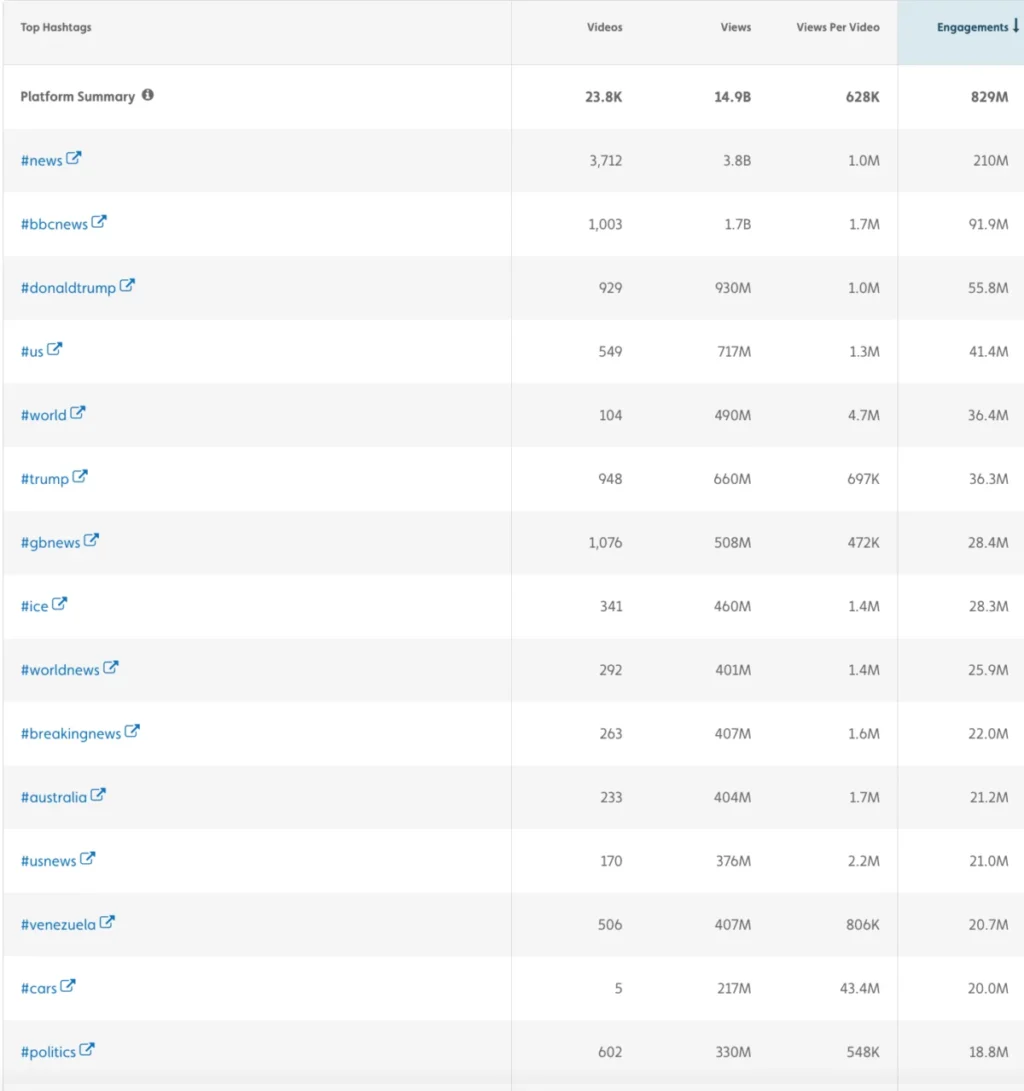
In the EMEA market, examining the most-viewed News & Politics hashtags on Instagram illustrates a fascinating blend of international political flashpoints, institutional media branding, and regional identifiers. Top-performing tags routinely feature global figures and crises (such as #trump, #ICE, and #venezuela), major legacy broadcaster branding (#bbcnews), and localized geographic tags that facilitate cross-border discoverability.
The Strategic Takeaway: European and African news publishers are successfully using hashtags as an advanced form of search engine optimization (SEO) within social ecosystems. By combining trending geopolitical keywords with trusted institutional brands, publishers expand their global reach, reinforcing their authority while helping international audiences track transnational developments.
4. North America: The TikTok Paradox of Hard News vs. Human Reaction
In the United States, social video performance on platforms like TikTok highlights a sharp divide between passive viewership and active engagement.
High-profile breaking news events—such as major international accidents, criminal investigations, or geopolitical crises—guarantee massive top-line viewership. For instance, recent coverage by outlets like Reuters surrounding high-profile accidents (such as British boxing champion Anthony Joshua’s involvement in a fatal traffic incident in Nigeria) easily rakes in upwards of 180 million views within a 30-day window.
However, true community engagement—measured through shares, comment volume, and algorithmic boosting—explodes when content sparks unexpected emotional or cultural reactions. A notable case study during the tracking period involved a crowd interview at an Immigration and Customs Enforcement (ICE) protest, where an interviewee made an unexpected remark about purchasing an AR-15 rifle. Although the original segment was framed as serious journalism, online communities seized on the absurdity of the exchange, driving over 63.5 million engagements in just seven days through widespread mockery and commentary.
The Strategic Takeaway: TikTok audiences do not consume or interact with "hard news" in the traditional broadcast manner. While breaking news establishes broad awareness, engagement surges when editorial content triggers visceral emotional or cultural dialogue. Publishers must design stories not merely to inform, but to spark conversation.
Official Responses and Industry Perspectives
As media executives grapple with these algorithmic realities, industry leaders are increasingly speaking out about the necessity of structural pivots within modern newsrooms.
"The era of throwing content against the wall to see what sticks is officially over," noted a prominent digital media strategist during a recent industry briefing. "Algorithms across YouTube, TikTok, and Meta have matured to the point where they punish laziness. Publishers must treat every platform as a distinct market with its own cultural norms, timing requirements, and narrative expectations."
Digital editors-in-chief across major networks have similarly emphasized the growing importance of data analytics platforms, such as Tubular Intelligence, in guiding daily newsroom routines. Rather than relying solely on traditional editorial intuition, modern executive producers are utilizing real-time cross-platform data to determine whether a developing political story warrants a 15-second vertical teaser, a breaking news TikTok clip, or a 20-minute investigative YouTube mini-documentary.
Furthermore, monetization pressures have forced commercial leadership within media companies to demand higher efficiency. With advertising revenue increasingly tied to viewer retention and meaningful interaction rather than empty impressions, aligning publishing schedules with audience habits—such as LATAM’s early-morning engagement windows—has become an urgent board-level priority.
Broader Implications for the Future of Journalism
The implications of these multi-region performance patterns extend far beyond simple social media optimization; they touch upon the very survival and credibility of modern journalism in an algorithmic age.
1. The Redefinition of Editorial Workflows
Newsrooms can no longer afford to operate with siloed television, print, and digital social teams. The data proves that format precision—knowing whether a story belongs in an ultra-short bracket or a long-form deep dive—requires cross-functional collaboration from the moment a story is pitched. Reporters must consider how their investigative findings can be packaged for different algorithmic environments without sacrificing journalistic integrity.
2. Combating Digital Fatigue and Churn
Audiences are increasingly exhausted by relentless streams of superficial, mid-length content that neither entertains quickly nor educates deeply. By pivoting toward the extremes identified in the data—either rapid, high-impact news flashes or immersive, long-form accountability journalism—publishers can rebuild trust and retain loyal subscriber bases who value depth and clarity.
3. Geopolitical Discovery Without Borders
As demonstrated by EMEA hashtag trends, local events quickly become global phenomena when tagged and categorized with international discoverability in mind. This fluidity means that local news organizations now possess the tools to reach global diasporas and international policy-makers, provided they master the metadata mechanics of social search.
Conclusion
Across every region and platform analyzed, one overarching pattern remains crystal clear: performance in the News & Politics genre is no longer just about what you cover, but how, when, and in what format you deliver it.
From the APAC region’s polarized preference for micro-updates and long-form explainers, to LATAM’s untapped early-morning engagement windows and EMEA’s sophisticated hashtag-driven discovery, modern audience behavior is entirely measurable, strategic, and actionable.
For media publishers, digital strategists, and newsroom leaders alike, the path forward does not lie in publishing more content. Success in 2026 requires publishing smarter—deeply aligning editorial strategy with real audience behavior, intricate platform mechanics, and distinct regional nuances.
For media organizations seeking to uncover deeper, custom News & Politics insights tailored specifically to their regional footprint and editorial vertical, advanced data platforms remain the ultimate compass for navigating the modern algorithmic frontier.
