
The Great Rewiring: How AI Agents Are Reshaping the Marketing Landscape for 2026
As we stand on the precipice of 2026, the marketing industry is undergoing its most significant structural evolution since the dawn of the commercial internet. For the past two decades, the "marketing playbook" has been defined by the pursuit of visibility—optimizing for search engines, mastering social algorithms, and capturing user data. However, as revealed in the upcoming Martech for 2026 report, those traditional levers are losing their potency.
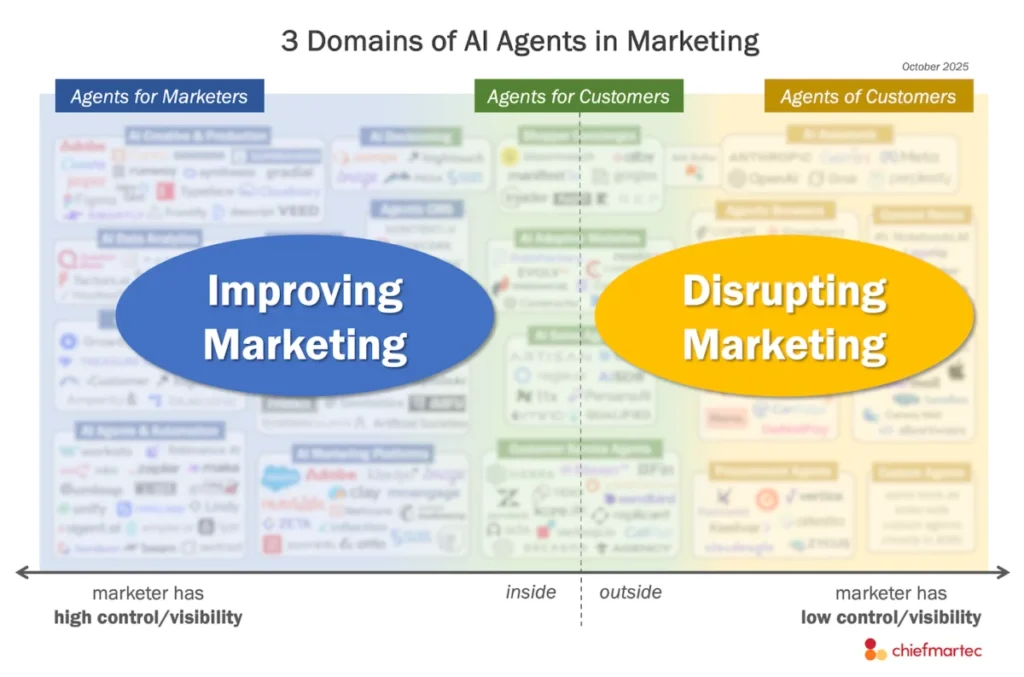
The industry is shifting from a paradigm of "marketer-led automation" to one of "agent-driven consumption." To navigate this, marketers must move beyond the hype cycle and understand the dual-front battle: the incremental improvements of internal AI tools and the radical, disruptive power of buyer-side AI agents.
The Main Facts: The Rise of the Agentic Era
The most critical takeaway from recent research is that AI agents are no longer a theoretical abstraction; they are operational reality. Data from the latest AI & Data in Marketing study indicates that a staggering 90.3% of surveyed marketing professionals are already integrating AI agents into their technology stacks.
While these participants represent a tech-forward cohort, their adoption patterns offer a reliable leading indicator of where the broader market is heading. These agents are not merely chatbots; they are autonomous systems capable of executing complex tasks, from campaign ideation and content production to advanced analytical modeling.
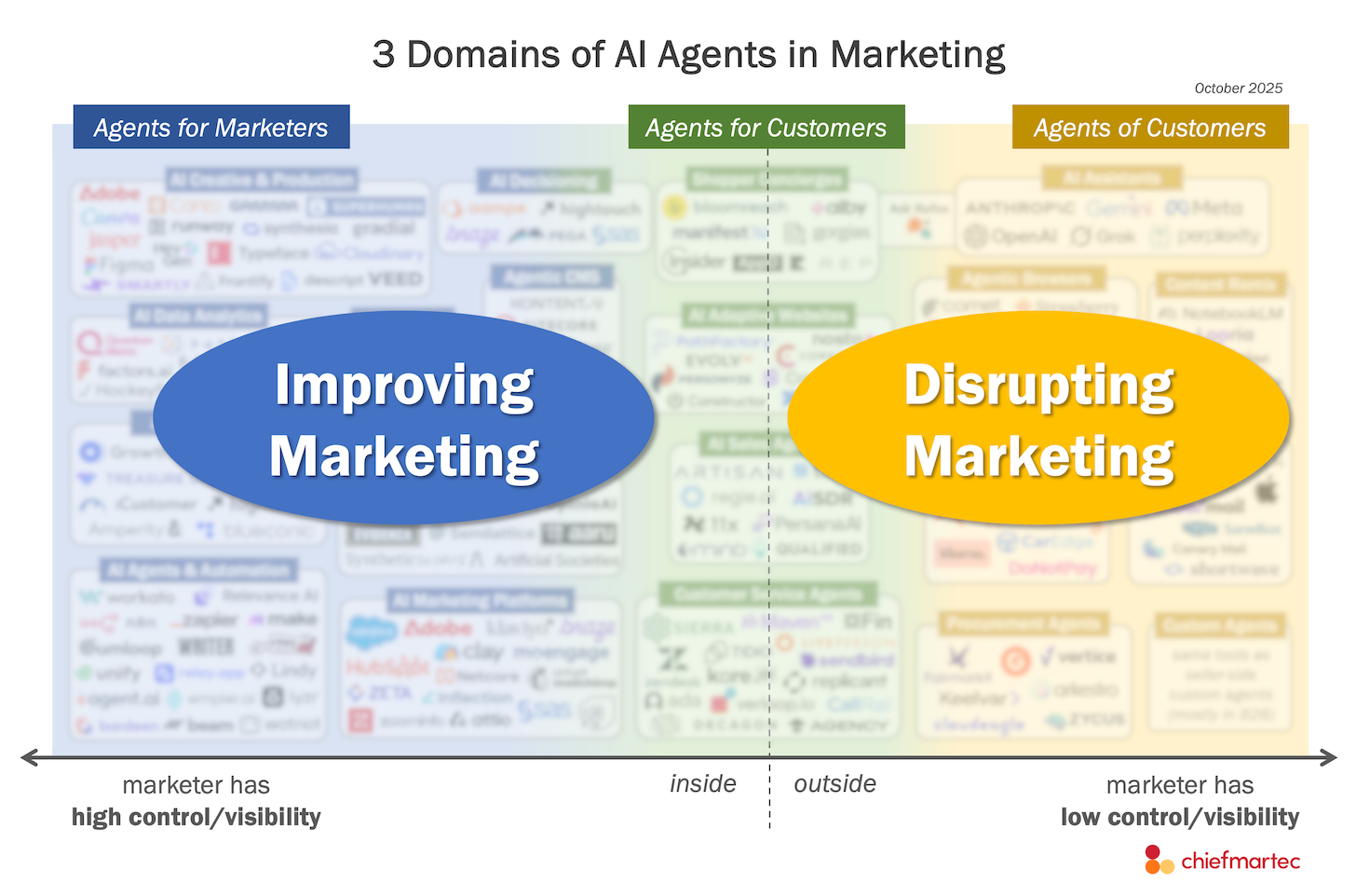
However, the industry is currently bifurcated. There is a clear distinction between agents designed to help marketers "do more with less"—the internal efficiency play—and agents designed to help buyers navigate a complex digital world. This second category, the buyer-side agent, represents a tectonic shift in the customer journey that threatens to render many current SEO and lead-generation strategies obsolete.
Chronology: The Accelerated Path to Agent-First Commerce
The transition to an agent-first landscape has moved with breathtaking speed over the last 18 months.
- Mid-2024: The industry focused heavily on "outbound AI SDRs." Companies began deploying agents to automate lead outreach, creating a flood of personalized, automated emails that clogged the top-of-funnel for many B2B organizations.
- Early 2025: The shift toward "consumer-side" intelligence began to materialize. As platforms like ChatGPT, Claude, and Perplexity gained market share, the traditional "search, click, land on page" funnel began to fray.
- Q3 2025: OpenAI and Google launched "agentic checkout" features. The ability for an AI to complete a transaction (via Shopify or Etsy integration) inside a chat window signaled that the browser—and the vendor’s website—was no longer the required destination for commerce.
- Q4 2025: The emergence of "voice-enabled agentic tasks," such as Google’s Gemini calling local stores to verify stock, marked the end of passive AI. Agents began interacting with human staff on behalf of the consumer, effectively flipping the script on the outbound automation trend of the previous year.
Supporting Data: Understanding the Landscape
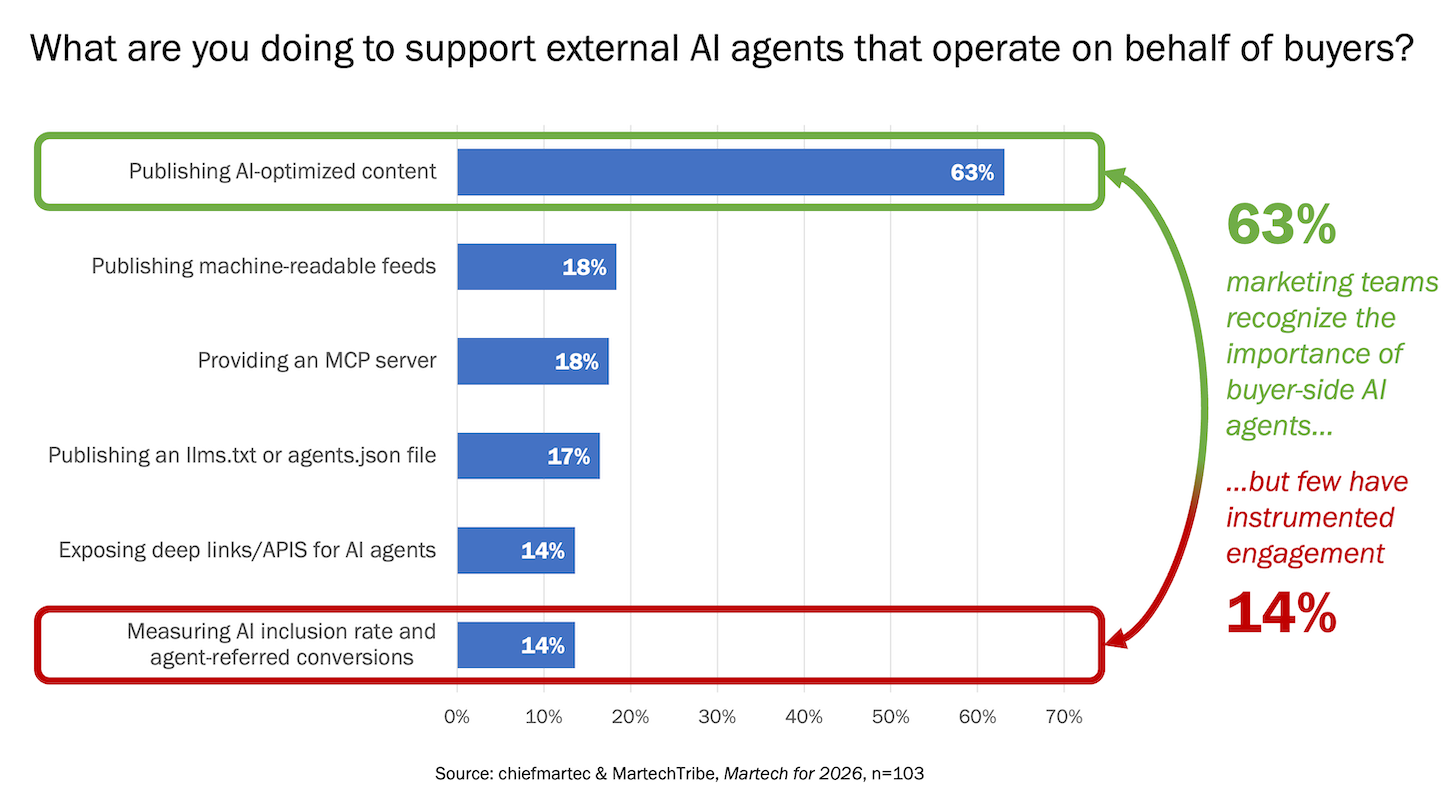
The Martech for 2026 report provides a sobering look at how marketing teams are responding to these changes.
While 63% of marketing teams acknowledge that the buyer’s search behavior has fundamentally changed due to AI assistants, only 14% have successfully instrumented their organizations to adapt. This "instrumentation gap" represents the primary risk for CMOs in the coming year.
Internal vs. External Agent Dynamics
- Internal Agents: These tools focus on productivity. They generate creative, summarize meetings, and optimize ad spend. They are the "force multipliers" for internal teams, aiming for efficiency.
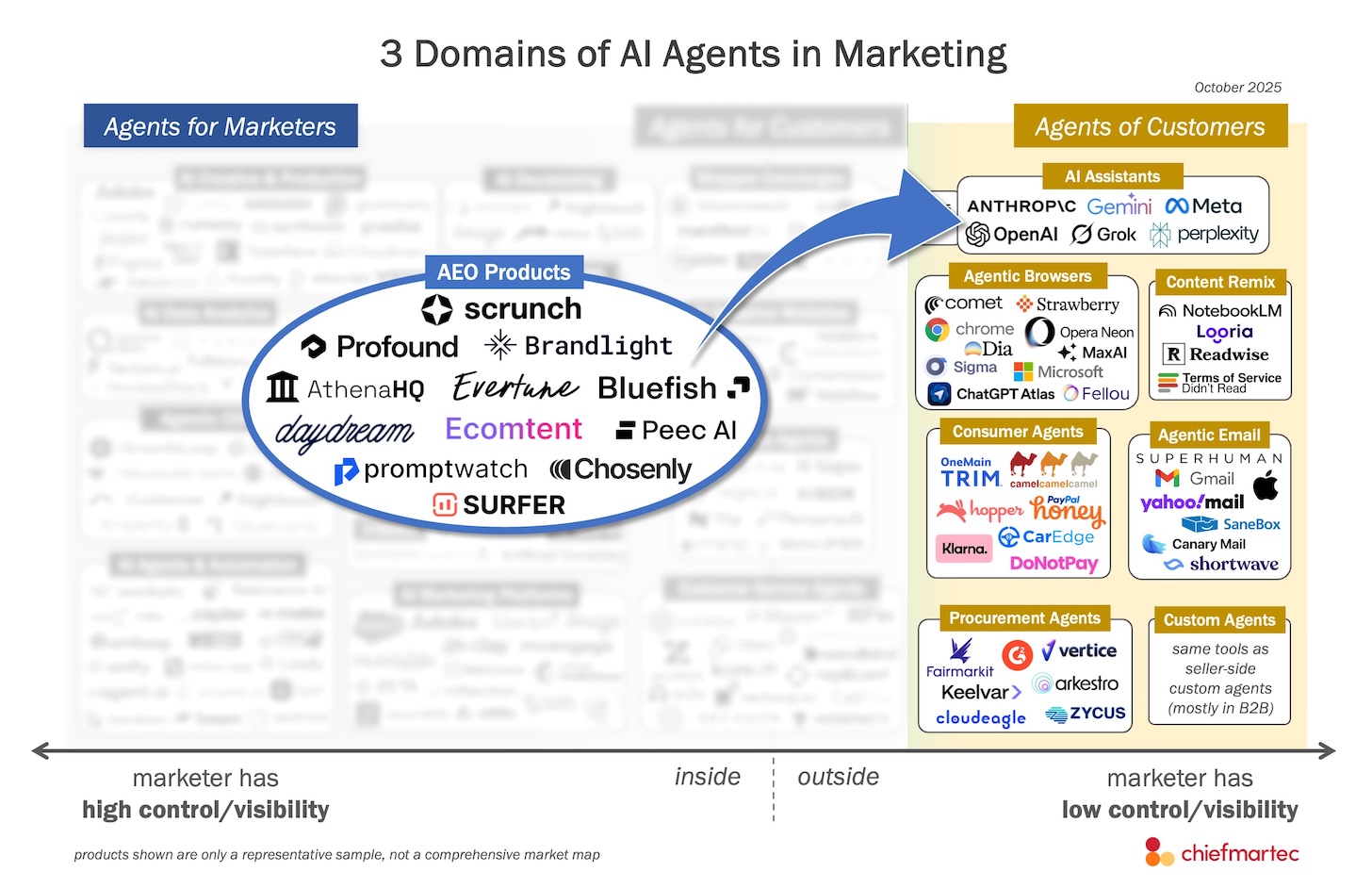
- External (Buyer-Side) Agents: These are the disruptors. They act on behalf of the customer, prioritizing the customer’s budget, time, and preference over the seller’s conversion goals.
The data suggests that while internal agents are seeing high adoption, the investment in "AEO" (AI Experience Optimization)—the practice of ensuring a brand is visible and actionable within AI-mediated search environments—remains in its infancy. Most companies are still trying to solve 2024’s problems with 2026’s tools.
Official Perspectives and Expert Analysis
Industry leaders are beginning to recognize that the era of "SEO-first" marketing is fading. The traditional goal of ranking #1 on Google is being supplanted by the goal of being the "primary data source" for an AI agent’s response.
"The shift from informational answer engines to action engines is the most significant hurdle for B2B and B2C brands alike," notes the Martech for 2026 report. "When an AI assistant can make a purchasing decision, call a store, or compare prices without ever showing the user a brand’s landing page, the entire concept of the ‘digital storefront’ is called into question."
The irony is not lost on experts: just as companies spent millions on outbound agents to harass customers, customers have deployed their own agents to filter, ignore, or automate their responses to those same companies. This "war of the agents" is expected to be a dominant theme in 2026.
Implications for the Future of Marketing
The implications for the marketing profession are profound and twofold:
1. The Decline of the Traditional Funnel
The linear path from "Awareness" to "Purchase" is being disrupted. When a buyer’s agent conducts the research and facilitates the transaction, the "awareness" stage is no longer about impressions or clicks—it is about the availability of structured, verifiable data that an AI can trust and synthesize.
2. The Move to Agent-to-Agent (A2A) Commerce
Human-to-Human (H2H) and Human-to-Machine (H2M) interactions are rapidly evolving into Machine-to-Machine (M2M) workflows. The "noisy" period of AI agents calling human sales reps will likely be short-lived. As APIs become more robust, we will see a rapid transition to automated, agent-to-agent negotiations where price, availability, and terms are settled in milliseconds, entirely bypassing human intervention.
3. The New Skill Set: AI Experience Optimization (AEO)
Marketers must pivot their technical expertise. The skill set of the future is not just managing a CRM or a CMS; it is managing "Agent Presence." This involves:
- Data Structure: Ensuring brand information is easily consumable and verifiable by LLMs.
- Transactional Integration: Connecting brand inventory and pricing systems directly to agent-friendly APIs.
- Trust Architecting: Since agents operate based on reliability, brands that provide accurate, real-time data will win, while those that hide behind opaque marketing copy will be filtered out.
Preparing for 2026: A Strategic Roadmap
As we head into the new year, the focus for leadership must shift from "How can we use AI to do more work?" to "How do we ensure our brand is the one chosen by our customers’ AI?"
The Martech for 2026 report, releasing on December 2, outlines the pragmatic steps for this transition. It is a roadmap for moving beyond the "do more with less" cliché and entering a phase of true, effective AI-driven strategy.
To remain competitive, organizations must stop viewing AI as a tool they use to sell, and start viewing it as an environment where their products must reside. The Great Rewiring of the buyer’s journey is not a future event—it is happening now. Those who instrument their business to communicate with, serve, and influence these buyer-side agents will own the next decade of commerce. Those who continue to chase the old traffic patterns will find themselves effectively invisible in an agent-first world.
To access the full research, including the complete data set on buyer-side agent adoption and the framework for AEO, you can register for the Martech for 2026 webinar on December 2. Join us to learn how to prepare your organization for the next wave of industry transformation.
