
Financial Software Showdown: Xero vs. FreshBooks in the Modern Business Landscape
As the digital economy continues to mature, small business owners and freelancers face an increasingly crowded software market when trying to digitize their financial management. Among the heavyweights in cloud-based accounting, Xero and FreshBooks have long vied for market share. While their feature sets have steadily converged over the years—each now offering robust double-entry accounting tools, automation, and reporting capabilities—their core DNA remains distinct.
Understanding the differences between these two platforms requires looking beyond basic feature lists to examine pricing architectures, user scalability, and target audience needs. This comprehensive analysis breaks down everything businesses need to know to choose the right financial engine for their operations.
1. Main Facts: Core Philosophies and Key Distinctions
At their core, Xero and FreshBooks approach financial management from opposite ends of the spectrum.
- The Freelancer’s Ally (FreshBooks): FreshBooks targets service-based businesses, agencies, and independent contractors. Its interface prioritizes client-facing workflows, custom invoicing, retainers, and recurring billing. It aims to reduce friction for users without formal accounting training.
- The Scaling Enterprise’s Engine (Xero): Xero is built for growing businesses juggling multiple products, sales channels, and international currencies. Grounded in traditional double-entry bookkeeping, Xero excels at inventory tracking, multi-currency reporting, and third-party app integrations.
Quick Verdict Summary
- Choose Xero if: You are scaling a product-based business, sell internationally across multiple currencies, require advanced inventory tracking, or need an unlimited number of internal and external users (like bookkeepers and accountants) to access the ledger without per-seat penalty fees.
- Choose FreshBooks if: You are a freelancer or service provider whose primary revenue driver is invoicing clients, managing retainers, and tracking billable hours through an intuitive, low-learning-curve interface.
2. Chronology: Evolution, Market Shifts, and Upcoming Pricing Changes
The rivalry between Xero and FreshBooks has evolved significantly over the past decade. Originally, the division was stark: FreshBooks handled simple invoicing, while Xero handled complex ledgers. Over time, both platforms borrowed from one another. FreshBooks introduced bank reconciliation and expense tracking to appeal to small businesses, while Xero enhanced its invoicing aesthetics and integrated AI tools to attract smaller operators.
Recent and Upcoming Changes
The landscape is shifting further with upcoming adjustments to cost structures:
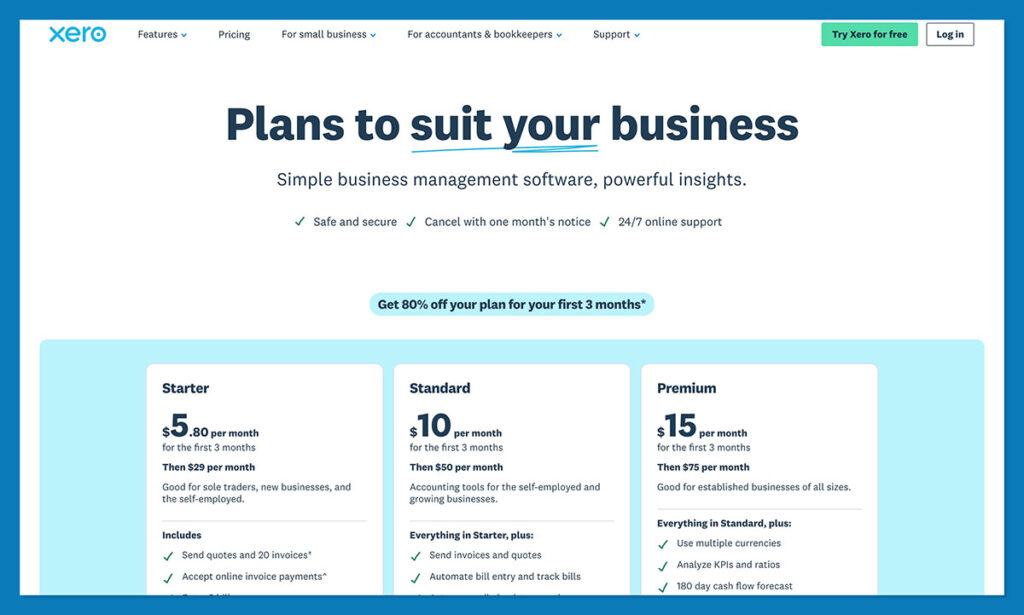
- Xero Price Adjustments: Xero’s US plans (Early at $25, Growing at $55, and Established at $90 per month) are slated for a price increase. Effective October 1, 2026, these tiers will move to $27, $59, and $97 for new and existing subscribers. Additionally, Xero is actively phasing out its legacy multi-organization discounts.
- FreshBooks Scaling Model: FreshBooks continues to lean into its client-volume pricing tier, maintaining strict user limits per account while expanding its integration ecosystem to accommodate modern hybrid service-product businesses.
3. Supporting Data: Pricing, Features, and Value Comparison
Evaluating the true cost of accounting software requires looking past headline monthly figures to understand how pricing scales as a business grows.
Pricing Structures Explained
- Xero Pricing (Feature & Usage Capped): Xero charges based on features and transaction volume rather than user seats. Its entry-level "Early" plan starts at $25/month (rising to $27 in late 2026) but severely caps invoicing capacity at 20 invoices and 5 bills per month. The "Growing" plan starts at $55/month, and the multi-currency "Established" plan sits at $90/month. Crucially, every Xero plan includes unlimited users.
- FreshBooks Pricing (Client & User Capped): FreshBooks structures its costs around the number of active billable clients and user seats. The "Lite" plan costs $23/month for up to 5 clients and a single user. The "Plus" plan ($43/month) expands to 50 clients, while the "Premium" plan ($70/month) offers unlimited clients. However, additional team members incur extra fees per user.
| Feature / Metric | Xero | FreshBooks |
|---|---|---|
| Best For | Growing product/multi-currency businesses | Freelancers & service agencies |
| Starting Price (US) | $25/month (Early Plan) | $23/month (Lite Plan) |
| User Limits | Unlimited users on all plans | 1 user included; extra seats cost extra |
| Inventory Tools | Advanced (COGS, gross profit, fixed assets) | Basic (stock quantities and basic items) |
| Multi-Currency | Comprehensive on Established plan | Single currency reporting only |
| Support Channels | Comprehensive online & community (No phone support) | Phone support available on higher tiers |
4. Official Responses and Industry Positioning
Both companies have publicly staked out their territories through product development and customer acquisition strategies.
Xero emphasizes its commitment to technological innovation, particularly through its proprietary AI assistant, JAX. JAX is designed to act as a virtual Chief Financial Officer, capable of answering plain-language questions about ledger data, generating cash-flow projections, benchmarking performance against industry peers, and evaluating uploaded documents. Xero positions itself as an all-in-one financial ecosystem that grows alongside an enterprise.
FreshBooks, meanwhile, emphasizes ease of use, customer support accessibility, and specialized workflows for service providers. By offering direct phone support (a feature notably absent from Xero’s customer service model) and maintaining a dashboard free of dense accounting jargon, FreshBooks officially positions itself as the most stress-free financial companion for self-employed professionals.

5. Implications for Business Owners and Future Outlook
Choosing between Xero and FreshBooks carries long-term strategic implications for a business’s operational efficiency and bottom line.
The True Cost of Team Collaboration
For businesses that require multiple stakeholders—such as business partners, internal finance staff, and external certified public accountants—to access financial records simultaneously, Xero offers a distinct financial advantage. Because Xero does not charge per user, expanding the internal financial team incurs zero software license inflation. Conversely, scaling a team on FreshBooks can quickly inflate monthly overhead due to per-user add-on costs.
Ecommerce and Global Scale
Product-based businesses operating across multiple channels (such as Shopify and Amazon FBA) will find Xero to be a much more resilient foundation. With robust native inventory tracking, cost of goods sold (COGS) monitoring, and true multi-currency reporting (via the Established plan), Xero prevents growing companies from outgrowing their accounting software prematurely.
Conversely, service-oriented enterprises, consultants, and independent agencies risk paying for advanced inventory and ledger features they will never use if they opt for Xero too early. For these entities, FreshBooks provides an agile, low-overhead environment that streamlines cash collection through automated payment plans, retainers, and late-fee enforcement.
Ultimately, the choice hinges on business architecture: FreshBooks wins the day for service providers seeking simplicity and streamlined invoicing, while Xero stands undefeated as the premier choice for scaling, product-driven, and multi-currency enterprises.
