
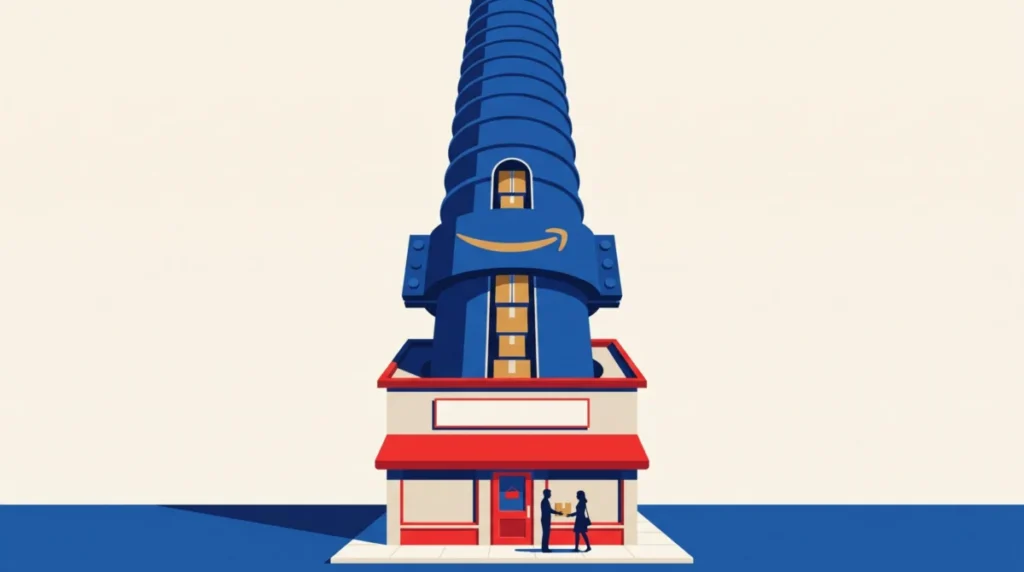
Beyond the Marketplace: The Strategic Evolution of Amazon’s ‘Buy with Prime’
In the hyper-competitive landscape of direct-to-consumer (DTC) e-commerce, the "Prime badge" has long served as a digital seal of trust—a shorthand for fast, reliable, and free delivery. For years, this advantage was confined strictly to Amazon.com. However, with the maturation of Buy with Prime (BwP), Amazon has fundamentally altered the logistics and conversion paradigm by exporting its most potent asset to the broader web.
Buy with Prime is not merely a checkout button; it is a complex infrastructure play that allows merchants to sell on their own branded websites while leveraging Amazon’s payment, logistics, and delivery ecosystem. As of late 2026, the service represents a pivot from Amazon being a walled-garden retailer to becoming the "operating system" for independent e-commerce.
The Mechanics of the Ecosystem
To understand Buy with Prime, one must look at the three pillars that support it: Amazon Pay, Multi-Channel Fulfillment (MCF), and Amazon Supply Chain Services (ASCS).
When a merchant integrates BwP, they are effectively outsourcing the most friction-heavy parts of the customer journey. The merchant retains the storefront and, crucially, the customer’s contact information (name, email, shipping address). Amazon, in turn, manages the logistics layer, the payment processing, and the returns handling.
How It Works Under the Hood
- Inventory Alignment: Merchants must hold stock in Amazon fulfillment centers. This inventory is typically part of the broader FBA (Fulfillment by Amazon) pool, or specifically managed through ASCS for brands that do not sell on the Amazon marketplace.
- The Checkout Layer: Depending on the platform, this is either a plug-and-play app (as seen with Shopify) or a custom integration using the BwP GraphQL API. When a Prime member checks out, they authenticate via their Amazon account, which populates their stored payment and shipping information.
- The Transaction: On Shopify, the payment is processed via Shopify Payments, while other platforms utilize Amazon Pay. The merchant remains the merchant of record, yet the fulfillment is executed via Amazon’s MCF infrastructure.
Chronology: From Invitation-Only to Industry Standard
The trajectory of Buy with Prime has been defined by rapid expansion and tactical friction.
- April 2022: Amazon officially announces the Buy with Prime pilot program. Initially, it is restricted to a select group of FBA merchants, signaling Amazon’s intent to capture revenue from traffic occurring outside its own domain.
- September 2022: The "Shopify Conflict" peaks. Shopify, protective of its own checkout ecosystem, warns merchants that the BwP script is an "unsupported external checkout script" that could compromise data security.
- January 2023: Amazon accelerates the rollout, promising general availability for eligible US merchants by the end of the month. They simultaneously launch "Reviews from Amazon," allowing brands to display their marketplace ratings on their own sites.
- August 2023: A historic truce is struck. Amazon and Shopify announce a jointly built integration, allowing the Prime button to exist within the native Shopify checkout flow. This essentially ended the "unsupported script" dispute.
- September 2024–2026: The ecosystem matures. Amazon introduces DSP (Demand-Side Platform) integration for BwP, allowing for sophisticated retargeting. By May 2026, Amazon Supply Chain Services opens to all businesses, and by September 2026, a "lighter" version of Prime delivery is launched, allowing merchants to offer Prime shipping speeds without fully transitioning to the Amazon checkout flow.
Supporting Data and Financial Structures
Amazon’s pitch to merchants is built on the promise of "conversion lift." The company claims that the presence of the Prime badge increases conversion rates by an average of 25%. However, this figure is derived from a limited sample size—specifically 37 merchants with traffic volumes between 5,000 and 3 million monthly visits.
The Cost of Convenience
The financial model for BwP is a multi-layered "stack" designed to capture margin at every stage:
- Service Fee: 3% of the order value (excluding tax).
- Fulfilment Fees: Variable costs based on unit size, weight, and order density.
- Storage Fees: Billed monthly, with a marked increase during the Q4 peak season and surcharges for inventory lingering longer than 180 days.
Recent pricing adjustments, specifically the reduction of the minimum service fee from $1.00 to $0.30 in early 2026, were designed to make BwP more attractive for lower-priced items, lowering the entry barrier for smaller-basket transactions.
Official Responses and Regulatory Scrutiny
The expansion of BwP has drawn the ire of regulators. In September 2023, the Federal Trade Commission (FTC) filed an antitrust complaint alleging that Amazon illegally maintains monopoly power by conditioning Prime eligibility in its store on the use of its fulfillment services.
While the FTC case focuses on the internal marketplace, the implications for BwP are clear: critics argue that Amazon is "tying" its logistics dominance to its checkout dominance. Amazon vehemently disputes these claims, arguing that merchants choose BwP because of its efficiency and the high expectations of the Prime membership base.
Regarding data privacy, Amazon maintains strict firewalls. Merchants receive customer data for their own CRM, but are prohibited from sharing "Prime member" status with third parties. Amazon, meanwhile, aggregates behavioral data from BwP checkout flows to refine its advertising algorithms—a practice that remains opaque to the merchants themselves.
Implications for Marketers: The Logistics-Advertising Hybrid
For modern marketers, Buy with Prime has transformed logistics into a performance marketing tool.
The DSP Advantage
The integration of Amazon DSP (Demand-Side Platform) with BwP allows brands to build audiences based on actual purchase behavior. Because Amazon can track the user from the ad click to the product page on the merchant’s site, the attribution loop is significantly tighter than typical third-party pixel tracking.
The "Badge" in Rival Ad Units
Perhaps most significantly, the Prime badge is no longer limited to Amazon. Through integrations with Google Shopping and TikTok, merchants can now display "Prime-fast" delivery promises within external ad units. This effectively allows a brand to compete on the same level as Amazon-native sellers, even when the shopper is browsing on a social media platform or a search engine.
Future Outlook: The "Lighter" Prime Integration
The most recent development—the September 2026 launch of a "lighter" Prime delivery option—marks a shift in strategy. By allowing merchants to offer Prime delivery speeds without requiring the user to sign in or use the Amazon checkout, Amazon is attempting to solve the issue of "checkout friction."
Early data from the 15-merchant pilot suggests that this version is highly effective, with over 40% of eligible orders choosing the Prime delivery speed. This signals that Amazon is willing to decouple the delivery benefit from the payment gate, provided it keeps the volume flowing through its fulfillment network.
Critical Considerations for Brands
As the service evolves, merchants must weigh the benefits of increased conversion against the risks of:
- Dependency: Entrusting the entire fulfillment and checkout experience to a single entity.
- Margin Erosion: The cumulative cost of service fees, storage, and fulfillment surcharges can be significant compared to a traditional 3PL (Third-Party Logistics) setup.
- Data Blindness: While you get the customer’s email, you do not have full visibility into the nuances of how Amazon’s algorithms categorize your shoppers for their own advertising ecosystem.
Ultimately, Buy with Prime is the culmination of Amazon’s long-term goal: to ensure that regardless of where a purchase happens online, Amazon is the infrastructure powering it. For the merchant, the question remains whether the 25% conversion lift is worth the price of admission to Amazon’s logistics kingdom.
