
Beyond the Headline: Decoding the Algorithmic and Behavioral Shifts Reshaping Global News and Politics on Social Video
In the modern media landscape, news publishers are no longer just competing against rival newsrooms for eyeballs. Instead, they find themselves locked in a high-stakes contest against opaque algorithmic factors—relevance engines, timing models, format precision algorithms, and ever-shifting platform feeds. Across regions and social platforms, recent performance data reveals an undeniable truth: audience behavior within the News & Politics genre on social video is intensely nuanced. Long-term success is no longer a byproduct of simply breaking a story first; rather, it depends entirely on aligning a publisher’s content strategy with how modern audiences actually consume, digest, and react to information.
By examining proprietary dataset metrics from Tubular Intelligence spanning from November 2025 through February 2026, researchers mapped out crucial performance indicators—including video length, optimal posting times, trending hashtags, and top-performing stories across the Asia-Pacific (APAC), Latin America (LATAM), Europe, Middle East, and Africa (EMEA), and North America. The findings offer a rare, data-driven window into what is truly driving social video engagement in the political and current events space.
Main Facts: The Anatomy of Modern News Consumption
The overarching narrative of the late 2025 and early 2026 social video data is clear: volume is giving way to strategy. Publishers who rely solely on a high-frequency, mid-length content treadmill are finding diminishing returns. Instead, audiences are polarizing their viewing habits toward two distinct extremes: rapid, bite-sized updates that deliver immediate context, and immersive, long-form explainers that satisfy a deep desire for investigative depth.
Furthermore, the data challenges long-held industry assumptions regarding publishing schedules. In regions like Latin America, a severe mismatch persists between when publishers prefer to hit "publish" (typically mid-afternoon) and when audiences are actually primed to engage (early morning hours). When coupled with the strategic deployment of multi-layered hashtags in EMEA and the viral mechanics of unexpected humor in North American TikTok feeds, the metrics prove that success in digital journalism is deeply mechanical. It is a formula dictated by regional nuances, platform-specific algorithms, and precise psychological triggers.
Chronology and Evolution: How Social Video Transformed Newsrooms
The Shift from Linear to Algorithmic Discovery (Late 2025 – Early 2026)
Historically, digital newsrooms treated social video as an extension of an RSS feed or a promotional funnel for their primary websites or linear broadcasts. As social platforms evolved into the primary search engines and news portals for younger demographics, news publishers had to rapidly adapt to platform-first publishing.
By late 2025, the competitive landscape had matured significantly. Platforms like TikTok, YouTube, and Instagram began heavily favoring native engagement loops over mere follower counts. In response, data analysts tracking the News & Politics genre began examining how content performance fluctuated across distinct geographic corridors.

The tracking period between November 11, 2025, and February 8, 2026, captured a turbulent global news cycle—featuring intense geopolitical flashpoints, high-profile elections, and major cultural moments. By analyzing millions of uploads across this timeframe, data scientists were able to map the precise evolutionary shifts in how global audiences interact with political and current events content.
Supporting Data: Regional Insights and Algorithmic Realities
A granular breakdown of the Tubular Intelligence metrics uncovers stark regional divergences in video consumption habits, publishing timing, and hashtag utility.
1. The Video Length Dilemma: APAC’s Dual-Track Engagement
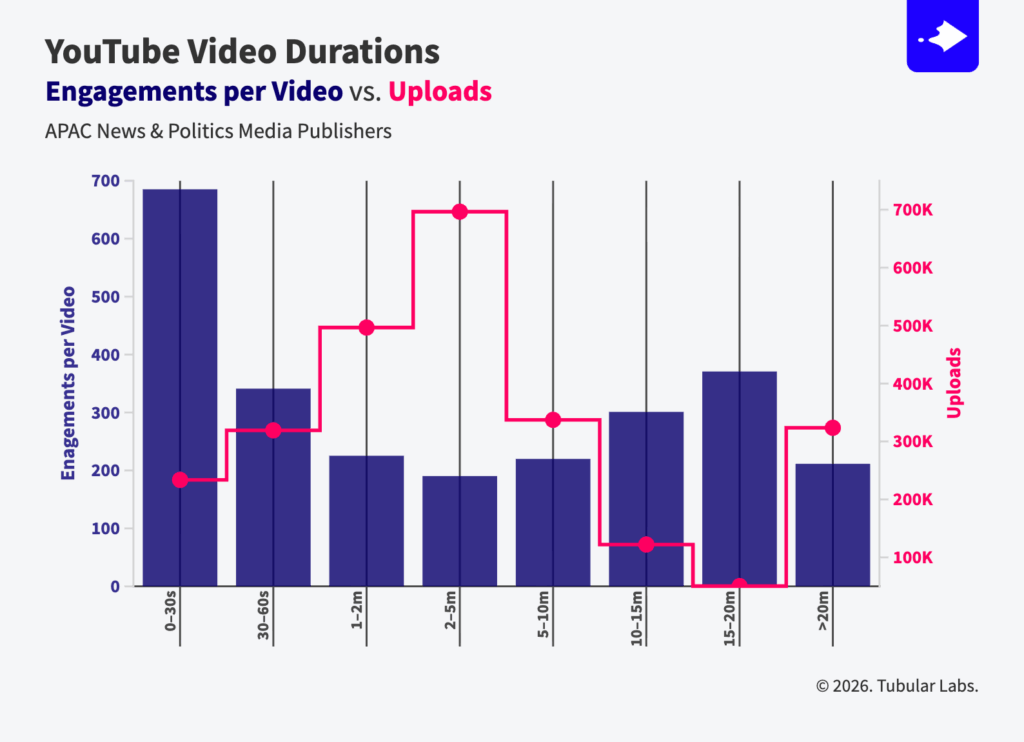
When evaluating optimal video duration, the data shatters the myth of a universal "sweet spot." In the APAC region, News & Politics publishers face a bifurcated audience.
- The Extremes Win: APAC audiences display the highest engagement metrics for either ultra-short updates lasting between 0 to 30 seconds, or deep-dive, long-form segments spanning 15 to 20 minutes.
- The Volume Trap: Conversely, mid-length videos (ranging from 2 to 5 minutes) dominate upload volume across APAC newsrooms. However, these mid-tier formats fail to maximize engagement per video.
The Implication: Publishers relying heavily on standard mid-length videos are frequently optimizing for operational output rather than maximum impact. They risk producing content that is too long for a quick scroll, yet too brief to satisfy a viewer looking for comprehensive analysis.
2. The LATAM Timing Mismatch: Publishing Habits vs. Peak Engagement
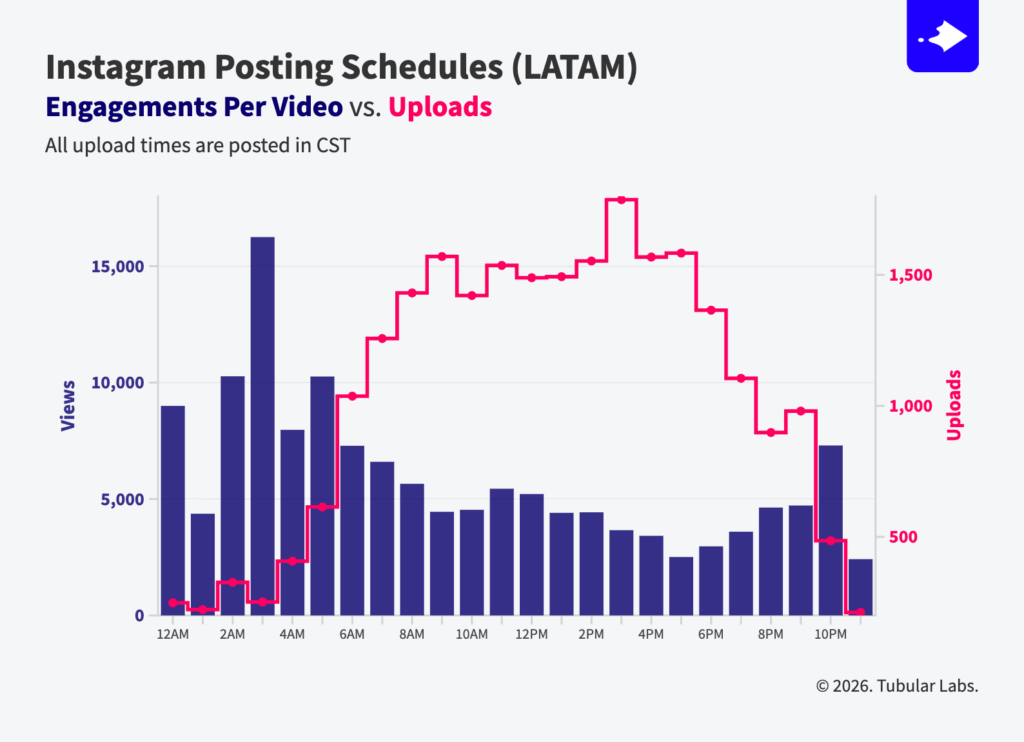
In Latin America, the data exposes a profound inefficiency in newsroom publishing workflows.
- Publisher Behavior: LATAM media publishers upload the vast majority of their news and politics content during the mid-to-late afternoon, clustering heavily around 3:00 PM to 3:59 PM CST.
- Audience Behavior: Real-world engagement metrics tell a completely different story. Audience engagement per video actually peaks much earlier in the day, specifically between 3:00 AM and 3:59 AM CST.
The Implication: This stark temporal mismatch presents an immediate optimization opportunity. Newsrooms that shift a portion of their distribution pipeline toward early-morning delivery windows can capture stronger per-video engagement while encountering significantly less publisher noise and competition.
3. EMEA Hashtag Strategies: Beyond Basic Categorization
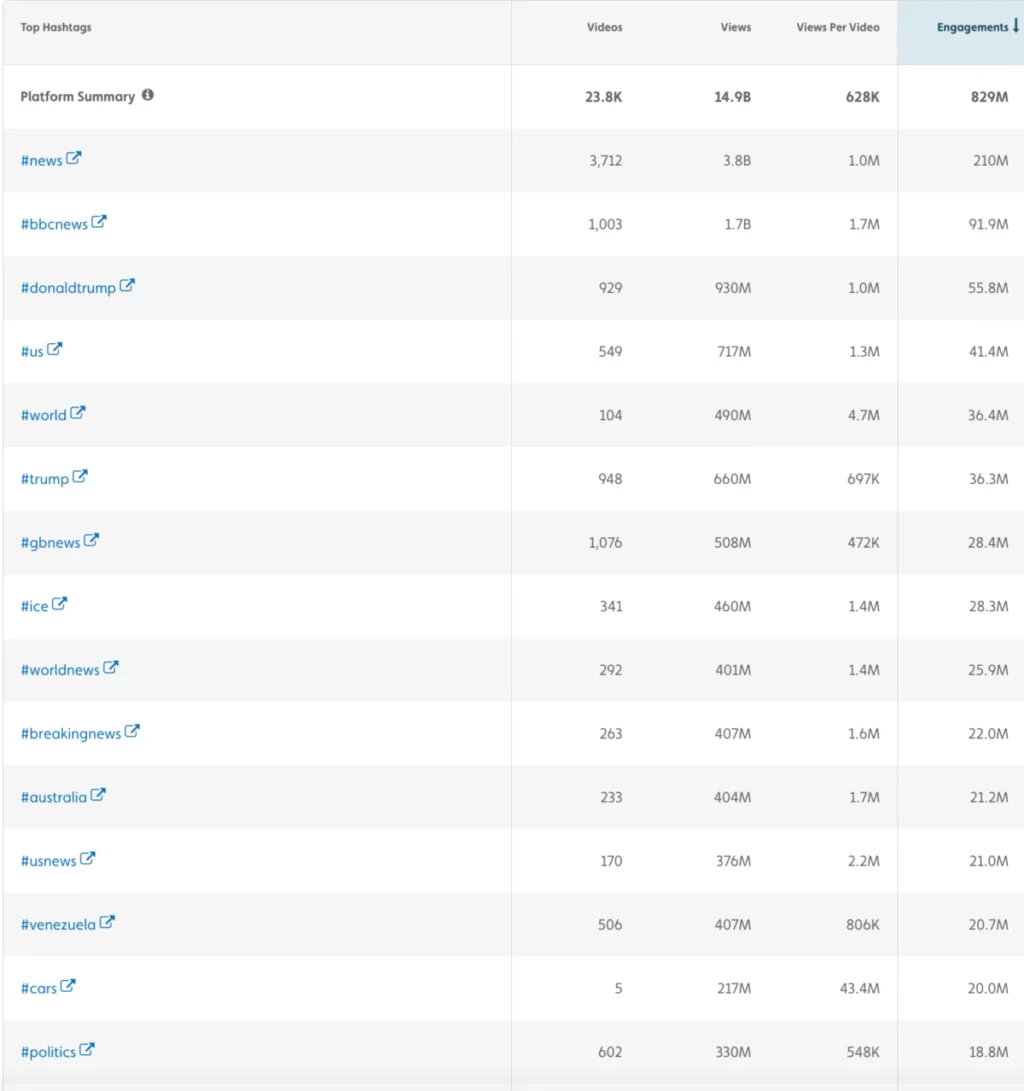
In the EMEA region, an analysis of the most-viewed News & Politics hashtags on Instagram reveals that publishers are utilizing metadata far beyond simple categorization. The top-performing tags feature a calculated blend of:
- Global political flashpoints (e.g.,
#trump,#ICE,#venezuela) - Major legacy broadcaster branding (e.g.,
#bbcnews) - Country-specific geographic identifiers that boost international discoverability.
The Implication: EMEA publishers are leveraging hashtags as strategic discovery tools. By combining hyper-local identifiers with global geopolitical keywords, newsrooms are successfully expanding their footprint, reinforcing brand authority, and helping international audiences contextualize events happening outside their domestic borders.
4. North American TikTok Dynamics: Mass Reach vs. Conversational Surges
Looking at North American publishers on TikTok between November 2025 and February 2026 highlights a fascinating divergence between viewership and genuine engagement.
- Mass Views via Hard News: High-profile breaking news events continue to drive immense raw viewership. For instance, major international developments—such as reports surrounding British heavyweight boxing champion Anthony Joshua following a fatal car accident in Nigeria—generated massive top-line reach (amassing roughly 180 million views within 30 days on platforms like Reuters’ TikTok channel).
- Explosive Engagement via Unexpected Humor: Conversely, content designed around serious topics can experience explosive engagement spikes when it triggers unexpected emotional or cultural reactions. For example, clips from crowd interviews at political protests (such as a viral interview regarding AR-15 purchases during an ICE protest) generated over 63.5 million engagements in just seven days. Despite the serious subject matter, online audiences heavily mocked or debated the nuanced human interactions, turning the post into a viral conversational anchor.
The Implication: TikTok users do not consume "hard news" in a vacuum. While breaking stories establish top-of-funnel awareness, engagement surges when content sparks organic conversation, cultural commentary, or humor. Newsrooms must design social packages not merely to inform, but to provoke thoughtful dialogue.
Official Responses and Industry Perspectives
Media strategists and data analysts emphasize that these findings signal a permanent maturation of digital news distribution.
Industry experts point out that the era of "spray-and-pray" social publishing—where newsrooms blasted identical video assets across every platform at uniform times—is officially over. Leading publishers are shifting toward a platform-native, audience-first methodology.
"Performance in News & Politics is no longer just about what you cover; it is fundamentally about how, when, and in what format you deliver it," noted digital media analysts reviewing the Tubular Intelligence data. "Audience behavior is entirely measurable, strategic, and actionable for any newsroom willing to listen to the data."
Implications: The Roadmap for Modern Newsrooms
The empirical evidence gathered across APAC, LATAM, EMEA, and North America outlines a clear strategic roadmap for media publishers, journalists, and brand marketers navigating the social video ecosystem:
- Embrace Format Polarization: Newsrooms must evaluate whether their standard video lengths are serving the audience or simply fitting old broadcast habits. Investing in hyper-concise vertical shorts alongside well-produced, long-form explanatory journalism yields far better engagement than sticking to the middle ground.
- Audit Publishing Schedules: Publishers must stop relying purely on traditional 9-to-5 newsroom hours. By testing unconventional distribution windows—such as capturing early-morning engagement spikes identified in regions like LATAM—brands can outmaneuver competitors and capture captive audiences.
- Treat Metadata as Editorial Strategy: Hashtags and keywords are not afterthoughts. In regions like EMEA, successful publishers use a sophisticated mix of brand identifiers, trending global figures, and localized tags to crack algorithmic search and broaden audience reach.
- Design for Conversation, Not Just Awareness: As demonstrated on platforms like TikTok, breaking news drives views, but emotional resonance, cultural relevance, and unexpected human elements drive deep engagement. Newsrooms that successfully translate complex political stories into culturally resonant, conversational formats will continue to dominate the digital landscape.
Ultimately, the data proves that the path forward for publishers is not about producing more content. It is about publishing smarter—tightly aligning content strategies with real-world audience behaviors, platform mechanics, and regional nuances.
