
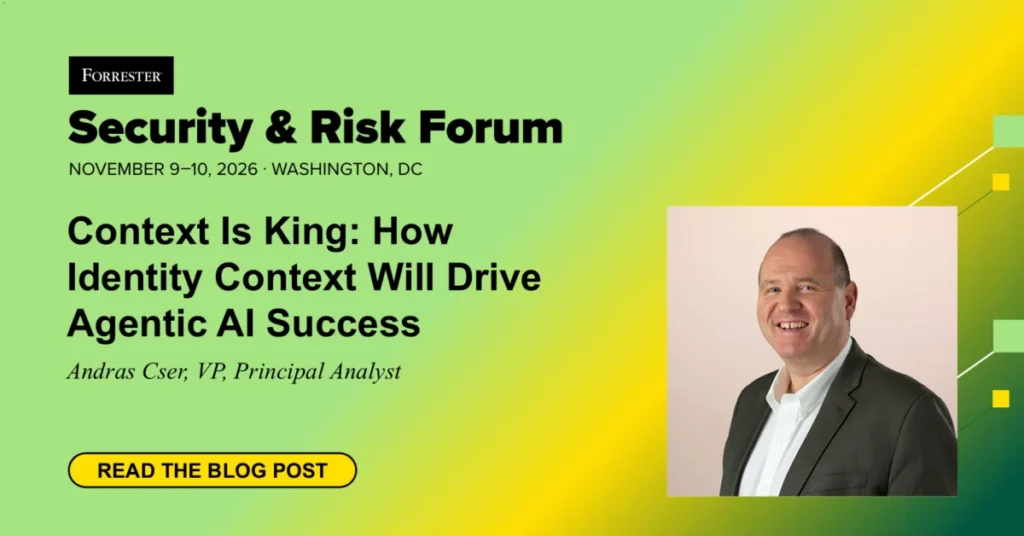
The Rise of Agentic AI: Securing the Next Frontier of Enterprise Autonomy and Identity Governance
As the artificial intelligence landscape matures, the tech industry is pivoting away from the novelty of generative content and stepping into a far more complex paradigm: action. The next wave of enterprise technology is defined by "Agentic AI"—autonomous systems designed not just to converse, write code, or generate imagery, but to execute complex operational workflows, make decisions, and interact with enterprise software securely and at scale.
However, this transition introduces unprecedented security and governance challenges. As autonomous agents are granted the capability to execute tasks independently, they inherently require digital identities, permissions, and access controls. Securing these non-human actors has rapidly become the most critical emerging frontier in cybersecurity.
This shifting paradigm will take center stage at the upcoming Forrester Security & Risk Forum, where industry leaders are gathering in Washington, D.C., to tackle the urgent need to operationalize agentic AI securely. Alongside these developments, major global players—from tech innovators across Europe, the Middle East, and Africa (EMEA) to fintech giants like Ant International—are actively reshaping their infrastructure to support autonomous agents, redefining the future of digital commerce and enterprise operations.
Main Facts: The Shift from Generative Content to Autonomous Action
The transition from generative AI to agentic AI marks a fundamental milestone in the evolution of enterprise software. While large language models (LLMs) revolutionized productivity by drafting emails, summarizing reports, and generating media, they fundamentally operated as passive tools requiring continuous human oversight.
Agentic AI changes this equation entirely. These systems possess goal-directed autonomy. Given an objective, an agent can break the task down into sub-components, utilize various tools and APIs, query databases, make financial transactions, and dynamically adapt its strategy based on real-time feedback.
- The Core Challenge: Operationalizing agentic AI securely. Organizations can no longer rely solely on traditional perimeter security or static user identity models.
- The Identity Frontier: Autonomous agents require machine identities. Managing the lifecycles, permissions, authentication protocols, and boundaries of these non-human identities is now a paramount enterprise security requirement.
- Contextual Foundations: Experts emphasize that organizations must establish robust contextual identity frameworks today to successfully govern autonomous systems tomorrow. Context—understanding why, how, and under what conditions an agent is taking an action—is the linchpin of secure agentic deployment.
Chronology: How Agentic AI Moved from Theory to Enterprise Reality
The journey toward agentic AI has accelerated dramatically over the last several years, shifting from academic research laboratories to the core of enterprise boardrooms.
Phase 1: The Generative Boom (2022–2023)
The release of breakthrough generative models captured global attention. Enterprises rushed to adopt chatbots and content generation tools. Security teams focused primarily on data privacy, preventing prompt injection attacks, and ensuring that proprietary corporate data was not ingested into public training models.
Phase 2: The Push Toward Workflow Automation (2024)
Organizations quickly realized that simple chat interfaces had limitations. The demand grew for AI that could do things rather than just talk about them. Early framework integrations (such as LangChain and AutoGPT) allowed developers to string together multi-step prompts, enabling AI to interface with external APIs. Security protocols struggled to keep up, often treating these semi-autonomous scripts with the same credentials used by human developers.
Phase 3: Commercial Integration and Protocol Standardization (2025–2026)
By 2025 and into 2026, agentic AI transitioned from experimental code to commercial reality. Major fintech and enterprise software providers began architecting platforms specifically built for autonomous interaction.
- September 2025: At its merchant-focused Voyage event in Shanghai, Ant International outlined its dual-track strategy, addressing immediate payment workflow friction while deliberately building infrastructure designed to support future AI agents.
- Late 2025 / Early 2026: Regulatory bodies and industry analysts began sounding the alarm on non-human identity proliferation. Awards programs, such as Forrester’s Technology & AI Awards for EMEA, began recognizing organizations that successfully balanced rapid technological innovation with trust, security, and measurable business outcomes.
- November 2026: Industry experts converge at the Forrester Security & Risk Forum in Washington, D.C., to establish definitive frameworks for securing agentic AI at scale, cementing identity governance as the foundational pillar of enterprise AI adoption.
Supporting Data & Industry Case Studies: EMEA Leadership and Ant International
The enterprise race toward agentic AI is not localized; it is driving strategic shifts across global markets, supported by measurable investments and operational restructuring.
Recognizing Excellence: Forrester’s 2026 Technology & AI Award (EMEA)
Technology leaders across Europe, the Middle East, and Africa face intense pressure. They are tasked with maintaining resilient, efficient IT systems while simultaneously driving organizational growth, building customer trust, and turning emerging technologies into tangible business value.
The Forrester Technology & AI Award highlights organizations that successfully navigate this complex landscape. Winners demonstrate that AI integration—particularly as organizations move toward autonomous agents—cannot sacrifice operational resilience or security compliance. Instead, trustworthy AI deployment acts as a competitive differentiator in the EMEA market.
Ant International: Fixing Today’s Payments, Building for Tomorrow’s Agents
The practical reality of transitioning to agentic AI is vividly illustrated by financial technology leaders. Much of the discourse surrounding agentic payments has historically remained locked in theoretical protocol discussions. However, companies like Ant International are taking a pragmatic, dual-pronged approach.
At the Voyage event in Shanghai, Ant International executives articulated a comprehensive strategy:
- Immediate Optimization: The company is focusing heavily on automating and fixing existing merchant payment and finance workflows. By streamlining today’s friction points, organizations build the digital maturity required for advanced automation.
- Future-Proofing for Agents: Simultaneously, Ant International is building backend infrastructure designed to seamlessly accommodate autonomous financial agents. In the near future, these agents will negotiate, verify, and execute transactions on behalf of merchants and consumers autonomously. For this vision to succeed, financial protocols must integrate robust identity verification to prevent unauthorized automated transactions.
Official Perspectives and Keynote Insights
As enterprises rush to deploy autonomous workflows, industry analysts and security leaders are issuing clear warnings regarding governance.
According to upcoming keynotes at the Forrester Security & Risk Forum, the next phase of artificial intelligence will fail if organizations treat security as an afterthought. "The next wave of AI is not about generating content—it’s about taking action in a secure and operationalized manner," security analysts note.
Key themes emerging from upcoming security leadership sessions include:
- The Proliferation of Non-Human Identities: Traditional Identity and Access Management (IAM) systems were built for humans logging in from specific locations during standard business hours. Agentic AI shatters this model, generating countless dynamic, programmatic identities that require real-time authentication and permission scoping.
- The Imperative of Contextual Governance: Establishing a contextual identity foundation is no longer optional. Organizations must be able to evaluate the context of an agent’s request—such as its underlying intent, the data it is accessing, and the potential downstream effects—before granting execution rights.
- Cross-Industry Collaboration: Financial institutions, tech providers, and cybersecurity standard bodies must collaborate to establish universal protocols for agentic authentication. Without standardized guardrails, autonomous systems risk bypassing traditional compliance frameworks.
Implications: What Enterprise Leaders Must Do Next
The transition to agentic AI carries profound implications for enterprise architecture, risk management, and corporate strategy. Organizations that fail to adapt their security postures risk exposing themselves to catastrophic operational errors, data breaches, and financial fraud executed at machine speed.
To navigate this new frontier successfully, enterprise leaders should take the following strategic steps:
1. Overhaul Identity and Access Management (IAM) for Machines
CISOs and IT leaders must audit their current IAM infrastructure. Traditional role-based access control (RBAC) designed for human employees is insufficient for autonomous agents. Organizations must implement dynamic, attribute-based access controls (ABAC) and zero-trust architectures specifically tailored for non-human workers.
2. Prioritize Contextual Security Foundations
As highlighted by leading security analysts, context is the ultimate safeguard. Enterprises must deploy monitoring tools that analyze not just what an AI agent is doing, but why it is doing it. Maintaining visibility into the decision-making chain of autonomous agents ensures compliance and prevents runaway automated loops.
3. Adopt a Dual-Track Investment Strategy
Following the model of industry innovators, technology leaders should balance short-term operational improvements with long-term agentic readiness. Fixing foundational workflows—such as data hygiene, API standardization, and payment infrastructure—creates the stable bedrock necessary to deploy autonomous agents safely in the future.
4. Engage with Industry Forums and Regulatory Frameworks
Security leaders cannot operate in a silo. Participating in major industry events, such as the Forrester Security & Risk Forum, allows organizations to share threat intelligence, align on emerging security standards, and prepare for upcoming regulatory scrutiny regarding autonomous systems.
Conclusion
Agentic AI represents the most exciting—and potentially perilous—frontier in modern enterprise technology. By shifting the focus from passive content generation to active, autonomous execution, businesses unlock unprecedented levels of efficiency and capability. However, this power demands an equally monumental commitment to security, identity governance, and operational resilience.
As organizations prepare for the challenges and opportunities ahead, establishing contextual identity foundations today will determine which enterprises thrive in the age of autonomy and which are left vulnerable to its risks. The future belongs to those who can master both the intelligence of the agent and the security of the enterprise.
