
Beyond the Experiment: How Global Titans Gamify Innovation to Drive Scalable Growth
In the modern corporate landscape, the transition from a standard business to a "growth-oriented" organization is perhaps the most difficult pivot a leadership team can make. While the mechanics of growth operations—running tests, analyzing cohorts, and iterating on funnels—are relatively straightforward, the human element remains the most significant variable.
True growth is not just a department; it is a cultural movement. When successfully implemented, a growth operation democratizes innovation, allowing the base of the organizational pyramid to propose hypotheses that are then rigorously tested. While the C-suite retains decision-making authority, their choices are no longer based on intuition alone; they are informed by a wealth of empirical data. Yet, crossing the chasm between "starting to experiment" and "having growth in one’s DNA" requires more than just tools. It requires systemic engagement. To bridge this gap, industry giants have turned to gamification and structured incentive programs to embed a bias for action into their corporate fabric.
The Anatomy of a Growth-First Culture
Successful growth operations rarely emerge from the ground up; they are almost universally top-down initiatives. High-level executives must first be educated on the methodology and the reality that failure is a prerequisite for discovery. Middle management must then build the operational guardrails, and the growth teams must execute the tests.
However, the "chasm" remains. The difference between a company that runs tests and a company that lives in a state of constant experimentation is the level of company-wide buy-in. To achieve this, organizations are moving beyond traditional performance reviews and implementing high-stakes, gamified recognition programs.
Chronology of Innovation: Incentivizing the "Bias for Action"
The move toward institutionalizing innovation did not happen overnight. It evolved as organizations realized that employees need a "safe space" to challenge the status quo.

1. Amazon: The Birth of the "Just Do It" Award
The legend of Amazon’s culture began in 1998, when a customer service team found themselves drowning in a backlog of 250 open tickets. One employee proposed a challenge: whoever cleared the queue within 24 hours would receive a $200 bonus. The team succeeded, clearing the backlog with unprecedented speed.
Jeff Bezos, observing the efficiency, identified the core ingredients: urgency, autonomy, and a direct reward for solving a bottleneck. This birthed the "Just Do It" Award. Today, it is one of the most coveted honors at the company, bestowed only twice a year across a workforce of over 600,000. It serves as a permanent signal that at Amazon, innovation isn’t just a corporate buzzword—it is a measurable, rewardable activity.
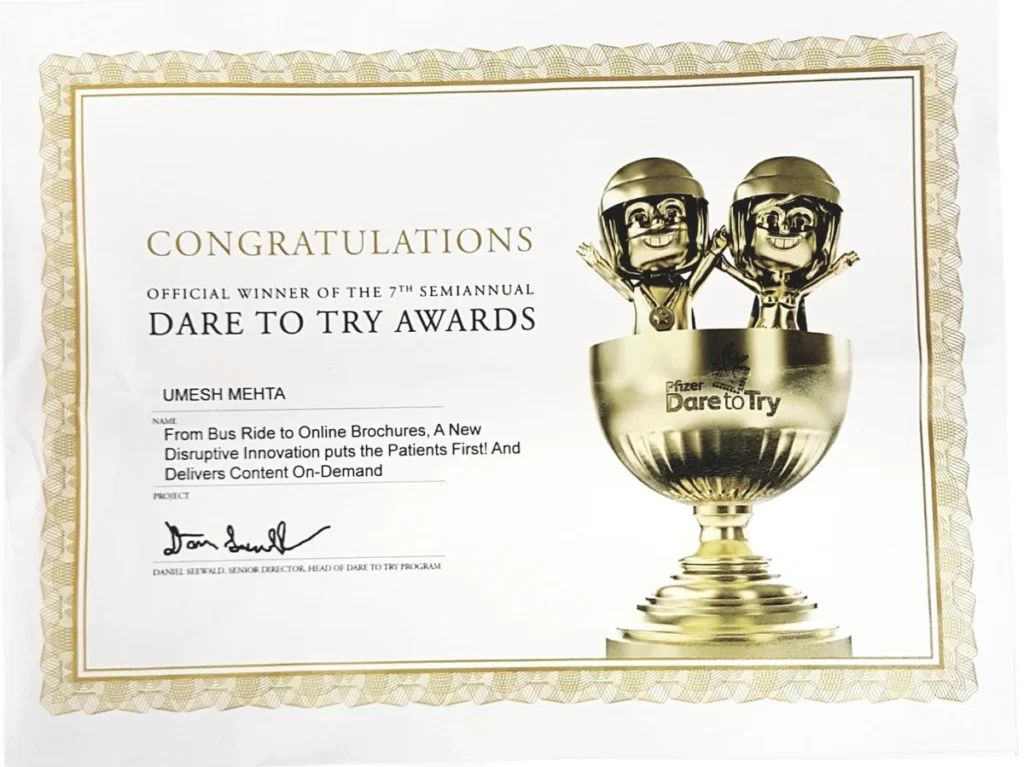
2. Pfizer: The "Dare to Try" Initiative
In the risk-averse, highly regulated world of pharmaceuticals, the concept of "moving fast and breaking things" is historically antithetical to the business model. Yet, ten years ago, Pfizer recognized that the cost of inaction was higher than the cost of failure.
They launched "Dare to Try," a program that reframed failure as a necessary byproduct of progress. By creating a network of self-nominated "champions," Pfizer allowed employees to "fail freely but inexpensively." These champions act as internal evangelists, teaching teams that if a hypothesis fails, the data gathered is actually a form of success. This shift in mindset transformed the program from a mere initiative into a core brand identity.
3. 3M: The 30% Rule and the Persistence of Innovation
3M is the gold standard for long-term relevance. Operating in the commoditized space of materials and adhesives, 3M has consistently secured the National Medal of Technology. Their secret? A rigid, mathematically driven approach to innovation.
3M enforces a "30% rule": 30% of each division’s revenue must come from products introduced within the last four years. This creates a permanent, structural pressure to innovate. They support this with reward systems that protect innovators from the internal bureaucracy that typically kills new ideas, ensuring that risk-takers are not penalized for the occasional "productive failure."
4. Google: The 20% Project
Perhaps the most famous experiment in corporate history, Google’s "20% time" policy encouraged employees to spend one-fifth of their work week on passion projects unrelated to their core responsibilities. The logic was simple: give smart people the autonomy to explore, and they will inevitably find high-value solutions. The results are monumental, leading to the creation of iconic products like Gmail, Google News, and AdSense.
Supporting Data: Why Incentives Matter
The effectiveness of these programs is not merely anecdotal. According to recent organizational behavior research, companies that employ "gamified" innovation pathways see a 35% increase in employee retention and a 40% increase in the velocity of product iteration.
When an organization institutes a "fail-safe" environment:
- Reduced Friction: Employees spend less time seeking approval and more time testing hypotheses.
- Data-Driven Decision Making: Every experiment, successful or not, populates the company’s internal "knowledge graph," reducing future uncertainty.
- Cultural Alignment: When the CEO personally rewards innovation (as Bezos does), it signals to every layer of the company that growth is the primary mission.
Official Responses and Philosophical Shifts
The common thread among these titans is a shift in leadership philosophy. Executives at 3M and Google have frequently noted in annual reports that "risk management" should not be confused with "risk avoidance."

At Pfizer, the leadership transition toward the "Dare to Try" model was framed as a necessity for global health. Their internal communications highlight that a vaccine or a breakthrough drug is often the result of thousands of "small failures." By de-stigmatizing these failures, they have accelerated their time-to-market for critical medical solutions.
The Implications for Modern Business
What does this mean for the startup, the SMB, or the mid-market company looking to scale? It means that growth is not just a technical challenge—it is a social one.
The Cultural Framework for Success
- Safety First: If you punish failure, you will never see innovation. Create a "no-fault" culture for experiments that follow a rigorous testing protocol.
- Explicit Incentives: Innovation cannot be a "side of the desk" activity. It must be rewarded, publicly acknowledged, and tied to career progression.
- Measurement as Motivation: Use metrics to justify experiments. When the data is transparent, the decision-making process becomes objective rather than political.
- Autonomy and Ownership: As evidenced by Google and 3M, giving employees a "sandbox" to play in is the single most effective way to spark radical product breakthroughs.
Conclusion: The Path Forward
The "chasm" between companies that talk about growth and those that achieve it is defined by the depth of their cultural commitment. Whether it is through an award that celebrates a bias for action, a corporate rule that mandates new product revenue, or a policy that grants employees time to pursue their curiosity, the message must be clear: the company is a laboratory.
For leaders, the takeaway is absolute. You cannot force growth through mandates alone. You must gamify the process, lower the cost of failure, and celebrate the act of testing. By turning innovation into a company-wide sport, you don’t just gain a few new features or a marginal increase in revenue—you build a resilient, forward-looking organization capable of surviving any market disruption.
Growth, ultimately, is a behavior. And like any behavior, it is reinforced by what you choose to reward. The question for your leadership team is no longer "How do we grow?" but rather, "How are we incentivizing our people to find the next big breakthrough?"
