
The Dawn of the Agentic Supply Chain: Why Autonomous AI Will Expose Your Data Weaknesses First
Main Facts
The modern global supply chain is on the cusp of an unprecedented operational revolution, driven by the rapid evolution of artificial intelligence. Traditional supply chains have long relied on laborious, human-intensive monitoring, manual reporting, and reactive problem-solving. However, the emergence of agentic AI promises to shift this paradigm entirely, transforming supply networks into autonomous, goal-driven ecosystems. In an agentic supply chain, AI agents proactively orchestrate complex workflows—spanning planning, sourcing, manufacturing, logistics, inventory, and fulfillment—to deliver optimal business outcomes. Meanwhile, human operators retain ultimate control over high-level strategy, governance, and complex operational exceptions.
Yet, this transformative vision comes with a stark reality check for enterprise leaders: agentic AI will not fix a weak data foundation; it will simply expose your data weaknesses much faster.
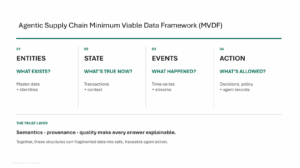
Before autonomous agents can independently recommend or execute critical operational decisions, they require a robust, reliable data bedrock known as a Minimum Viable Data Foundation (MVDF). This architecture ensures that AI agents can accurately identify the entities involved, understand their current operational states, interpret historical context, and determine which actions are permitted under corporate policy.
To achieve this, organizations must establish an authoritative system of action. This requires deeply harmonized master data covering products, locations, suppliers, customers, and resources, alongside a shared semantic model that unifies disparate operational silos. Without these foundational elements, deploying agentic AI scales operational chaos rather than efficiency.
Chronology and Evolution of Supply Chain Automation
From Manual Oversight to Reactive Digitization
For decades, supply chain management was defined by siloed enterprise resource planning (ERP) systems, spreadsheets, and manual tracking. Operational visibility was frequently retrospective, relying on lagging indicators and weekly or monthly planning snapshots. When disruptions occurred—such as port congestion, supplier bankruptcies, or sudden spikes in consumer demand—supply chain teams spent days gathering data just to understand the scope of the problem before attempting to formulate a manual response.
The Rise of Predictive and Prescriptive Analytics
Over the past ten years, supply chain technology evolved toward predictive and prescriptive analytics. Organizations implemented control towers and machine learning models to forecast demand spikes, identify potential bottlenecks, and suggest risk-mitigation strategies. However, these tools remained fundamentally passive or advisory. Human intervention was still required to interpret the alerts, validate the underlying data, contact external partners, and execute corrective actions across different enterprise systems.
The Shift to Autonomous Agentic Orchestration
The current era introduces agentic AI—systems capable of autonomous reasoning, multi-step planning, and direct execution. Rather than merely alerting a human manager to a potential inventory stockout, an agentic supply chain system can independently evaluate alternative suppliers, assess cost and lead-time constraints, negotiate terms via digital protocols, issue purchase orders, and update logistics schedules in real time.
However, this quantum leap in autonomy requires a fundamental shift in data architecture. An AI agent cannot improvise effectively in a chaotic data environment. It requires an orchestrated symphony of clean, synchronized, and context-aware data to operate safely and consistently.
Supporting Data and Technical Architecture: Building the MVDF
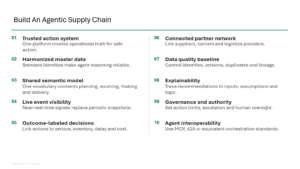
Implementing an agentic supply chain requires technology leaders to architect data systems that meet stringent requirements for real-time visibility, governance, and interoperability. Industry frameworks highlight several critical pillars necessary to support an enterprise agentic ecosystem.
1. An Agent Orchestra Needs to Keep Time (Event-Driven Visibility)
AI agents cannot make sound decisions based on stale planning snapshots. They must respond continuously to live operational conditions. This necessitates event-driven visibility that extends far beyond the enterprise firewall, integrating deeply with external suppliers, third-party logistics (3PL) providers, and freight carriers. Furthermore, rigorous data quality controls must be enforced to handle identity resolution, lineage, versioning, data freshness, and confidence scoring.
2. An Agent Orchestra Needs a Conductor (Interoperable Standards)
For multiple specialized AI agents to collaborate effectively across an enterprise, interoperable orchestration standards are non-negotiable. These standards enable agents to communicate, delegate tasks, and verify outcomes reliably. This governance layer ensures that automated actions remain bounded by strict corporate policies, thresholds, and safety parameters.
3. The Five Shared Anchors of an MVDF
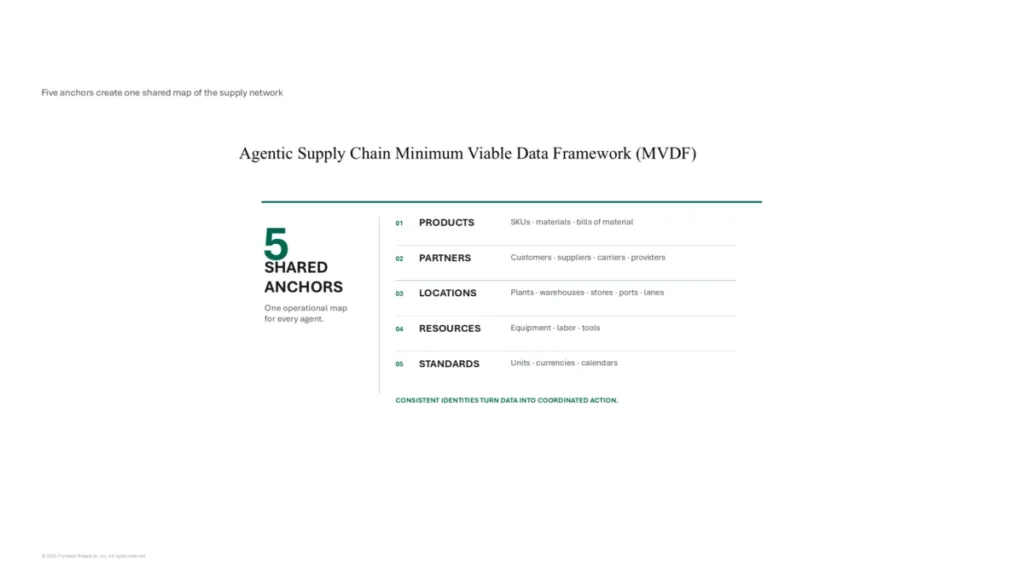
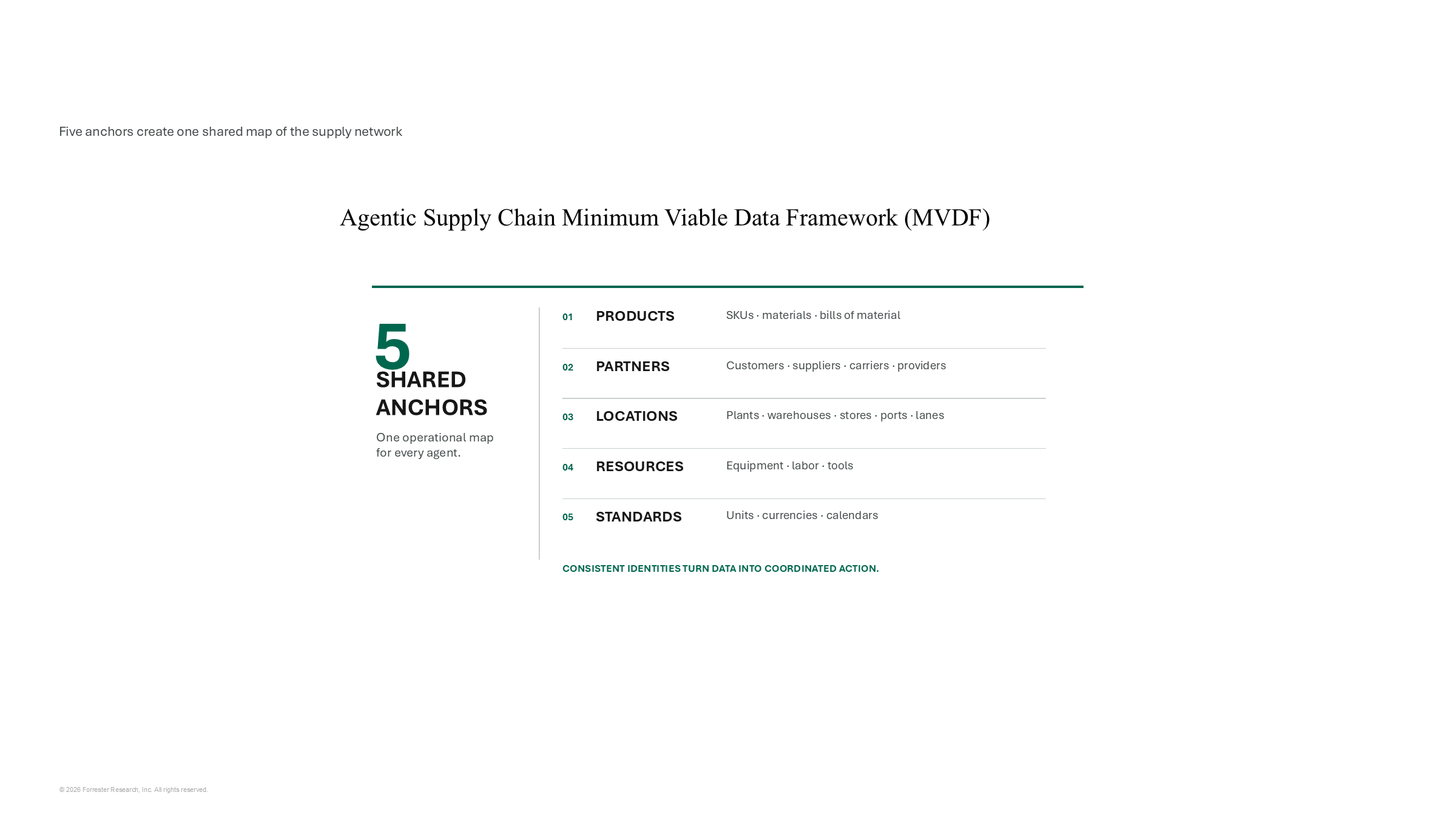
An effective Minimum Viable Data Foundation standardizes five core operational anchors to provide a consistent baseline for agentic reasoning:
- Products: Universal item definitions, specifications, and variants.
- Partners: Suppliers, vendors, customers, and carriers with verified identities.
- Locations: Warehouses, manufacturing plants, ports, and transit nodes.
- Resources: Machinery, labor pools, fleet vehicles, and IT assets.
- Operating Standards: Contractual terms, regulatory constraints, service-level agreements (SLAs), and operational thresholds.
By assigning an authoritative enterprise definition and a persistent identifier to each anchor, organizations can map legacy source-system records, resolve duplicate entries through governed match-and-merge rules, and maintain clear relational links across the supply chain network.
Official Perspectives and Industry Guidance
As organizations rush to capitalize on artificial intelligence, technology analysts and enterprise architects are urging caution against premature AI deployment without adequate data preparation.
Industry experts emphasize that the success of agentic AI is inextricably linked to data hygiene and semantic alignment. Harmonized master data and a shared semantic model are consistently identified as foundational prerequisites for digital maturity. When enterprises attempt to bypass data harmonization and launch advanced AI models directly on top of legacy, fragmented databases, the results are often disastrous: AI hallucinations, unauthorized transactions, compliance breaches, and automated supply chain disruptions.
To help organizations navigate this transition, advisory bodies recommend conducting comprehensive data audits to identify gaps in master data management (MDM) and product lifecycle management (PLM) systems. Enterprises are encouraged to establish cross-functional data governance steering committees comprising supply chain leaders, data engineers, and compliance officers to define the operational boundaries and ethical frameworks within which AI agents will operate.
Implications for Enterprise Leaders
The transition toward agentic supply chains carries profound strategic, organizational, and technical implications for modern enterprises.
Strategic Implications: Competitive Advantage Through Speed
Organizations that successfully master the data foundations required for agentic supply chains will achieve unprecedented operational agility. By automating routine decision-making and exception handling, companies can radically reduce lead times, minimize excess inventory, optimize working capital, and respond to geopolitical or environmental disruptions in minutes rather than weeks. This capability will establish a definitive competitive advantage in an increasingly volatile global marketplace.
Organizational Implications: Redefining the Workforce
The rise of agentic AI does not eliminate the need for human talent; rather, it elevates it. Supply chain professionals will transition from transactional task execution—such as chasing purchase orders and updating spreadsheets—to strategic oversight, policy governance, and exception management. Upskilling the workforce to work alongside autonomous agents, interpret agent decision trails, and refine governance parameters will become a critical human resources priority.
Technical Implications: Eradicating Silos
Enterprise architecture teams face an urgent mandate to break down historical data silos. Legacy ERP, warehouse management systems (WMS), and transportation management systems (TMS) must be integrated via robust semantic layers and event-driven architectures. Organizations that fail to modernize their data foundations will find themselves locked out of the autonomous future, burdened by legacy systems that cannot support the high-speed data feeds required by modern AI agents.
Governance and Risk Management
Because agentic AI takes direct operational actions—such as committing funds, rerouting shipments, or altering production schedules—risk management becomes paramount. Enterprises must build robust observability tools that track every agent decision, preserving a clear audit trail of what data the agent consumed, which policies it applied, and why a specific action was chosen. Explainability and compliance cannot be treated as an afterthought; they must be baked directly into the Minimum Viable Data Foundation from day one.
