
Beyond Model Superiority: Inside Alibaba Cloud’s Full-Stack Pivot to the Agent Era at Apsara Conference 2026
Main Facts
At the flagship Apsara Conference 2026, Alibaba Cloud aggressively redefined its market position, shifting the enterprise artificial intelligence conversation away from raw model capabilities toward autonomous, scalable execution. Building upon its 2025 foundation—where the company first packaged infrastructure, foundational models, and platform services into a unified AI stack—Alibaba unveiled an expansive, end-to-end vision for the "Agent Era."
The core takeaway from the 2026 gathering is that the next phase of corporate AI competition will not be decided by who possesses the largest or most powerful foundational model. Instead, victory will belong to the ecosystem that can successfully operationalize intelligent agents at scale, embed deep business context, and ensure continuous autonomous improvement over time.
Alibaba’s newly minted strategy centers on the Agent-Native Cloud, a comprehensive paradigm spanning specialized silicon, underlying cloud infrastructure, enterprise data repositories, foundation models, specialized agent frameworks, and global operational systems. By transitioning from AI-assisted human productivity to autonomous, agent-driven execution, Alibaba is attempting to rewrite the enterprise software playbook. Furthermore, the conference underscored "context engineering" as the ultimate strategic control point, highlighting that proprietary enterprise knowledge is the primary differentiator for turning generic AI into a tailored business engine.
Chronology: The Evolution of Alibaba’s AI Strategy
To understand the magnitude of Alibaba Cloud’s 2026 declarations, it is necessary to trace the rapid, calculated evolution of the company’s cloud and artificial intelligence roadmap over recent years:
- Pre-2024: The Infrastructure Foundation. Alibaba Cloud spent years fortifying its global hyperscale infrastructure, focusing on high-performance computing, distributed storage, and elastic resource allocation to support massive data workloads.
- Apsara Conference 2025 (The AI-Native Pivot): Alibaba introduced its unified AI stack. For the first time, infrastructure, foundation models (such as the Qwen family), and platform services were harmonized into a single cohesive offering. The company positioned itself as a premier AI-native cloud provider, aiming to simplify how enterprises consumed raw computing power and machine learning tools.
- Late 2025 to Early 2026: The Shift to Autonomy. As foundational models became ubiquitous and commoditized, market demand shifted. Enterprises grew tired of static chat interfaces and simple productivity assistants; they began demanding systems capable of executing complex, multi-step workflows without constant human intervention.
- Apsara Conference 2026 (The Agent-Native Cloud Era): Alibaba formally retired the notion that infrastructure and models exist in silos. Unveiling a synchronized, full-stack platform covering silicon, data, models, and multi-agent frameworks, Alibaba signaled a definitive move into the Agent Era, asserting that agentic orchestration is the ultimate frontier of enterprise cloud computing.
Supporting Data & Ecosystem Dynamics
The urgency behind Alibaba Cloud’s 2026 announcements is driven by shifting market dynamics and the rapid maturation of generative AI technologies within global enterprises.
- The Commoditization of Foundation Models: Industry data leading up to 2026 indicates that performance gaps between major foundational models have compressed significantly. As inference costs plummet and open-source models proliferate, raw model intelligence is no longer a sustainable competitive moat for cloud providers.
- The Rise of Multi-Agent Frameworks: According to enterprise technology deployment metrics, organizations are increasingly looking to deploy fleets of cooperative AI agents—specialized digital workers capable of communicating with each other, dividing labor, and executing long-running business processes across supply chains, customer service, and financial operations.
- Context and Identity Integration: Market studies emphasize that security, data privacy, and proprietary business context represent over 70% of the friction points enterprises face when scaling AI. Alibaba’s strategic focus on context engineering directly addresses this bottleneck, ensuring that AI systems are anchored in secure, identity-aware business logic rather than generic web data.
- Full-Stack Cohesion: While legacy cloud providers often force enterprises to stitch together disparate third-party silicon, model repositories, and orchestration layers, Alibaba’s 2026 strategy relies on a tightly integrated hardware-to-application pipeline designed to minimize latency and maximize token throughput for heavy agentic workloads.
Official Responses and Industry Perspectives
The announcements at the Apsara Conference 2026 drew intense scrutiny and analysis from global technology advisory firms, industry analysts, and enterprise leaders.
The Analyst Perspective (Forrester Insights)
Leading technology analysts have closely tracked Alibaba’s strategic pivot, viewing it as a bellwether for the broader global cloud market.
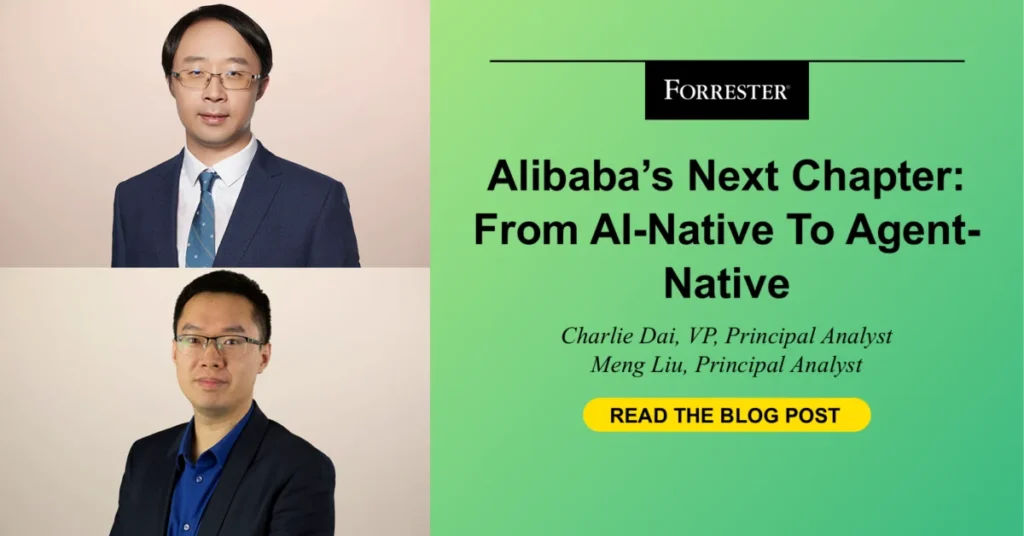
- Charlie Dai, expert in AI-native cloud, agentic AI, context engineering, and harness engineering, notes that the enterprise software landscape has fundamentally crossed a threshold. The conversation is no longer about testing what a model can do in a sandbox, but how organizations can safely harness, govern, and scale autonomous agents within complex operational environments.
- Meng Liu, specialist in enterprise fraud management, identity verification, fintech, and security and risk in financial services, emphasizes the critical role of identity and context. As autonomous agents take on higher-value transactional tasks, traditional identity and access management (IAM) frameworks are being pushed to their absolute limits. Securing agentic workflows requires rigorous identity context to prevent systemic vulnerabilities and financial fraud.
Enterprise Reactions
Early adopters attending the conference reported a palpable shift in tone among technology buyers. CIOs and CTOs are increasingly skeptical of vendor pitches that lead solely with benchmark scores or parameter counts. Instead, enterprise leaders are demanding architectural blueprints that demonstrate how AI systems can securely ingest proprietary databases, interact with legacy enterprise resource planning (ERP) systems, and maintain deterministic reliability under real-world operational stress.
Strategic Implications for Enterprise Leaders
Alibaba Cloud’s evolution toward an Agent-Native infrastructure carries profound implications for technology leaders across all industries, extending far beyond the vendor’s direct customer base. To remain competitive in the Agent Era, enterprise decision-makers must recalibrate their strategic roadmaps:
1. Look Beyond Headline Model Announcements
Chasing the newest, largest foundational model is a diminishing returns game. Enterprise leaders must pivot away from model-centric evaluations and focus heavily on infrastructure readiness. The real differentiator is the underlying architecture that allows models to connect, reason, and execute tasks securely within corporate boundaries.
2. Prioritize Context Engineering
As models become commoditized, proprietary corporate data and contextual relevance become the primary drivers of business value. Organizations must invest heavily in data cleanliness, semantic layering, and retrieval-augmented generation (RAG) pipelines. An AI system is only as intelligent as the context it is permitted to access; without deep business awareness, agents remain generic and ineffective.
3. Redefine Identity and Security for Autonomous Agents
Traditional cybersecurity models assume a human is always at the keyboard authorizing actions. In an agent-driven enterprise, software agents will autonomously initiate transactions, access sensitive databases, and collaborate with external systems. Enterprise security teams must establish robust identity context frameworks, continuous monitoring, and strict guardrails to govern autonomous agent behavior.
4. Build for Orchestration, Not Just Automation
Moving from AI-assisted productivity to agent-driven execution requires a shift in organizational mindset. Leaders must design workflows where multiple specialized agents can collaborate—handoff tasks, resolve conflicts, and learn from human feedback loops. Harness engineering and multi-agent orchestration platforms will form the backbone of next-generation enterprise applications.
5. Future-Proof the AI Stack
Organizations must avoid vendor lock-in while demanding deep integration. Whether partnering with Alibaba Cloud or other global infrastructure providers, enterprises should seek out full-stack capabilities—ranging from optimized silicon to flexible agent frameworks—that can scale seamlessly as autonomous workloads expand.
For enterprises navigating the complex transition toward agentic AI, context engineering, and secure cloud operations, deeper strategic guidance is available. Technology leaders can engage with industry experts such as Charlie Dai (specializing in AI-native cloud, agentic AI, and context engineering) and Meng Liu (specializing in enterprise fraud, fintech security, and risk management) to structure resilient, future-proof AI roadmaps.
