
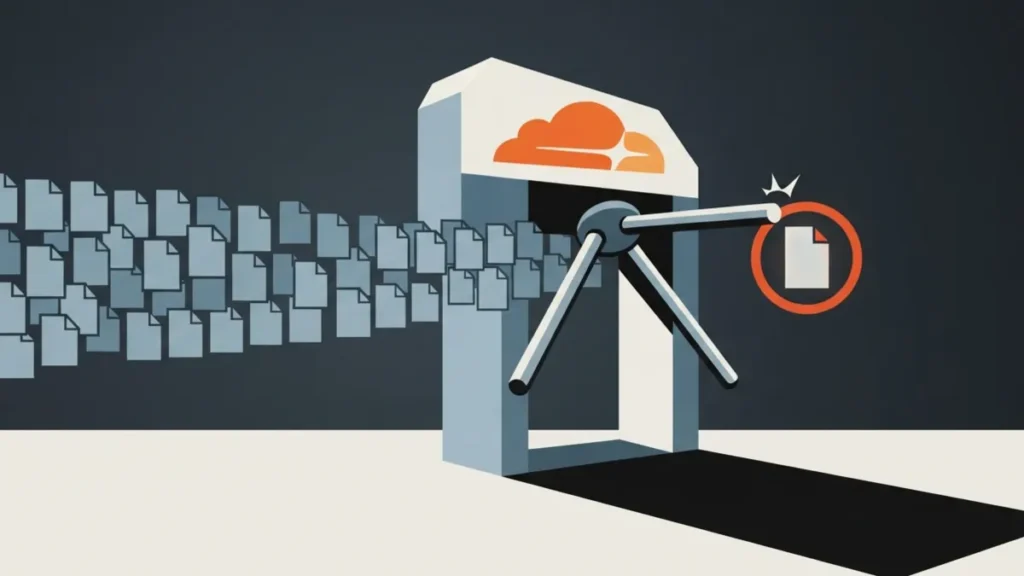
The Evolution of the Web Economy: Cloudflare’s Pivot to "Pay-Per-Use" AI Monetization
On July 1, 2026—a date now cemented in the industry calendar as "Content Independence Day"—Cloudflare officially signaled a paradigm shift in how the internet values human-generated content. In a move that could redefine the symbiotic, yet increasingly strained, relationship between web publishers and artificial intelligence developers, Cloudflare announced it is moving away from its experimental "Pay-Per-Crawl" model toward a more sophisticated "Pay-Per-Use" framework.
The announcement, spearheaded by Matthew Conroy on the company’s official blog, represents a pragmatic response to the unsustainable realities of the modern AI ecosystem: a web where bots consume more bandwidth than humans, and where content owners are seeing their traffic eroded by AI-generated summaries that offer little in the way of attribution or financial compensation.
The Core Shift: From Mass Harvesting to Meaningful Value
For the past year, Cloudflare has operated under the assumption that the "Pay-Per-Crawl" model—which utilized the dormant HTTP 402 "Payment Required" standard—was the best way to curb the excesses of AI scrapers. While innovative, the company now admits that crawling is a fundamentally flawed proxy for value.
"A single page might be crawled once and then cited in thousands of AI-generated answers, or crawled repeatedly and never cited at all," the company noted in its announcement. By shifting to a "Pay-Per-Use" model, Cloudflare is attempting to align financial incentives with tangible outcomes. Under this new logic, publishers are not compensated for the act of being scanned by a bot, but rather for the utility their content provides when it is actually synthesized into an answer for an end user.
This shift is being piloted through two distinct commercial experiments. The first, in partnership with Ceramic.ai, focuses on a "pay-per-query" model. According to Ceramic.ai founder Anna Patterson, the goal is to provide a seamless, programmatic way for millions of content owners to be compensated every time their information appears in a search result. The second partnership, with You.com, explores an on-demand payment structure where AI agents pay for premium content at the precise moment of consumption, eliminating the need for upfront licensing agreements.
Chronology: A Year of "Content Independence"
The path to this announcement has been marked by a series of aggressive technical and policy interventions by Cloudflare.
- July 1, 2025: Cloudflare marks the inaugural "Content Independence Day," launching the private beta of its "Pay-Per-Crawl" system. This allowed publishers to set pricing or block access for AI crawlers using the HTTP 402 protocol.
- August 2025: Cloudflare expands the 402 framework, enabling publishers to embed specific licensing instructions. At this stage, the company highlights the gross imbalance in the ecosystem: some AI crawlers were fetching over 38,000 pages for every one referral link generated.
- September 2025: Data reveals that training-related crawling accounts for nearly 80% of all AI bot activity, while search-related traffic continues to decline, signaling that the "open web" is being consumed primarily to train models rather than to serve users.
- April 2026: A landmark study conducted with ETH Zurich exposes that AI crawlers are effectively breaking the web’s cache layer. Because AI bots prioritize unique content, they bypass the efficiencies of standard caching, placing immense strain on server infrastructure.
- June 2026: Cloudflare reports that automated traffic now constitutes 57.4% of all web traffic. The ratio of "legitimate" bots to human users has reached a tipping point, with re-fetching stale content accounting for over half of all bot-driven traffic.
- July 1, 2026: The launch of the "Freshness Signals" research program and the pivot to "Pay-Per-Use" models.
Supporting Data: The Cost of the "Stale" Web
The impetus for today’s announcement is not merely altruistic; it is an infrastructure-driven necessity. Cloudflare’s internal data suggests that more than 50% of the traffic generated by "legitimate" AI bots is dedicated to re-fetching pages that have not been updated since the bot’s last visit.
This behavior creates a "double-waste" scenario: AI companies squander expensive compute cycles processing stale data, and publishers incur unnecessary bandwidth and hosting costs to serve content that provides no new information. By developing a "freshness signal"—a mechanism that allows a crawler to confirm a page is unchanged without fully rendering or downloading it—Cloudflare estimates it can significantly reduce server load while improving the quality of AI search results.
This is set against a backdrop of declining traffic for publishers. A series of studies—most notably from the Pew Research Center in 2025—demonstrated that when AI-generated summaries appear in search results, the click-through rate to the source website drops by approximately 50%. Subsequent analysis by firms like Ahrefs and Seer Interactive has confirmed this trend, with some reporting that organic click-through rates for major publishers have plummeted by over 60% in the last 18 months.
Official Responses and Strategic Positioning
Cloudflare is positioning itself as the "plumbing" of the new internet economy rather than the landlord. By providing the infrastructure for payment and signals, the company is allowing the market to decide what a "click" or a "citation" is worth.
"Our role is to provide the plumbing that allows organizations to bring their own payment models and scale them across the publishers already on Cloudflare’s network," the company stated. This cautious approach distinguishes the firm from companies that seek to set pricing standards themselves.
However, the industry reaction to this new landscape is fragmented. The rise of "Answer Engine Optimization" (AEO) has become the new battleground for SEO professionals. While firms like HubSpot and Microsoft have leaned into AEO as a distinct discipline, others, including Google, have suggested that optimizing for AI remains a subset of traditional SEO. Cloudflare’s own reporting tools—which provide publishers with data on specific queries, snippets, and rankings within AI results—suggest that the industry is inevitably moving toward a world where visibility in a chatbot response is as critical as a traditional search ranking.
Implications: The Future of the Open Web
The implications of this shift are profound. By moving toward a model where content owners are compensated for the "value" of their information rather than the "volume" of its retrieval, Cloudflare is attempting to stabilize the internet’s fractured economy.
1. Sustainability of the Publishing Model
If publishers can effectively monetize their content via "pay-per-query" or "pay-per-result," the incentive to block AI bots may decrease. This could lead to a more cooperative, rather than adversarial, relationship between the creators of information and the builders of intelligence.
2. The End of "Bot-Driven" Bloat
By incentivizing AI companies to use "freshness signals," Cloudflare is tackling the efficiency crisis. If successful, this will reduce the carbon footprint and the economic burden of massive-scale crawling, potentially lowering the barrier to entry for smaller, more specialized search engines.
3. The Shift in SEO/AEO
As reporting tools become more granular, publishers will need to pivot their strategies. Success will no longer be measured by "traffic" in the traditional sense, but by "influence" within AI-generated outputs. The ability to track which queries trigger a specific snippet will become the primary KPI for digital marketing teams globally.
4. Long-Term Uncertainty
Despite the optimism surrounding the Ceramic.ai and You.com partnerships, Cloudflare remains remarkably cautious. The company has not provided a specific timeline for the broad, universal deployment of these tools, nor have they committed to a standard pricing structure. The "pay-per-use" model is, for now, an experiment.
As the industry navigates the second half of 2026, the success of these initiatives will be measured by one core metric: can the web survive as a viable economic engine if AI continues to consume its output at an accelerating rate? Cloudflare’s "Content Independence Day" suggests that the answer lies not in closing the web, but in fundamentally changing how the world pays for it. Whether the major foundation model builders—who have thus far been reluctant to pay for access—will agree to this new terms of service remains the most significant variable in the future of the digital landscape.
