
Navigating the Future: Unveiling the "Martech for 2026" Industry Blueprint
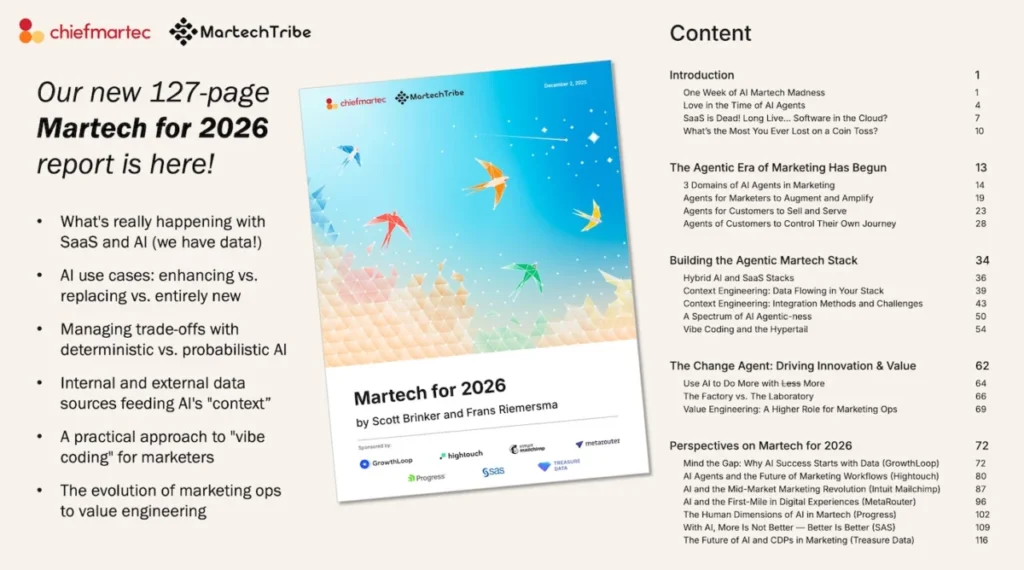
The marketing technology (martech) landscape is currently undergoing its most significant transformation since the dawn of the digital age. As artificial intelligence moves from a speculative novelty to an operational backbone, marketing leaders are scrambling to distinguish genuine strategic utility from the noise of the hype cycle. In response to this critical juncture, industry experts Scott Brinker and Frans Riemersma have released their comprehensive 127-page report, "Martech for 2026."
This document arrives at a pivotal moment, offering a data-backed, jargon-free roadmap for professionals tasked with navigating the complexities of the next two years. Breaking from the industry standard of "gate-walled" content, the authors have made the report available as a direct, no-strings-attached download, signaling a commitment to democratizing high-level industry insights.
Main Facts: A Blueprint for the Next Era
The "Martech for 2026" report is not merely a collection of trends; it is an architectural guide to the modern marketing stack. Spanning 127 pages, the report synthesizes months of rigorous research, including primary data from a recent, large-scale survey titled AI & Data in Marketing.
The core objective of the report is to provide actionable intelligence that cuts through the "techno-babble" currently saturating the C-suite. By focusing on clear language and visual storytelling, Brinker and Riemersma aim to equip CMOs, CTOs, and marketing operations managers with the vocabulary and framework necessary to advocate for their 2026 budgets and strategic roadmaps.
The publication is structured to address the "what, why, and how" of modern marketing, emphasizing that the technology itself is secondary to the human and data-driven processes that empower it.
Chronology: From Concept to Industry Standard
The development of the 2026 report was a multi-month undertaking that followed a deliberate, iterative process:
- Phase 1: The Research Foundation. Several months ago, the authors launched the AI & Data in Marketing survey. This initiative sought to capture the ground-level reality of how marketers are actually deploying AI, rather than how vendors claim it is being used.
- Phase 2: Collaborative Synthesis. Brinker and Riemersma spent the subsequent months distilling the survey data and identifying seven major thematic pillars that will define the martech landscape through 2026.
- Phase 3: The Editorial Firewall. To ensure independence, the authors partnered with seven industry-leading sponsors. Crucially, these sponsors had no input into the editorial content. They were granted access to the final report only after its completion, ensuring the findings remained objective.
- Phase 4: Expert Integration. The authors conducted a series of deep-dive interviews with executives from the seven partner firms. These insights were then curated into dedicated chapters, providing diverse, expert perspectives on the challenges ahead.
- Phase 5: Public Launch. The report was published in late 2025, providing a long-term runway for organizations to integrate the findings into their 2026 fiscal planning.
Supporting Data: Understanding the AI & Data Shift
The report draws heavily on original research, providing a rare glimpse into the actual efficacy of AI implementations. While the full scope of the data is extensive, the report highlights several key trends:
- The Integration Gap: A significant portion of the report explores the disconnect between "AI potential" and "data readiness." The research indicates that while AI is widely adopted, the underlying data hygiene—the "fuel" for AI—remains a major bottleneck for the majority of enterprises.
- Workflow Evolution: The data shows that the role of the marketer is shifting from "content creator" to "AI orchestrator." The report quantifies the hours saved through automation, but balances this with the necessity of human oversight in maintaining brand voice and ethical standards.
- The "Better is Better" Mandate: Survey respondents highlighted a growing fatigue with "feature bloat." The data suggests that for 2026, the industry is moving away from the "more is more" mentality, favoring deeper, high-quality integrations over a broad, fragmented suite of disconnected tools.
Official Perspectives: Perspectives from the Frontline
One of the most valuable aspects of the "Martech for 2026" report is the inclusion of specialized chapters from seven industry leaders. These interviews allow readers to see how specific domains—from data infrastructure to workflow management—are reacting to the AI revolution.
1. Data Foundations
- GrowthLoop: Addresses the critical "gap" between AI ambitions and data reality, arguing that AI success is fundamentally a data-engineering problem.
- Treasure Data: Explores the evolving role of Customer Data Platforms (CDPs) as the central nervous system for AI-driven marketing strategies.
2. Workflow and Execution
- Hightouch: Focuses on the transition to "AI Agents" and how these autonomous systems will redefine marketing workflows by automating repetitive execution tasks.
- MetaRouter: Analyzes the "First-Mile" of digital experiences, emphasizing the importance of data privacy and collection integrity in an AI-first world.
3. Market Strategy and Human Dimensions
- Intuit Mailchimp: Provides a specific lens on the "Mid-Market Marketing Revolution," highlighting how small to mid-sized businesses can leverage AI to punch above their weight class.
- Progress: Offers a nuanced look at the "Human Dimensions of AI," reminding readers that technology must ultimately serve the customer-brand relationship.
- SAS: Advocates for a "quality over quantity" approach, emphasizing that in the age of AI, the focus should be on refining models and strategies rather than merely increasing output volume.
Implications: Preparing for the 2026 Landscape
The implications for the industry are profound. The "Martech for 2026" report suggests three major shifts for organizations:
The Shift from Tool-Centric to Data-Centric
Organizations must pivot away from "buying the latest app" toward "investing in data architecture." As AI becomes the standard, the differentiator will no longer be the algorithm itself—which will soon become a commodity—but the proprietary data that feeds it.
The Rise of the "Human-in-the-Loop" Model
The report is a strong counter-narrative to the idea that AI will replace human marketers. Instead, it posits that the future belongs to the "augmented marketer." The human element remains the essential check on ethics, creativity, and strategic intent. Those who learn to direct AI, rather than just consume it, will lead the market.
Budgetary Discipline
The report serves as a warning against reckless spending. By advocating for a "Better is Better" philosophy, the authors encourage stakeholders to audit their current stacks. The implication is clear: if a tool does not contribute to a measurable, high-quality customer experience, it is a liability in an increasingly competitive environment.
Conclusion: A Call to Action for the Modern Marketer
The "Martech for 2026" report is more than a document; it is a collaborative effort to stabilize a rapidly oscillating industry. By stripping away the paywalls and the "comment-to-download" friction, Brinker and Riemersma have provided the community with an essential resource that favors substance over self-promotion.
As we look toward 2026, the complexity of the martech landscape will only increase. However, with the frameworks established in this report, leaders have a map. The next two years will be defined not by who has the most AI, but by who has the most effective strategy for applying it.
Download the full report here and join the conversation as we redefine what it means to be a marketer in the era of intelligence.
About the Authors: Scott Brinker and Frans Riemersma are recognized authorities in the martech space, known for their work in mapping the ecosystem and providing architectural guidance for global enterprises. Their ongoing commitment to transparency and education continues to serve a community of over 42,000 professionals.
