
The Software Abundance Paradox: Why Stewardship, Not Creation, Will Define the Future of Enterprise IT
NEW YORK — As artificial intelligence radically reduces the friction and cost of software development, enterprise technology leaders are hurtling toward a profound structural paradox. According to recent research from industry analysts, the historic bottleneck of writing code is vanishing. However, this sudden abundance of digital tools is creating a massive secondary crisis: the challenge of governing, maintaining, and rationalizing an unprecedented proliferation of enterprise applications.
The shift marks a philosophical and operational turning point for Chief Information Officers (CIOs) and technology executives worldwide. As the capability to spin up custom workflows, automated scripts, and specialized applications democratizes across business units, the defining constraint for IT leadership is no longer how to build software, but what to keep.
Main Facts: The Anatomy of Software Abundance
The core finding of recent research conducted by analysts Joe Cicman and Diego Lo Giudice is deceptively simple: Get more of what you want, and you also get more of what you don’t want.
For decades, the creation of enterprise software was bounded by high costs, specialized labor shortages, and lengthy development lifecycles. These friction points acted as natural filters, ensuring that only projects with clear, heavily vetted business cases made it into production. AI has systematically dismantled those barriers.
Today, generative AI and low-code/no-code platforms allow organizations to write code, generate requirements, build complex cross-functional workflows, and execute automated tests in a fraction of the time and at a fraction of the cost. Consequently:
- Creation costs have plummeted: Ideas that previously failed to secure IT funding because of prohibitive ROI thresholds are now economically viable.
- Democratization of development: Non-technical teams across departments—from marketing and HR to supply chain and finance—can now build functional software to solve hyper-specific local problems.
- The new bottleneck: Governing systemic abundance replaces writing code as the primary technical challenge. When creation is cheap, curation becomes expensive.
Chronology: How We Arrived at the Era of Generative IT
To understand the weight of the current transition, it is helpful to trace the evolution of enterprise software delivery over the past twenty years.
Phase 1: The Era of Scarcity and Centralized IT (Late 1990s–2010s)
Enterprise software was defined by monolithic architectures, heavy vendor lock-in (such as legacy ERP and CRM systems), and centralized IT departments that acted as gatekeepers. Building software required substantial capital expenditure, massive engineering teams, and years of planning. The risk was under-delivery; companies often struggled simply to get the digital tools they needed.
Phase 2: The SaaS and Cloud Explosion (2010s–Early 2020s)
Cloud computing and Software-as-a-Service (SaaS) decentralized software acquisition. Business units began bypassing central IT by expensing cloud tools via corporate credit cards, giving rise to "shadow IT." While SaaS made software easier to acquire, it introduced integration nightmares, data silos, and subscription bloat.
Phase 3: The AI-Driven Creation Boom (Present Day)
With the advent of advanced code-generation models and intelligent developer assistants, software creation is no longer constrained by human coding bandwidth. Autonomous agents and generative tools can translate plain-language business logic directly into functional applications. This has triggered an unprecedented surge in digital output, shifting the enterprise pain point from acquisition to proliferation control.
Supporting Data and Market Realities: Busting the Myths of AI-Led IT
As enterprises grapple with this new operational reality, legacy assumptions about software economics are fracturing. Industry leaders emphasize that the narrative surrounding AI-driven software development is plagued by misconceptions.
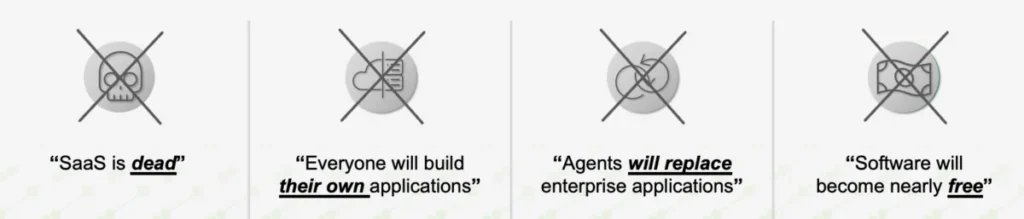
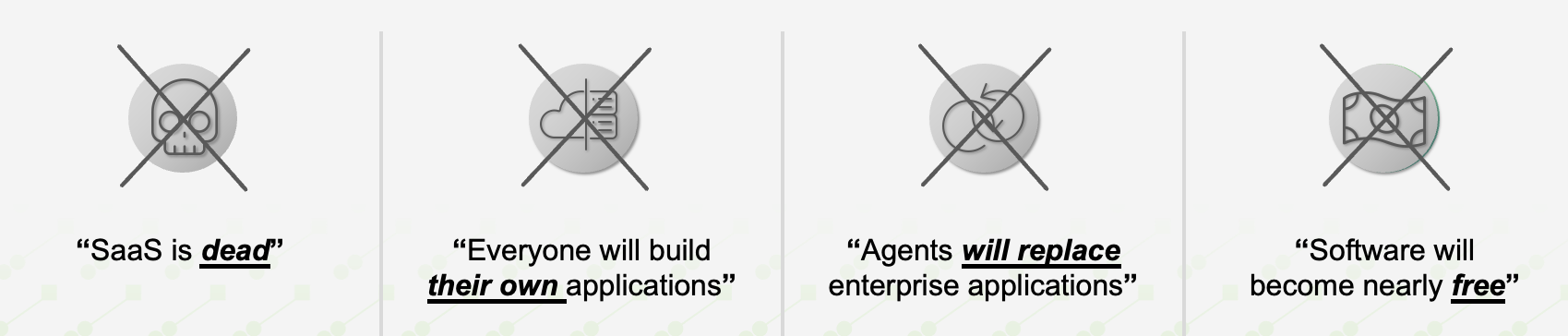
Myth 1: "SaaS Is Dead"
A popular narrative suggests that because AI can generate custom applications instantly, off-the-shelf Software-as-a-Service will become obsolete. Analysts argue otherwise. While custom micro-applications will multiply, standard enterprise engines (such as core financials, payroll, and regulatory compliance frameworks) will still rely on robust, pre-built platforms.
Myth 2: "Developers Are Dispensable"
Another dangerous misconception is that AI eliminates the need for human software engineers. While AI dramatically accelerates routine coding tasks, human oversight is more critical than ever. Developers are shifting from manual coders to system architects, security supervisors, and governance arbiters.
Myth 3: "Software Will Become Nearly Free"
While the marginal cost of writing a line of code approaches zero, the total cost of ownership (TCO) is rising. Software accumulates technical debt, demands cybersecurity monitoring, requires integration maintenance, and consumes cognitive bandwidth. As Cicman notes, "There is no such thing as a free lunch."
Official Responses and Strategic Frameworks: The Rise of Stewardship
Faced with an avalanche of AI-generated applications, forward-thinking enterprises are adopting formal frameworks to manage digital sprawl. Forrester’s Application Capability Stewardship Framework outlines how technology leaders must transition from traditional project managers to active stewards of their digital portfolios.
The Mandate of Stewardship
Stewardship is defined as the continuous process of inspecting digital outcomes and making hard determinations regarding an application’s lifecycle:
- Promote: Identify high-performing, AI-generated tools built by edge teams and scale them across the enterprise.
- Reuse: Catalog internal micro-services and workflows to prevent redundant building across different business units.
- Fund: Allocate resources rationally based on ongoing business value rather than initial creation velocity.
- Govern: Enforce strict compliance, data privacy, and security protocols across a decentralized web of applications.
- Retire: Ruthlessly decommission redundant, obsolete, or poorly performing software that adds complexity rather than value.
The CIO’s New Checklist
This shift mirrors challenges seen in other emerging tech domains. For instance, as enterprise giants like SAP integrate autonomous agents into corporate workflows, CIOs are forced to make deliberate structural choices. Leaders must decide precisely where to grant execution authority to automated agents while tightly retaining ownership of company knowledge, continuous agent learning, and rigorous outcome measurement. Similarly, global manufacturers shifting from labor-arbitrage models to software-defined, adaptive production face parallel pressures to govern digital transformation without collapsing under complexity.
Implications: What Technology Leaders Must Do Now
The transition from a culture of creation to a culture of stewardship carries deep implications for the future organizational chart, technology investments, and enterprise risk management.
1. Shift Metrics from Output to Outcomes
For decades, IT performance was measured by velocity metrics: lines of code written, features shipped, and projects delivered on time. In an AI-saturated landscape, these metrics are obsolete or actively harmful, as they encourage the generation of unneeded software. Future IT performance will be measured by portfolio cleanliness, risk mitigation, and net business value generated per dollar of maintenance cost.
2. Embrace the Burden of Deletion
Corporate culture historically celebrates building; deleting software is often viewed as a failure. Technology leaders must cultivate a culture where retirement is normalized. Every piece of software brought into the enterprise carries an ongoing maintenance tax. If an application’s complexity outweighs its utility—regardless of how cheaply or easily AI built it—it must be systematically archived.
3. Redefine Enterprise Architecture and Security
When business analysts and non-technical operators can generate functional software via conversational prompts, traditional security perimeters dissolve. Shadow IT transforms from a collection of unauthorized SaaS subscriptions into an explosive universe of custom-built, AI-generated micro-apps operating outside standard compliance frameworks. Security teams must move left, embedding automated governance directly into the generation pipelines themselves.
Looking Ahead
The upcoming industry forums—such as the Forrester Technology & Innovation event in New York—are set to place application capability stewardship at the very center of the enterprise debate.
The ultimate takeaway for technology leaders is sobering yet empowering: Stop obsessing over whether you can build it. Instead, start deciding whether you should own it—and, if so, how. In the age of AI abundance, the leaders who separate themselves from the laggards will not be those who can create the most software, but those who have the discipline to manage what remains.
