
Beyond the Hype: The Urgent Transition from AI Adoption to AI Adaptation
Most marketing organizations have officially crossed the threshold of AI adoption. The software subscriptions are paid, the login credentials have been distributed, and the initial excitement of generating a prompt has rippled through the workforce. Yet, a striking paradox remains: while the tools are ubiquitous, the fundamental way in which marketing teams operate has remained largely stagnant.
This widening chasm between "having the tools" and "integrating the capability" is the defining challenge of the current business cycle. As marketing leaders scramble to justify their AI investments, many are discovering that the true hurdle isn’t technological—it is human.
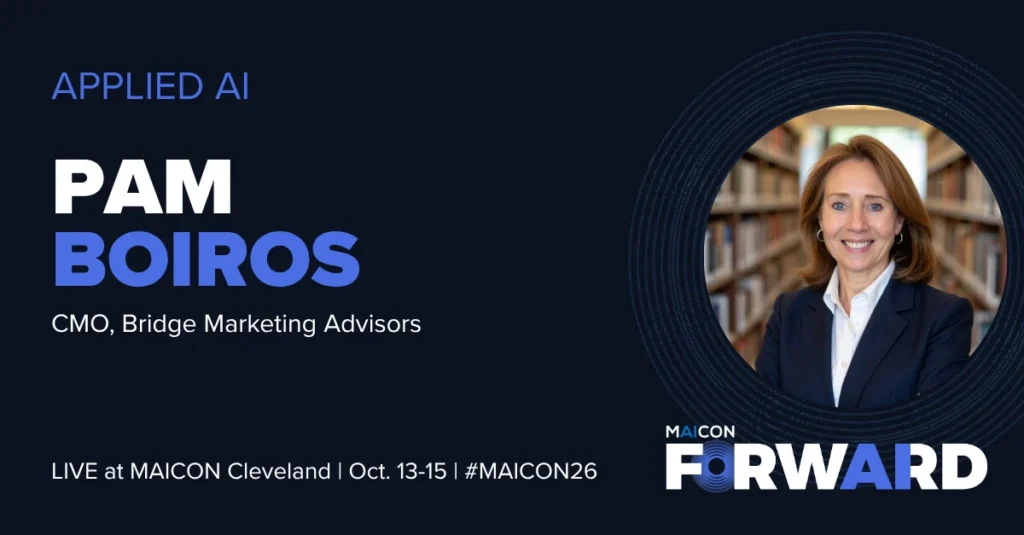
At the upcoming Marketing Artificial Intelligence Conference (MAICON) 2026, fractional CMO and AI strategist Pam Boiros will tackle this disconnect head-on. In her session, "AI Adaptation: The People Side of Scale," Boiros aims to move the needle from mere experimentation toward a permanent, structural shift in how marketing departments deliver value.
The Great Divide: Adoption vs. Adaptation
To understand the current state of the industry, one must first distinguish between the two phases of AI integration. Adoption is an event; adaptation is a process.
According to Boiros, who has previously helmed marketing organizations at industry titans like Skillsoft and meQuilibrium, the signs of adoption are superficial. "You know you’ve moved from AI adoption to AI adaptation when AI stops feeling like a separate initiative and starts changing how the work itself gets done," she explains.
The Anatomy of Adoption
Adoption is characterized by the "scattered" phase. It involves:
- Access: Providing software licenses to team members.
- Training: Hosting one-off webinars or workshops.
- Initial Use Cases: Occasional usage for brainstorming or drafting emails.
The Anatomy of Adaptation
Adaptation, conversely, is an architectural shift. It represents a mature environment where:
- Workflow Redesign: Processes are reconstructed to play to the specific strengths of both humans (judgment, empathy, strategy) and machines (speed, pattern recognition, data synthesis).
- Managed Quality: Managers act as editors and coaches, setting explicit standards for AI-assisted outputs.
- Psychological Safety: Employees possess the confidence to iterate, the judgment to challenge machine hallucinations, and the clarity to operate within established guardrails.
Chronology of a Failed Integration
Historically, new technology implementations follow a predictable trajectory. In the early stages (2022–2023), the focus was on the "novelty" of generative AI. Marketers were dazzled by the ability of LLMs to produce coherent text.
By 2024, the focus shifted to "productivity." Companies mandated the use of AI to cut costs and increase output. However, as 2025 progressed, a plateau occurred. Data began to suggest that while output volume increased, quality often dipped, and employee burnout became a hidden byproduct of "AI fatigue."
Now, entering 2026, the industry is entering the "Integration Era." The narrative has shifted from "How can we use AI?" to "How can we restructure the department around AI?" This is the crux of the adaptation problem: organizations that fail to evolve their workflows now risk becoming trapped in a cycle of inefficient, manual-AI hybrid labor that offers no net gain in strategic output.
The Hidden Culprit: Why Culture Eats Strategy for Breakfast
Boiros has identified five fundamental building blocks of AI adaptation, yet she argues that one is consistently underestimated by leadership teams: Culture.
"Culture shows up in what people actually feel safe and empowered to do every day," Boiros notes. In many corporate environments, the internal culture rewards "polished answers" and absolute certainty. AI, by its nature, is an experimental medium. It requires a willingness to be wrong, to iterate, and to admit that a machine’s output needs significant human intervention.
When a company culture discourages vulnerability, employees react in one of two ways:
- Avoidance: They shun the tools entirely to avoid the risk of producing "sub-par" work.
- Shadow AI: They experiment in secret, hoarding their findings and "hacks" because they fear that being open about their learning process might expose them to scrutiny or judgment.
True adaptation requires a "fail-forward" environment. Leading organizations are those where leaders themselves demonstrate the use of AI, share their own mistakes openly, and treat the "unknown" as an asset rather than a liability. When the C-suite speaks openly about what they are learning, it signals to the rest of the organization that AI is a collective capability, not an individual productivity hack.
Addressing the Psychology of Resistance
One of the most persistent myths in management is that resistance to AI is rooted in a refusal to learn. Boiros, through three years of deep-dive training with diverse marketing teams, argues that the resistance is actually rooted in fear.
When an employee says, "I don’t have time for this," what they are often saying is, "I am terrified that my current expertise is becoming obsolete, and I don’t know how to bridge the gap without losing my job."
The "Too Much to Do" Fallacy
Leaders often respond to resistance with more training. Boiros suggests this is a mistake. "What works better is creating space for people to learn without feeling like they’re taking on a second job," she asserts.
The strategy for overcoming resistance involves:
- Integration with Current Work: AI must be applied to the tasks already on the employee’s desk, not added as a new layer of responsibility.
- Protected Time: Providing "sandbox" hours where employees are explicitly told that experimentation is their primary objective.
- Peer-to-Peer Learning: Removing the hierarchy from training. When peers demonstrate how they solved a problem, it reduces the "imposter syndrome" that often comes with top-down mandates.
Implications: The New Metrics of Success
As marketing leaders move toward adaptation, the metrics by which they measure success must undergo a radical transformation. Counting the number of AI tools subscribed to or the number of hours saved is no longer sufficient.
Leaders must now ask:
- Quality over Quantity: Are we producing work that is actually superior to what we produced a year ago?
- Human-Centric Value: Are our team members spending more time on high-judgment, high-empathy, and high-creativity tasks?
- Structural Resilience: Have we created repeatable workflows that can survive the rapid turnover of models and tools?
If the answer to these questions is no, the organization is merely "adopting"—they are essentially running faster on a treadmill that isn’t moving them toward long-term strategic advantage.
The MAICON 2026 Roadmap
At MAICON 2026, Boiros will distill these lessons into a practical, actionable playbook. Her session is designed for leaders at all levels—from managers overseeing small creative teams to CMOs navigating enterprise-wide digital transformation.
Key Takeaways for Attendees
Attendees of Boiros’ session will leave with:
- A Proven Framework: A methodology for moving beyond the "pilot" phase of AI implementation.
- Workflow Design: Techniques for identifying which tasks to automate and which to preserve for human intervention.
- Governance Models: Strategies for establishing guardrails that ensure safety and compliance without stifling the creative process.
- Cultural Change Tactics: Concrete ways to foster a "curiosity-first" culture that reduces employee anxiety and accelerates adoption.
Conclusion: The Path Forward
The transition to AI adaptation is not a technological journey; it is a management journey. It requires a shift in how we perceive the role of the marketer and how we value the combination of human intuition and artificial intelligence.
As the industry moves toward MAICON 2026, the question for every marketing leader is clear: Are you merely collecting tools, or are you building a team that is fundamentally capable of thriving in an AI-native future?
By focusing on the "people side of scale," leaders can transform their organizations from passive users of technology into architects of a new, more effective way of working.
For those looking to move from adoption to adaptation, join Pam Boiros and over 50 other industry experts at MAICON 2026. Register today to secure your place in the future of marketing.
About the Expert:
Pam Boiros is a fractional CMO at Bridge Marketing Advisors and a renowned AI strategist. As a co-founder of Women Applying AI, she is dedicated to fostering hands-on, practical AI literacy across the industry. Her work bridges the gap between complex technological potential and the practical realities of marketing leadership.
