
The Shift to Machine-Readable Economics: How AI Paywalls and the X402 Protocol Are Reshaping the Web
The foundational social contract of the internet is fracturing. For decades, the transaction between content creators and search engines was elegantly simple: publishers provided indexed pages, search engines delivered human visitors, and everyone profited from the exchange through traffic, ad impressions, and brand visibility.
Today, the proliferation of Generative AI has short-circuited that feedback loop. Autonomous agents, large language models, and zero-click search features like Google’s AI Overviews digest vast quantities of web content, synthesize answers on the fly, and satisfy user intent without ever sending a single human visitor to the originating source.
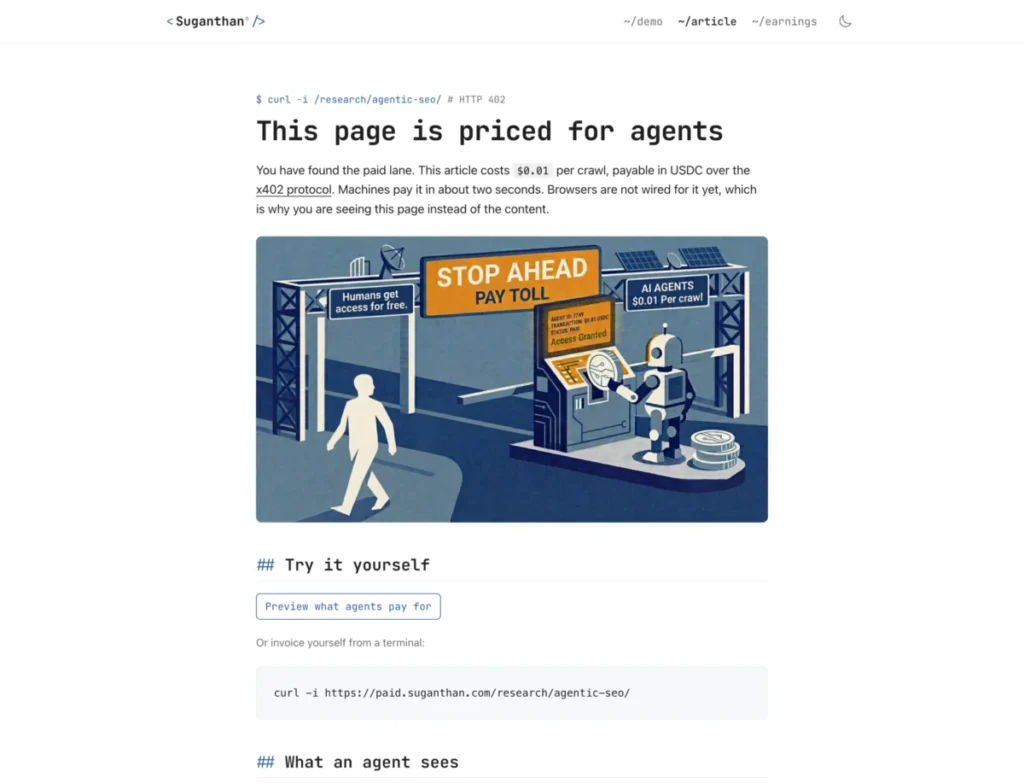
As the traditional traffic pipeline dries up, publishers and technologists are locked in a high-stakes scramble to redefine how digital information is monetized. While tech giants test opaque, centralized revenue-sharing programs, independent developers are pioneering decentralized, pay-per-crawl infrastructures. The goal? To turn every web page into an automated, programmatic tollbooth where artificial intelligence agents pay directly for the data they consume.

Main Facts: The New Frontier of Content Monetization
The debate over AI data usage reached a critical inflection point following twin developments in web architecture and platform policy:
- Google’s AI Contribution Pilot: Google has officially rolled out a testing program in Search Console that pays select publishers when their content substantially drives answers generated within AI Overviews, AI Mode, or the Gemini application.
- The Rise of Machine-to-Machine Payments: Innovators are testing native HTTP payment architectures—specifically utilizing the open
x402protocol—to allow AI crawlers and agents to settle micro-transactions instantly via blockchain networks before accessing gated web pages.
While Google’s pilot represents an attempt by a dominant platform to self-police and reward value after the fact, independent experiments demonstrate that a radically different future is possible—one where publishers bypass platforms entirely and charge autonomous agents directly at the server level.
Chronology: How We Got Here
The friction between AI web scraping and content ownership has evolved rapidly over the past several years, culminating in a flurry of infrastructure announcements throughout late 2025 and 2026:

- 1997: The HTTP status code
402 Payment Requiredis formally reserved in the original HTTP specification for future digital commerce frameworks, remaining largely dormant for nearly three decades. - April 2026: Technical SEO analysts uncover early help pages regarding Google Search Console features that hint at automated compensation models for AI answers, though their exact function remains obscure at the time.
- July 1, 2026: Cloudflare announces its Monetization Gateway, signaling a push toward web infrastructure that can charge AI crawlers for resource access.
- August 4–18, 2026: During Cloudflare’s "Agents Week," the company opens reservations for virtual wallet handles. Concurrently, Amazon Web Services (AWS) makes AgentCore payments generally available, allowing autonomous agents to execute financial transactions at scale.
- September 4, 2026: Industry reporting highlights that aggressive bot-blocking strategies by publishers using Cloudflare are successfully driving legacy media companies and independent publishers to the negotiating table for lucrative AI licensing deals.
- September 13–15, 2026: Blockchain analytics firm TRM Labs reports that millions of
x402payment settlements have flooded decentralized networks. Simultaneously, Google confirms its "AI contribution pilot" to media outlets, and independent developers successfully test live, automated micro-transactions using testnet USDC and AI coding assistants like Claude Code.
Supporting Data and Technical Realities
To understand the mechanics of the emerging machine-paywall economy, one must look at how these systems handle authorization, cost, and verification.
The Black Box of Platform-Managed Compensation
Google’s AI contribution pilot operates entirely behind closed doors. Publishers who opt-in receive a monthly earnings report inside Google Search Console, reflecting instances where Google’s algorithms deem a page to have "contributed significantly" to an AI-generated response.
However, the program has drawn skepticism from digital publishers for several key reasons:

- Zero Transparency: Publishers receive an aggregate earnings figure with no breakdown of the mathematical formulas or metrics used to calculate the payout.
- Strict Qualification Rules: Payouts are restricted strictly to pages that actively contribute during the generation phase of AI Overviews, AI Mode, or Gemini. Content that is merely cited or linked after an answer has already been drafted does not qualify.
- Uneven Adoption: While major media conglomerates can leverage their brand equity to secure multi-million-dollar direct licensing deals with AI companies, smaller independent publishers are left reliant on opaque platform dashboards or forced to block crawlers outright.
The Decentralized Alternative: Pay-Per-Crawl via X402
In contrast to platform-controlled revenue shares, decentralized micro-payment protocols like x402 give site owners absolute control over their pricing and data distribution.
When an AI agent or automated crawler attempts to access a protected URL on a modern edge worker (such as a Cloudflare Worker configured with x402 middleware), the server intercepts the request and issues an HTTP 402 Payment Required response.
Embedded within that response is a machine-readable payload detailing the payment terms:

 "x402Version": 2,
 "accepts": [
 "scheme": "exact",
 "network": "eip155:84532",
 "amount": "10000",
 "asset": "0x036CbD53842c5426634e7929541eC2318f3dCF7e",
 "payTo": "0xEdF2444D0259BBB8aC5094216D0148938F8308ff",
 "maxTimeoutSeconds": 300,
 "extra":  "name": "USDC", "version": "2"
 ]
In this live configuration, the server requests precisely one cent (0.01 USDC) on a testnet network (such as Base Sepolia). An autonomous agent equipped with a digital wallet evaluates the cost against its pre-programmed spending guardrails. If the price falls within budget, the agent signs the transaction, submits the payment, receives cryptographic proof of settlement, and instantly downloads the requested content—all without human intervention, API keys, or pre-registered accounts.
Official Responses and Industry Perspectives
The rapid commercialization of AI interactions has split the publishing and technology sectors into distinct camps, balancing risk, reward, and accessibility.
- The Platform Argument: Tech giants argue that automated compensation pilots and centralized licensing deals are necessary to bridge the gap between open web discovery and closed-loop AI generation. They contend that aggregating data is vital for maintaining the accuracy of conversational search models.
- The Publisher Backlash: Smaller publishers frequently resort to modifying their
robots.txtfiles or deploying aggressive bot-blocking walls. While this protects proprietary content from being harvested for free, it carries the severe penalty of rendering the site invisible in AI training datasets and recommendation engines. - The Infrastructure Perspective: Network security and edge computing leaders, notably Cloudflare, maintain that traditional "pay-per-crawl" models are evolving toward "pay-per-use" frameworks. Because simply downloading a web page does not guarantee that its information was utilized by an AI model, aligning micro-transactions directly with utility and consumption provides a fairer economic exchange.
Implications for the Future of the Web
As the architecture of the internet transitions from human-centric browsing to agentic automation, the monetization models governing it must adapt. Several profound implications emerge from this shift:

1. The Death of One-Size-Fits-All Monetization
The standard advertising and human subscription models will no longer suffice for machine-consumed data. While general-purpose articles and basic explainers will likely remain free to maximize broad human discoverability and audience reach, high-value assets—such as proprietary research, specialized datasets, real-time analytics, and expert software tools—will increasingly sit behind programmatic, machine-readable paywalls.
2. Guardrails and Autonomous Spending Limits
Allowing artificial intelligence agents to spend money independently introduces complex security paradigms. Just as human users rely on credit card spending limits and fraud protection, AI agents require strict localized guardrails. Developers integrating payment-enabled tools (such as Claude Code hooks or AWS AgentCore payment frameworks) must enforce hard caps on per-call expenses and daily allowances to prevent runaway scripts from unintentionally draining digital wallets.
3. The Power Dynamic Between Creators and Platforms
Centralized revenue-sharing programs risk repeating the pitfalls of early digital advertising, where publishers surrendered financial visibility and strategic leverage to dominant intermediaries. Conversely, open protocols like x402 point toward a peer-to-peer future where content creators dictate their own pricing terms directly to machine buyers, ensuring a more resilient and equitable digital ecosystem.

Conclusion
The convergence of artificial intelligence scraping and native HTTP micro-payments signals the end of the web as a purely free-to-read public utility for machines. While platform-led initiatives like Google’s AI contribution pilot offer a preliminary glimpse into automated compensation, their lack of transparency leaves independent creators vulnerable.
By experimenting with decentralized protocols, cryptographically verified requests, and automated agent wallets, the developer community is laying the groundwork for a fairer digital marketplace. Whether transacted in testnet tokens today or real-world stablecoins tomorrow, the future of content distribution is clear: if an AI agent wants to read your work to build its intelligence, it is going to have to pay for the privilege.
