
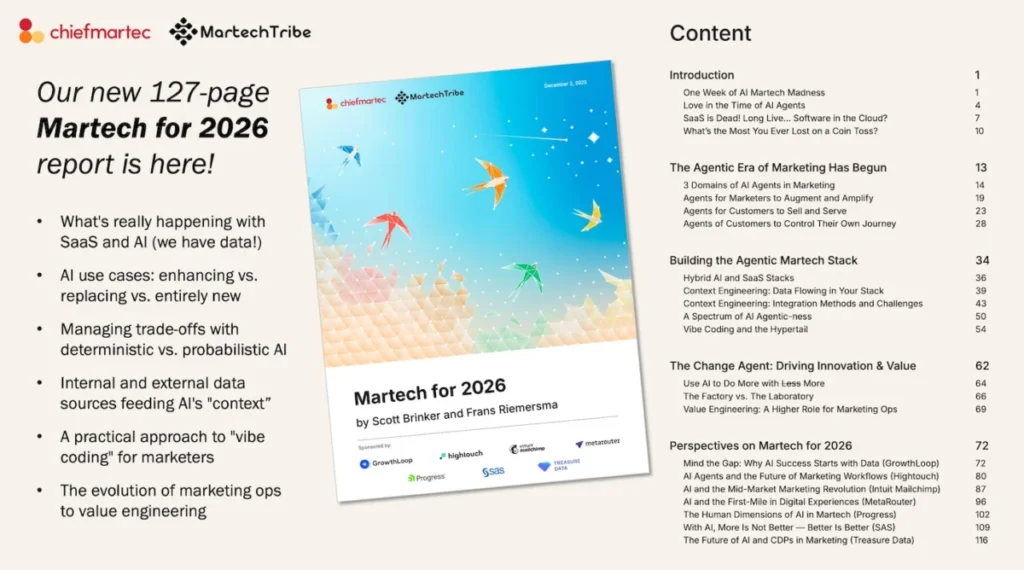
Navigating the Future: A Deep Dive into the ‘Martech for 2026’ Industry Report
The marketing technology (martech) landscape is currently undergoing its most significant transformation since the dawn of the digital age. As we look toward 2026, the convergence of artificial intelligence, data architecture, and human workflows has created a complex, yet fertile, ground for innovation. To help professionals navigate this shifting terrain, a comprehensive new report, Martech for 2026, has been released, offering a definitive roadmap for the next two years of industry development.
Clocking in at 127 pages, the report serves as a major resource for CMOs, marketing technologists, and operational leaders. Unlike many industry publications that gate content behind lead-generation forms or social media engagement requirements, this report has been made entirely open-access, prioritizing accessibility and industry-wide knowledge sharing.
Main Facts: The Anatomy of a New Era
The Martech for 2026 report, spearheaded by industry experts Scott Brinker and Frans Riemersma, is the culmination of months of rigorous research. Its primary objective is to demystify the intersection of AI and data in marketing, stripping away the dense layers of "techno-jargon" that often obscure actionable strategy.
The report is structured into seven major subject areas, designed to provide a holistic view of where marketing technology is heading. These pillars cover everything from the structural integration of AI agents to the fundamental shift in how businesses handle first-party data. By focusing on plain-language explanations and high-impact visual illustrations, the authors aim to bridge the gap between abstract technological promise and day-to-day execution.
A critical aspect of the report’s publication model is its financing. While the authors estimate that a document of this depth could command a market price of $1,000 or more, they have opted for a sponsorship model. Seven key industry partners provided the necessary support to ensure the report remains free. Crucially, the authors maintained strict editorial independence; sponsors had no input on the core content, and in a unique twist, they were only granted access to the report alongside the general public.
Chronology: The Road to 2026
The research journey for Martech for 2026 began several months ago with the launch of the AI & Data in Marketing survey. This initiative served as the foundational data set for the document.
- Phase One (Q3/Q4): The authors conducted an extensive survey to capture the pulse of the marketing industry regarding AI adoption. This data provided the empirical backbone of the report.
- Phase Two (Mid-Development): Brinker and Riemersma synthesized the survey findings, identifying the primary pain points and growth opportunities for modern marketing organizations.
- Phase Three (Sponsorship Interviews): Rather than allowing sponsors to influence the editorial narrative, the authors conducted deep-dive interviews with leaders from seven prominent firms. These conversations were subsequently translated into dedicated chapters, providing diverse expert perspectives on specific technical challenges.
- Phase Four (Release): The report was finalized and published, marking a major milestone for the industry as it prepares for the challenges of 2026.
Supporting Data: The Pulse of the Industry
The core of the report relies on the AI & Data in Marketing survey, which highlights a stark reality: while excitement for AI is at an all-time high, the practical application remains fraught with challenges.
Key findings suggest that marketing teams are moving past the "novelty phase" of generative AI. The focus is shifting toward integration—how to move AI from a creative side-kick to a structural component of the martech stack. The survey data indicates that companies are increasingly prioritizing "data readiness" over "feature accumulation."
Furthermore, the report illustrates that the "more is better" philosophy is dying. As AI capabilities evolve, the emphasis is pivoting toward "better is better." This shift—from high-volume, low-context output to high-precision, data-informed strategy—is a recurring theme that dominates the report’s data visualizations.
Official Perspectives: The Sponsor Contributions
The report features distinct chapters authored by leaders from seven key industry players. These contributions offer a panoramic view of the technical landscape:
- GrowthLoop (Mind the Gap: Why AI Success Starts with Data): Focuses on the often-overlooked necessity of data hygiene. AI models are only as good as the datasets they are fed; GrowthLoop highlights the technical bridge required to make data actionable for AI systems.
- Hightouch (AI Agents and the Future of Marketing Workflows): Explores the shift from "tools" to "agents." The future isn’t just about software that humans use; it’s about autonomous agents that perform complex, multi-step marketing tasks.
- Intuit Mailchimp (AI and the Mid-Market Marketing Revolution): Examines how small and mid-market companies can leverage AI to compete with larger enterprises, effectively democratizing sophisticated marketing capabilities.
- MetaRouter (AI and the First-Mile in Digital Experiences): Addresses the "first-mile" problem—the critical importance of data collection and ingestion. Without clean, compliant data at the source, the rest of the martech stack remains unstable.
- Progress (The Human Dimensions of AI in Martech): Shifts the focus toward the "human-in-the-loop" model, emphasizing that AI is a tool for empowerment rather than a wholesale replacement for human strategy and ethics.
- SAS (With AI, More Is Not Better — Better Is Better): Provides a cautionary note against the "AI sprawl" that many companies are currently experiencing, advocating for strategic, purposeful AI deployment over rapid, unvetted adoption.
- Treasure Data (The Future of AI and CDPs in Marketing): Analyzes the evolving role of the Customer Data Platform (CDP) as the primary brain for AI-driven customer insights.
Implications: Preparing for the Next Two Years
The publication of Martech for 2026 is not merely an academic exercise; it is a call to action for the marketing community. The implications for professionals are clear:
1. The Rise of the "AI-Native" Marketing Stack
By 2026, the distinction between a "martech stack" and an "AI stack" will likely vanish. Organizations that fail to treat AI as a foundational layer—rather than an add-on feature—will find themselves at a significant competitive disadvantage.
2. The Data Infrastructure Imperative
The report underscores that no amount of sophisticated AI can compensate for poor data architecture. Companies must prioritize the "plumbing" of their marketing infrastructure—ensuring that data flows cleanly, securely, and accurately across all systems—before scaling their AI initiatives.
3. Shift in Human Roles
As AI agents take over repetitive, operational, and analytical tasks, the role of the marketer is evolving. The focus is shifting toward "orchestration." Marketers of the future will spend less time executing manual campaigns and more time defining objectives, managing the constraints of AI systems, and interpreting the complex outputs generated by their tech stacks.
4. Ethics and Governance
With the integration of AI into customer-facing experiences, governance has become a top-tier concern. The report touches upon the responsibility that comes with automated decision-making. As we move toward 2026, organizations will need to establish robust frameworks for AI ethics, transparency, and consumer privacy, ensuring that technological progress does not come at the cost of brand trust.
5. Sustainability and Focus
Perhaps the most significant takeaway is the trend toward consolidation. The era of "bloated" tech stacks—where companies buy software for every conceivable micro-task—is reaching a breaking point. The report encourages a more minimalist, high-impact approach to technology procurement, prioritizing tools that deliver tangible value and long-term sustainability.
Conclusion: A Living Resource
As the industry stands on the precipice of the next two years, Martech for 2026 provides the clarity needed to cut through the noise. It is a rare example of high-level industry analysis that remains accessible, grounded, and intensely practical.
For the 42,000+ professionals currently following the discourse led by Brinker and Riemersma, this report serves as a benchmark. It invites feedback, encourages critique, and fosters a collaborative environment where marketers can learn from one another. By moving away from the gatekeeping models of the past and embracing an open-knowledge approach, the authors have provided a roadmap that is as valuable as it is timely.
As we look toward 2026, the question is no longer if AI will change the landscape, but how effectively individual organizations can adapt to these changes. With this report in hand, the path forward is at least a little clearer.
