
The New Newsroom: Decoding Algorithmic Success in the Digital Age
In the modern media ecosystem, news publishers are no longer just competing with rival outlets for a share of the public’s attention. They are locked in an invisible, high-stakes battle against algorithmic gatekeepers that prioritize relevance, timing, and structural precision above all else. For publishers in the News & Politics vertical, the days of relying solely on the gravitas of a headline are over. Instead, success in the digital sphere has become a game of data-driven synchronization.
According to the latest Tubular Intelligence data analyzed from November 2025 through February 2026, audience behavior across social video platforms is remarkably nuanced. The findings suggest that the traditional “one-size-fits-all” approach to content distribution is failing. Instead, media organizations that align their content strategy with the specific consumption habits of their regional audiences are seeing significantly higher engagement metrics. By dissecting video duration, posting cadence, hashtag strategy, and trending topics across APAC, LATAM, EMEA, and North America, a clearer picture of the modern newsroom has emerged.
Main Facts: The Algorithmic Shift
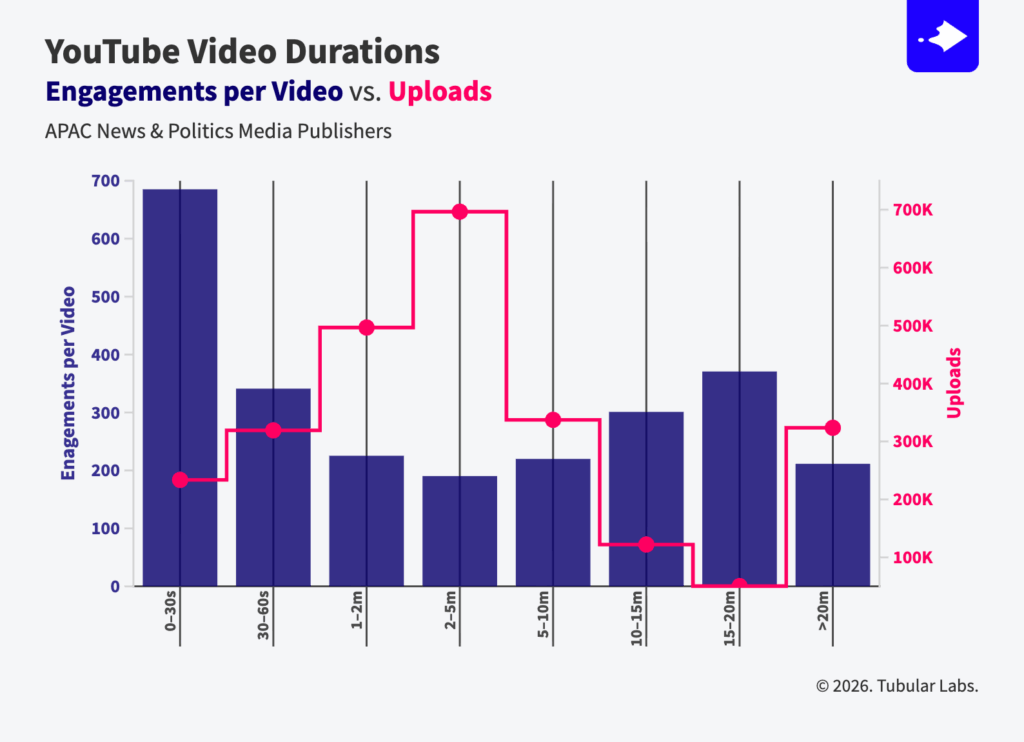
The core takeaway from the Q1 2026 data is that content volume is a vanity metric. Many publishers are trapped in a cycle of churning out mid-length content, believing that sheer output will satisfy the algorithms. However, the data reveals a "barbell effect" in consumer behavior: audiences are increasingly bifurcated. They are either looking for immediate, ultra-short updates (under 30 seconds) that satisfy a need for instant information, or they are carving out time for deep-dive, long-form explainers (15–20 minutes) that provide context and analysis.
This shift suggests that mid-length content—often the "sweet spot" for traditional television news—is becoming a digital dead zone. It is neither fast enough for the scroll-heavy environment of TikTok and Instagram nor substantial enough to foster the deep loyalty associated with long-form YouTube documentary or panel content.

Chronology of Trends (Nov 2025 – Feb 2026)
The observation period from November 2025 through February 2026 was marked by significant geopolitical instability and social unrest, providing a unique stress test for newsrooms.
- November 2025: Publishers began experimenting with aggressive cross-platform distribution strategies, noticing a drop-off in engagement for 3-minute video packages.
- December 2025: As holiday traffic spiked, data identified a massive, untapped audience in the LATAM region during the pre-dawn hours.
- January 2026: EMEA publishers shifted their hashtag strategy from generic categorization to brand-building and geopolitical identifiers, resulting in a measurable increase in search-driven discoverability.
- February 2026: In the U.S., viral clips demonstrated that while "hard news" draws the initial click, human-interest elements, unexpected humor, or controversial public reactions are what drive the "share-ability" factor that sustains long-tail engagement.
Supporting Data: Regional Nuances
The regional breakdown provided by Tubular Intelligence offers a blueprint for publishers looking to optimize their performance.
APAC: The Duration Divide
In the Asia-Pacific region, the disconnect between upload volume and engagement is striking. While the majority of uploads fall into the 2–5 minute range, these videos consistently underperform in terms of engagement per video. Conversely, the most successful content categories are polar opposites: ultra-short clips and long-form deep dives. Publishers in this region who persist in producing "middle-ground" content are effectively diluting their impact.
LATAM: The Early-Morning Opportunity
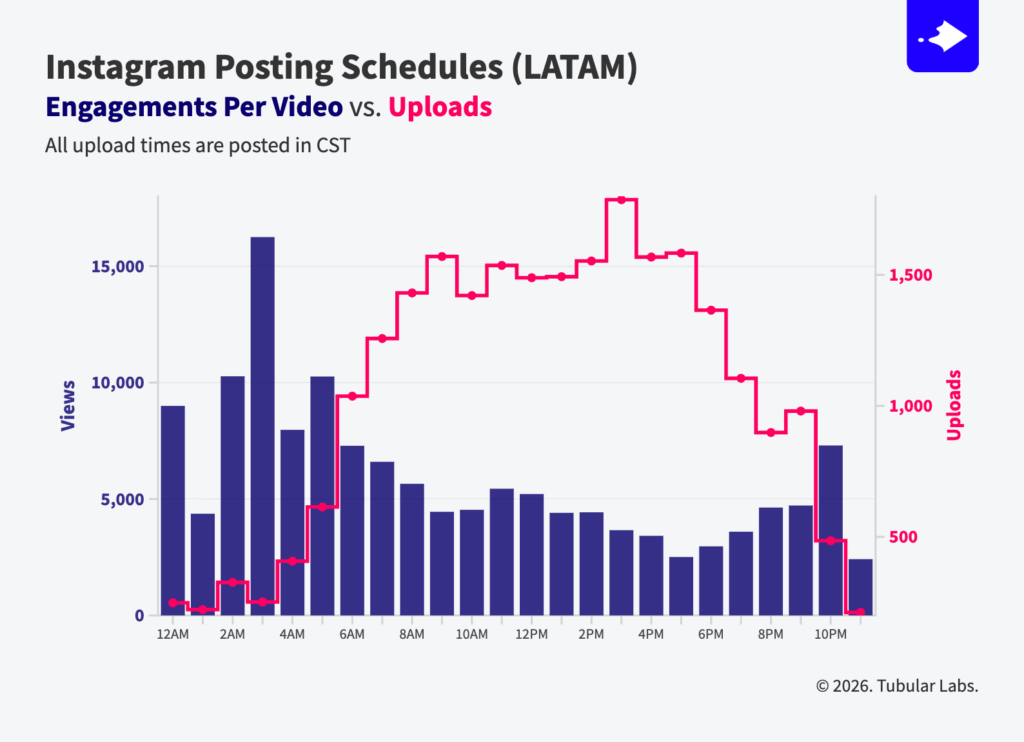
One of the most counterintuitive findings involves the posting schedules of publishers in Latin America. Analysis of Instagram data shows that while most newsrooms continue to flood the feed with content during the 3:00–4:00 PM CST window, this is not when audiences are most attentive. Engagement per video peaks significantly during the early morning hours—specifically between 3:00 and 3:59 AM CST. This indicates a massive opportunity for publishers to capture a "blue ocean" market: by shifting distribution schedules to early-morning windows, they can reach audiences when competition is low and user attention is high.
EMEA: Hashtags as Strategic Assets
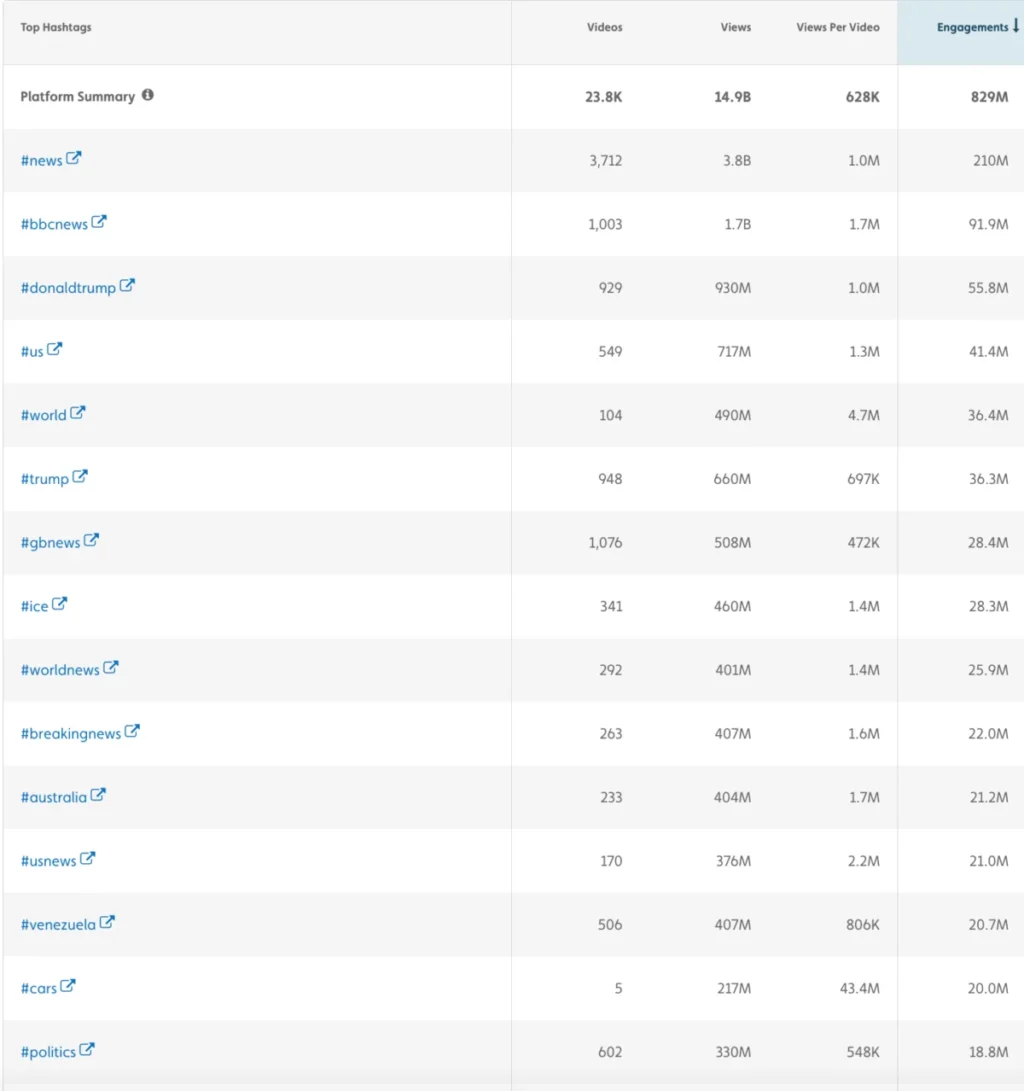
In the EMEA region, the hashtag has evolved beyond simple categorization. Leading publishers are using a blend of global political flashpoints (e.g., #trump, #venezuela), branded newsroom identifiers (e.g., #bbcnews), and localized tags. This strategy is not merely about tagging; it is a search engine optimization (SEO) play that reinforces brand authority and allows international viewers to track cross-border stories, thereby expanding the potential reach of a single piece of content.
Official Industry Perspectives
Industry experts analyzing these trends emphasize that the "digital-first" newsroom must move away from intuition and toward empirical optimization.
"The data shows that publishers are using hashtags for more than just categorization," states a report from the Tubular Intelligence team. "They’re leveraging political figures, geopolitical events, and country identifiers to boost search visibility. The goal is to help global audiences track what’s happening beyond their own borders, which is critical in an era of globalized news consumption."
Furthermore, the data suggests that for platforms like TikTok, the definition of "news value" has fundamentally changed. When looking at the top-performing videos in the U.S. during this period, the common denominator was not just the importance of the news, but the emotional response it triggered. A video regarding a car accident involving a public figure might draw massive viewership, but a video capturing a bizarre or humorous reaction to a political protest often yields higher engagement—comments, shares, and stitches—than the formal report itself.
Implications for Future Strategy
The implications for newsroom leadership are clear: publish smarter, not more.
- Stop optimizing for output: High volume is a liability if the length and format do not match the platform’s specific user behavior.
- Audit the "Mid-Length" Trap: If your newsroom produces primarily 3–5 minute videos, re-evaluate if that content could be split into a 30-second hook or expanded into a 15-minute analytical piece.
- Exploit the Time-Zone Gap: In regions like LATAM, the "early bird" approach is a proven strategy for capturing engagement in a less-saturated environment.
- Embrace the "Human" Factor: Hard news is the baseline, but the "conversation" is what drives the algorithm. Publishers must find ways to present serious topics in a way that invites, rather than inhibits, public discourse and emotional engagement.
As we look toward the remainder of 2026, the publishers that will thrive are those that view their audience not as a monolithic block, but as a diverse group of users with distinct behaviors across different times, regions, and platforms. By utilizing granular data to inform every editorial decision—from the length of a clip to the time of a post—newsrooms can transition from being reactive participants in the social media ecosystem to being the strategic architects of their own success.
The era of "broadcasting" is over; the era of "precision distribution" has arrived. For those willing to adapt, the data provides a clear roadmap to higher engagement and a more loyal, informed audience.
