
The New Era of Visibility: Why Traditional PR is Being Replaced by Entity-Led Strategies
In the rapidly evolving landscape of digital search, the traditional playbook of public relations—pitching stories, networking with journalists, and securing brand mentions—is undergoing a radical transformation. For decades, the measure of a successful PR campaign was a feature in a major outlet or a high-domain-authority backlink. However, as Artificial Intelligence (AI) and Large Language Models (LLMs) like ChatGPT, Gemini, and Google’s AI Overviews become the primary interfaces through which consumers discover information, those old metrics are increasingly disconnected from business outcomes.
Today, if a brand isn’t recognized by an AI model as an "entity"—a trusted, authoritative source within a specific context—it effectively ceases to exist in the new digital marketplace.
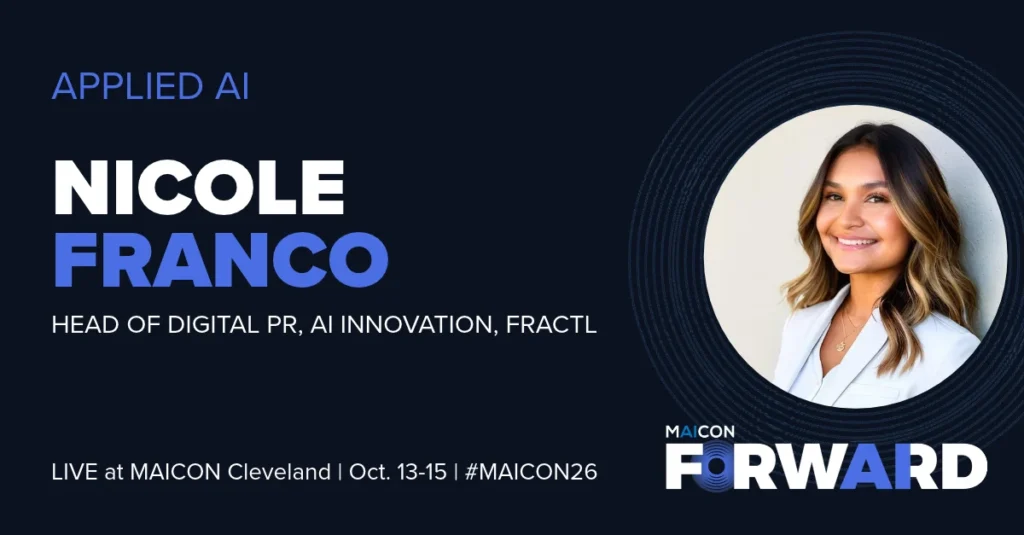
Nicole Franco, Head of Digital PR and AI Innovation at Fractl, is at the forefront of this shift. As a featured speaker at the upcoming Marketing Artificial Intelligence Conference (MAICON) 2026, Franco is set to unveil a new framework: "Entity-Led Digital PR Workflows." Her session promises to move beyond the superficial metrics of PR to address how brands can systematically build subject matter expert (SME) authority that resonates with both human readers and machine-learning algorithms.
The Disconnect: Why Traditional PR Fails in the Age of AI
For years, PR professionals operated under a simple premise: visibility equals authority. If you landed a placement in a high-traffic newspaper, search engines would reward your site with a "vote of confidence" via a link. While link equity remains a factor in traditional SEO, the rise of AI-generated answers has changed the game.
When a user asks a chatbot for a recommendation, the model does not simply scan for the highest number of backlinks. It evaluates the "entities" associated with the query. It looks for consistent, contextually relevant commentary, data-backed insights, and authoritative voices that have established a pattern of expertise in a specific niche.
"Traditional public relations taught marketers to pitch stories and build relationships with journalists," says Franco. "That work still matters, but it no longer decides whether a brand shows up when a buyer asks ChatGPT or Gemini for a recommendation."
The fundamental gap exists because PR has historically been treated as a series of disconnected, tactical bursts. A brand might secure a thought-leadership piece one month and a press release mention the next. To an AI model, these disjointed efforts lack the cohesive "entity signal" required to establish true authority.
Rethinking PR as an Entity Engine
To compete in the AI-driven future, Franco argues that organizations must stop viewing PR as a tactic and start viewing it as an "Entity Engine." This model treats the brand, its products, and its subject matter experts as interconnected data points.
"The best way to think about this is to identify a cohesive metric across your entities and see how you can create and repurpose content across all media," Franco explains.
In the Entity-Led model, the workflow is unified. A digital PR campaign is no longer just about the article placement; it is the seed for a multi-channel ecosystem. The expert commentary provided in a breaking news story serves as the foundation for a LinkedIn thought-leadership post, which in turn informs the brand’s website content, which is then indexed by LLMs as a definitive source of truth. By aligning these efforts, brands create a digital footprint that is robust, consistent, and—most importantly—recognizable by AI crawlers.
The Myth of "High-Authority" Media
One of the most provocative aspects of Franco’s research is her challenge to the long-standing obsession with high-domain-authority (DA) publications. In the traditional SEO world, a mention in a top-tier business journal was the gold standard. However, in the context of AI, relevance often trumps raw authority.
"High-authority media is great, but in the context of your brand," Franco notes.
Her data suggests that LLMs are highly contextual. If a food brand wants to appear in AI-generated answers, it is far more effective to secure a placement in a niche, category-specific site like All Recipes than in a generic, high-traffic business publication. For an AI model, the association between the food brand and a culinary-focused site is a stronger, more relevant signal than a mention in a broad, non-specific business outlet.
The implication is clear: Digital PR teams must shift their focus from "chasing the biggest logo" to "chasing the most relevant audience." By mapping out which sources an AI model cites for specific search verticals, brands can surgically target the publishers that will actually move the needle on visibility.
Turning Commentary Into a Structured Data Asset
Perhaps the most practical shift in Franco’s methodology is her approach to expert commentary. In traditional PR, many agencies fall into the trap of "AI slop"—generic, polished, and safe quotes that lack substance. These are ignored by journalists and provide zero value to LLMs.
Franco advocates for a strategy she calls "scaling commentary as a structured data asset." In this workflow, SME quotes are treated as raw material. Journalists and models are not looking for marketing jargon; they are looking for "candid, raw, and uncut sound bites" that offer genuine insight or surprising, data-backed perspectives.
"Think of quotes like data points," says Franco. "They are clips that a journalist will use to build their story, and they are the fragments of information that models pull from to synthesize answers."
By moving away from "polished paragraphs" toward a system that produces emotionally compelling, punchy, and highly specific commentary, brands can increase their hit rate. When a story breaks, the brands that have already established their SMEs as "reliable data sources" are the ones journalists—and eventually AI algorithms—will turn to first.
Implications for Marketing Leadership
As we look toward 2026, the implications for PR and marketing leaders are profound. Modernizing a PR strategy for the AI era requires a fundamental reorganization of the team.
- Strategic Alignment: PR can no longer operate in a silo. It must be tightly integrated with SEO and content strategy to ensure that the "entities" (experts and products) are consistently represented across all channels.
- Data-Driven Targeting: Teams must move away from vanity metrics. They need proprietary data to understand which publishers influence the AI models relevant to their industry.
- SME Empowerment: The brand’s experts must be trained to produce the kind of "raw, uncut" content that provides value to both human journalists and machine-learning models.
This transition requires a culture shift. Marketing leaders must move from "pitching for coverage" to "architecting for authority."
What to Expect at MAICON 2026
Nicole Franco’s session at MAICON 2026 will serve as a deep dive into this new paradigm. For professionals tasked with navigating the noise of an AI-saturated market, this session offers more than just theory—it offers a blueprint.
Attendees will leave with a practical, actionable playbook, including:
- The Entity-Led Framework: How to map your brand’s authority to the nodes that AI models prioritize.
- Proprietary Publisher Analysis: How to identify the high-relevance, high-impact media outlets that actually influence AI-generated search results.
- The Commentary Workflow: A repeatable system for extracting and deploying expert insights that earn high-quality coverage at scale.
As the lines between search, social, and AI continue to blur, the brands that win will be those that have successfully built a "machine-readable" reputation. By treating PR as an entity-led engine, organizations can ensure that when a customer asks a machine for a recommendation, their brand is the one the machine trusts.
The future of digital visibility is not about how many people read your story; it is about how well your brand is integrated into the knowledge structures of the modern web.
To learn more about the evolving landscape of AI in marketing, join Nicole Franco and over 50 other industry leaders at the Marketing Artificial Intelligence Conference (MAICON) 2026. Register today to secure your spot and start building your organization’s AI-ready PR strategy.
