
Inside the ChatGPT Ad Stack: OpenAI Reveals Its Architecture, Revenue Milestones, and the Black Box Facing Advertisers
SAN FRANCISCO — In a major technical disclosure, OpenAI has pulled back the curtain on how its burgeoning advertising ecosystem operates within ChatGPT. The comprehensive breakdown details how a dedicated language model interprets multi-turn conversations, orchestrates real-time ad auctions, and maintains a strict firewall between sponsored placements and organic AI-generated answers.
The transparency report arrives alongside a staggering commercial milestone: OpenAI reveals that its ChatGPT Ads platform has surpassed $1 billion in annualized revenue run rate, a feat accomplished in fewer than 200 days following its initial commercial rollout. Furthermore, the platform has attracted more than 100,000 participating advertisers.
Yet, beneath the glossy figures and sophisticated engineering schematics lies a more complex reality for digital marketers. While OpenAI’s technical documentation clarifies the inner workings of its ad delivery pipeline, it leaves critical questions unanswered regarding true advertiser return on investment (ROI), campaign visibility, and granular performance benchmarks.
1. Main Facts: Core Mechanics of the ChatGPT Ad Ecosystem
To understand how advertising functions inside an AI-driven conversational interface, OpenAI’s technical breakdown focuses on two fundamental pillars: architectural isolation and context-aware matching.
Architectural Separation: Answers vs. Ads
A primary concern for users and regulators alike has been whether commercial interests could bias AI responses. OpenAI insists that the system responsible for generating ChatGPT’s answers operates on completely separate models, codebases, and infrastructure from the ad selection system.
- Independent Pipelines: While both systems can read the ongoing conversation, they perform distinct tasks. As ChatGPT formulates its response, a parallel advertising pipeline evaluates whether a relevant sponsored placement exists.
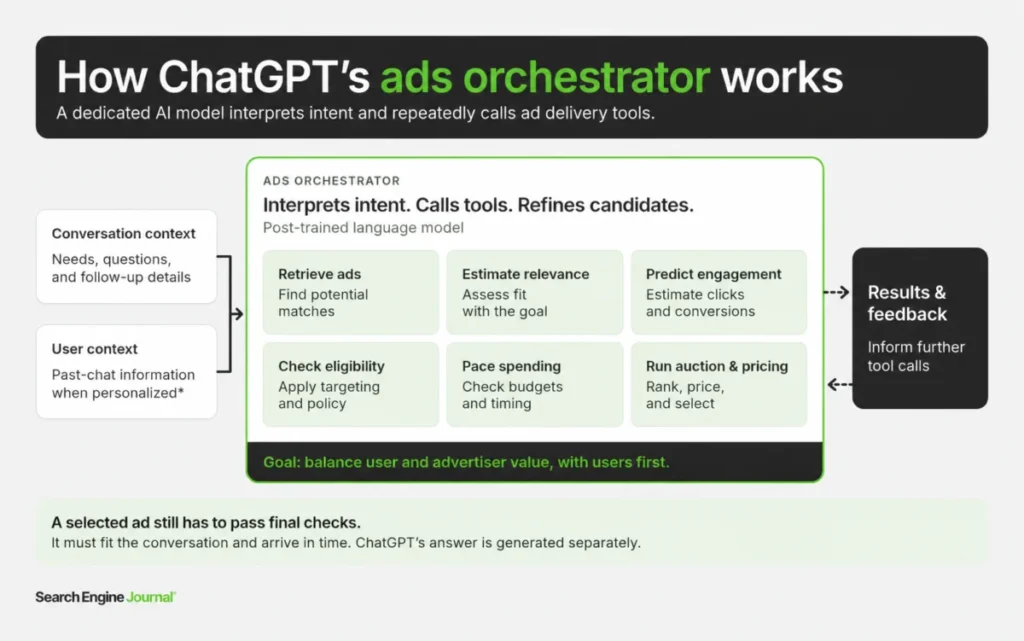
- Non-Blocking Delivery: ChatGPT does not wait for the ad system to return a result. If the ad selection process lags or fails entirely, the organic answer is delivered uninterrupted. Ads that arrive too late simply do not render.
- The "Sponsored" Label: When an ad does appear, it features a distinct sponsored label beneath the response. Additionally, a secondary system-generated introduction explains the contextual bridge between the discussion and the ad, keeping the explanation distinct from the advertiser’s headline, description, and call-to-action (CTA).
The "Orchestrator" and Stateful Sessions
Unlike traditional keyword-based search engines that evaluate queries in isolation, ChatGPT ads rely on "stateful" sessions. The system maintains contextual memory across multiple messages.
OpenAI utilizes a specialized model called the orchestrator. This model reads the conversational flow, converts relevant dialogue into semantic search queries, and generates "embeddings"—numerical representations of meaning that match ads to intent without requiring exact-match keywords.
Once potential ads are retrieved, they undergo strict filtering for location targeting, policy compliance, budget pacing, and semantic relevance before being submitted to a separate auction tool for final pricing and ranking.
2. Chronology: The Rapid Ascent of ChatGPT Ads
The trajectory of ChatGPT’s monetization strategy has moved at a blistering pace, transforming the generative AI landscape from a subscription- and enterprise-driven model into a fully realized ad-supported ecosystem.
- Late 2024 / Early 2025 (The Rumor Mill): Industry analysts speculate on how OpenAI will eventually monetize its massive free user base. Early tests hint at native visual integrations and integrated product recommendations.
- Mid-2025 (Official Launch): OpenAI officially rolls out its advertising infrastructure, opening the platform to an initial wave of beta testers and enterprise brands.
- Late 2025 (Rapid Scaling): Adoption surges past initial projections. Brands across retail, SaaS, finance, and consumer goods flood the platform to capture high-intent users during extended conversational queries.
- Day 200 Post-Launch (The $1 Billion Milestone): OpenAI officially announces that ChatGPT Ads has crossed a $1 billion annualized revenue run rate, cementing its status as one of the fastest-scaling ad networks in digital marketing history, backed by over 100,000 active advertisers.
- Current Day (Technical Disclosure): OpenAI publishes its comprehensive architectural breakdown, detailing the orchestrator model, auction mechanics, and impression delivery checks.
3. Supporting Data: By the Numbers
While OpenAI’s engineering blog highlights technological prowess and massive financial scale, a closer examination of the data reveals both impressive expansion and notable gaps in performance transparency.
- $1 Billion: Annualized revenue run rate achieved in less than 200 days. (Note: An annualized run rate projects a full-year performance based on a snapshot in time; it does not represent total cash collected to date).
- 100,000+: The total number of unique advertisers that have run campaigns on the platform since launch.
- The Missing Metrics: OpenAI’s public disclosures omit crucial performance benchmarks, including:
- Customer Acquisition Cost (CAC) averages across industries.
- Return on Ad Spend (ROAS) and conversion-rate distributions.
- Retention and churn rates for the 100,000 initial advertisers (i.e., how many continued spending after initial test budgets depleted).
- Control-group attribution studies proving whether ChatGPT ads drove incremental sales versus capturing customers who would have purchased organically.
4. Official Responses and Industry Perspectives
OpenAI’s engineering team frames the architectural design as a triumph of modern machine learning orchestration, emphasizing user trust and system resilience.
"By decoupling our answer generation models from our ad-serving orchestrator, we ensure that the integrity of ChatGPT’s reasoning remains uncompromised by commercial incentives," OpenAI noted in its technical documentation. "The system is built to serve relevant assistance first, with monetization operating as a parallel, non-blocking layer."
Industry Reception: Excitement Tempered by Caution
Digital marketing agencies and media buyers have responded to the disclosures with a mixture of enthusiasm and skepticism.
On one hand, sophisticated marketers praise the stateful session capability. For instance, in a scenario where a user spends several messages comparing project management software for a small agency before asking about pricing, the ad system can surface niche value propositions—such as "free guest accounts"—that traditional search engines would miss based on a generic "project management pricing" query.
On the other hand, performance marketers have voiced frustration over opaque reporting dashboards. A recurring industry critique centers on OpenAI’s revelation that winning an auction does not guarantee an impression. Because ads must clear secondary relevance checks and meet strict delivery windows, a campaign can technically win an auction yet fail to appear. Without transparent logging indicating where in the pipeline an ad dropped off, marketers are left guessing whether to adjust bids, alter creative copy, or refine targeting parameters.
5. Implications for Digital Marketers and Advertisers
As OpenAI continues to refine its ad stack, media buyers and brand strategists must adapt their playbooks to the unique dynamics of conversational AI marketing.
1. Shift from Keywords to Intent Narratives
Traditional search engine optimization (SEM) rewards exact-match keywords and high-volume query bidding. ChatGPT advertising requires a fundamentally different mindset. Because the orchestrator builds semantic embeddings from conversational depth, advertisers must align their landing pages and ad copy with nuanced consumer requirements that surface mid-conversation.
2. Navigating the "Black Box" of Impression Delivery
Marketers accustomed to the granular diagnostic tools of Google Ads or Meta Ads may find OpenAI’s current reporting environment limiting. Until OpenAI provides deeper visibility into internal log outcomes—such as whether a campaign failed location targeting, hit budget pacing limits, or lost out during secondary relevance filters—optimizing campaigns will require careful, iterative experimentation.
3. The Need for Hard ROI Evidence
With $1 billion in annualized revenue proving that brands are willing to spend, the pressure is now on OpenAI to demonstrate long-term value. Advertisers evaluating their budgets will increasingly demand verifiable conversion data, multi-touch attribution clarity, and industry-specific ROAS benchmarks to justify shifting capital away from established walled gardens.
Outlook
OpenAI’s technical disclosure provides a fascinating look under the hood of generative AI monetization. It proves that technological safeguards can be built to separate organic AI outputs from commercial ads. However, as the platform matures past its initial hyper-growth phase, the true test for ChatGPT Ads will not be how fast it can scale its revenue run rate, but how consistently it can deliver profitable, measurable returns for the 100,000+ brands placing their trust—and budgets—in conversational AI.
