
The Future of Local SEO: Navigating the AI Shift with Industry Veteran Bill Ross
In the rapidly evolving landscape of digital marketing, local SEO remains the backbone of sustainable growth for brick-and-mortar businesses and service-based enterprises alike. However, the days of "quick-win" tactics and keyword stuffing are firmly behind us. As search engines integrate increasingly sophisticated AI into their core algorithms, the rules of engagement are undergoing a radical transformation.
To understand how businesses can navigate this shifting terrain, we sat down with Bill Ross, a 20-year SEO veteran and principal strategist behind the growth of numerous global brands. In a candid conversation, Ross deconstructs the modern local SEO playbook, emphasizing the transition from vanity metrics to meaningful, conversion-driven performance.
The Foundation: Why Basics Still Outperform Hacks
For businesses just starting their digital journey, the temptation to chase complex, "growth-hack" strategies is high. Ross, however, argues that the most successful strategies are rooted in disciplined, foundational execution.
"It’s not necessarily difficult, but it is time-consuming," Ross explains. "Success often comes down to knowing what not to do. Many businesses dilute their efforts by chasing every new trend, whereas the winners focus on perfecting the basics: accurate business information, a verified Google Business Profile (GBP), and a consistent approach to local citations."
According to Ross, before a business even considers advanced link-building or technical schema markup, they must ensure their digital footprint is consistent. If a business lists a different phone number or address across various directories, it creates a "trust deficit" with search engines, which ultimately hampers visibility.
Citations and the Strategic Resource Allocation
With limited budgets, businesses often struggle to decide which directories deserve their attention. Ross suggests a two-tiered approach:
- The Boilerplate: Use automated tools like Moz Local to handle the essential, high-authority aggregators. These are the "table stakes" for any local business.
- The Niche/Geo-Specific: Beyond the basics, the focus should shift to citations that are either geographically relevant (local chambers of commerce, regional directories) or industry-specific (e.g., Houzz for contractors, TripAdvisor for hospitality).
"It’s about strategy, not quantity," Ross notes. "If a citation doesn’t offer value to your specific customer base or improve your geographic relevance, it’s a waste of internal resources."
The Art of Local Link Building
Link building remains a cornerstone of domain authority, but local link building requires a different, more nuanced approach. The goal is to build a "local authority" profile that signals to Google that your business is a pillar within its specific community.
Ross advocates for:
- Local Media Coverage: Getting featured in local newspapers, TV, or radio station websites.
- Community Engagement: Sponsoring local events or participating in local interviews.
- Industry Authority: Establishing links from trade publications that carry weight in your specific sector.
The secret to securing this coverage? "You have to be genuinely interesting," says Ross. "Don’t send out $99 press releases that go nowhere. Instead, pitch a unique angle—a solution to a problem your community faces. If you aren’t doing something worth talking about, don’t blame your SEO; rethink your business positioning."
Measuring Success: Beyond Vanity Metrics
One of the most critical takeaways from our conversation is the distinction between "vanity metrics" and "conversion metrics." Many business owners fixate on impressions, likes, or total traffic—numbers that look good on a report but don’t necessarily drive revenue.
"Directional metrics like traffic and rankings are fine for monitoring health," Ross explains, "but they shouldn’t be the goal. You need to track real actions: lead form submissions, phone calls, and booking requests."
Ross points to the underutilized analytics within the Google Business Profile as a goldmine. By analyzing the "calls" button, "directions" requests, and the actual search queries that lead users to a profile, businesses can gain deep insights into consumer intent. "If you scroll down in your Business Profile analytics, you can see the exact phrases people typed when they found you. That is your roadmap for future content."
The "Experience Gap": Why Your Website Might Be Sabotaging Your SEO
Perhaps the most surprising insight from Ross is his take on the "non-SEO" factors that destroy rankings. "You can earn the #1 spot on Google, but if your website is poorly designed, slow, or offers a disconnect between the online promise and the offline experience, your bounce rate will skyrocket."
Google tracks user interaction. If a user clicks on your listing, lands on a subpar page, and immediately clicks back to search results, that is a clear signal to Google that your business failed to satisfy the query. Over time, this erodes trust, causing your rankings to slip. Consistency between your digital presence and your physical service is non-negotiable.
Bridging the Gap for Service-Based Businesses
Service-based businesses—like plumbers, landscapers, or consultants—often lack a physical location for customers to visit, which makes local SEO harder because they miss out on the "proximity" signal.
Ross advises these businesses to:
- Aggressively Update the GBP: Keep your profile "alive" with fresh photos of your work, consistent review responses, and active post updates. This tells Google you are an active, legitimate business.
- Localized Service Pages: Build specific pages for the areas you serve, but don’t overreach. Creating 50 landing pages for cities you rarely visit will trigger spam filters. "Focus on the areas where you have actual proof of work," says Ross.
The AI Revolution: Searching in Conversations
The rise of AI-driven search (such as ChatGPT, Google’s AI Overviews, and voice assistants) is fundamentally changing the search landscape.
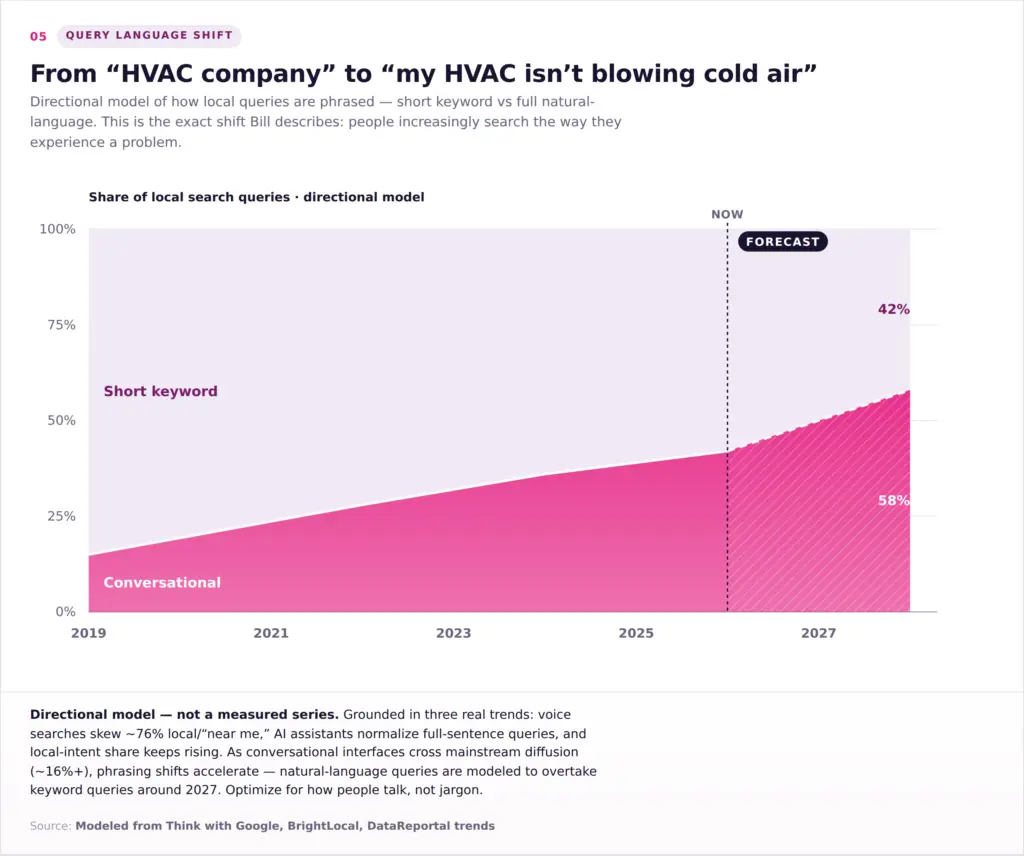
"We are moving away from simple keyword-based queries like ‘HVAC repair city name,’" Ross observes. "People are now asking AI tools, ‘My HVAC system is making a clicking sound and the upstairs is hot, what should I do?’"
This shift demands a content strategy focused on natural language and problem-solving. Businesses that can answer these specific, conversational questions will be the ones pulled into the AI’s answer, while those focused only on technical keywords will be left behind.
The Role of Review Management
Reviews are more than just social proof; they are a critical ranking signal. However, Ross warns against "generic" reviews. "If every review says ‘Great service, thanks,’ that offers very little semantic value to Google."
Effective review management involves:
- Encouraging Detail: Ask customers to mention specific problems you solved or specific services you provided.
- Engagement: Responding to reviews—both positive and negative—is a form of content creation. It shows Google that your business is active and cares about customer feedback.
Conclusion: The Path Forward
As the digital landscape continues to evolve, the businesses that win will be those that prioritize authentic brand-building over algorithmic shortcuts. AI will continue to dominate the search experience, but it will rely on the "real world" data provided by legitimate, well-optimized local businesses.
By focusing on real-world solutions, nurturing genuine customer relationships, and staying agile in the face of technological shifts, local businesses can not only survive the AI era but thrive in it. As Bill Ross aptly puts it, "There is no silver bullet. The strategy is to be helpful, be visible, and be consistent."
For more insights on local SEO, visit Emulent Digital Marketing, or follow Bill Ross on LinkedIn and Instagram.
