
The Evolution of Influence: Why PR Must Evolve into an "Entity Engine" for the AI Era
The traditional public relations playbook—a craft defined by media lists, polished press releases, and long-standing relationships with beat journalists—is facing an existential disruption. While human-to-human connectivity remains a cornerstone of communications, it is no longer the sole arbiter of brand visibility. Today, when a prospective buyer turns to ChatGPT, Gemini, or Google’s AI Overviews for a recommendation, the "PR" that matters isn’t just about who you know; it’s about how effectively your brand’s digital entities are mapped, indexed, and surfaced by large language models (LLMs).
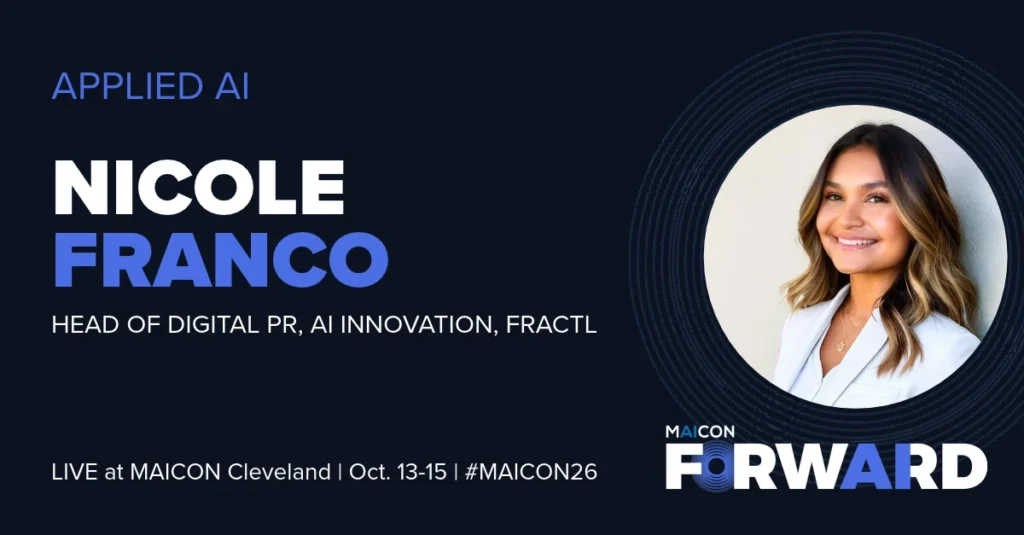
As the landscape of search shifts from blue links to conversational AI, the gap between legacy PR practices and modern digital visibility has widened. Addressing this critical pivot is Nicole Franco, Head of Digital PR and AI Innovation at Fractl, who will headline the upcoming MAICON 2026 conference. Her session, "Entity-Led Digital PR Workflows: Using Commentary, AI Prompts, and Media Partnerships to Build SME Authority in Search," promises to redefine the role of the communications professional in an age dominated by algorithms.
The Paradigm Shift: Rethinking PR as an Entity Engine
For decades, PR was viewed as a linear process: develop a narrative, pitch it to a journalist, secure a placement, and measure the impact through impressions or sentiment. In the AI era, this model is insufficient.
Franco argues that modern PR must transition from a story-centric model to an "Entity Engine." In the eyes of an AI, a brand is not a collection of headlines; it is a complex web of "entities"—the subject matter experts (SMEs), the specific products, the core brand identity, and the proprietary data that links them together.
"The best way to think about this is to identify a cohesive metric across your entities and see how you can create and repurpose content across all media," Franco explains.
This approach breaks down the silos that have traditionally separated social media, content marketing, and public relations. Under the Entity Engine framework, a piece of thought leadership is not an isolated asset. Instead, it serves as the fuel for a broader machine: a single, data-backed insight might simultaneously power a breaking news quote, a LinkedIn thread for an SME, a white paper for a search-optimized landing page, and a training data point for an LLM looking to cite an authoritative source.
Contextual Authority: The Death of the "Big Logo" Obsession
One of the most persistent myths in public relations is that "bigger is always better." For years, agencies have chased placements in top-tier national business publications as the gold standard of success. However, Franco’s proprietary data from Fractl suggests that this obsession with prestige, divorced from context, is a tactical error in the age of AI.
"High-authority media is great, but in the context of your brand," says Franco.
To illustrate this, consider a food brand aiming for visibility in AI-generated grocery recommendations. A placement in a generalist business publication, despite having immense domain authority, may do little to help the brand rank when a user asks, "What is the best sourdough recipe?" However, a feature in a niche, high-authority vertical publication like All Recipes is significantly more likely to be prioritized by an LLM as a trusted source for that specific intent.
This shift demands a new form of "contextual auditing." PR teams must now ask:
- Where does our core audience live online?
- Which sources do the LLMs currently favor when answering questions related to our industry?
- Is our "high-authority" coverage actually relevant to the semantic web of our product entities?
Authority, in the AI era, is not a monolith. It is a signal-to-noise ratio that varies by vertical. Chasing a logo that doesn’t align with the user’s intent is an investment in vanity rather than visibility.
Turning Commentary Into a Structured Data Asset
One of the most tactical takeaways from Franco’s upcoming session is the transition from "filler" PR to "structured data" PR.
Traditionally, PR professionals provide journalists with polished, safe, and often generic quotes—what industry insiders sometimes call "PR slop." This content rarely moves the needle for journalists, and it certainly doesn’t provide the substance that AI models need to synthesize high-quality, cited answers.
Franco advocates for a workflow where expert commentary is treated as a "structured data asset." The goal is to provide raw, candid, and emotionally compelling sound bites that act as objective data points.
"They don’t want the same commentary or AI slop that many PRs might be sharing," Franco notes. "They want raw, uncut, candid sound bites that will add substance to their stories."
By shifting the SME engagement model from "write a long, safe response" to "provide a sharp, provocative, and data-backed sound bite," companies can effectively turn their executives into a reliable resource for journalists. When a journalist uses these clips, the "entity" of the expert is reinforced within the publication’s content, which in turn feeds the training data and citation paths of the AI models scanning that publication.
Implications for the Modern Marketing Organization
The implications of this shift are profound for leadership teams. If PR is no longer just about media relations, the department’s KPIs must change.
1. From Reach to Relevance
Metrics like "total reach" or "ad equivalency" are becoming obsolete. The new north star for PR teams should be "AI Visibility" and "Entity Association." Are your SMEs showing up as the primary sources in AI-generated answers for your target keywords?
2. The Integration of SEO and PR
Historically, PR and SEO were distinct disciplines. In the era of Google’s AI Overviews, they are effectively the same thing. PR teams must now understand technical search concepts, such as schema markup and entity linking, to ensure that when they earn a media mention, the AI actually recognizes the brand as the source of that expertise.
3. The Need for Agility
Traditional PR cycles are often too slow for the "real-time" nature of AI. When a breaking news story occurs, the brand that provides the most valuable, high-substance commentary first is the one that gets indexed. Building a repeatable system for rapid, expert-led response is now a competitive advantage.
Preparing for MAICON 2026: The Roadmap Forward
As we approach MAICON 2026, the industry is at a crossroads. The tools of the past are still present, but the environment has changed entirely. Nicole Franco’s work serves as a blueprint for those who refuse to be left behind by the algorithms.
Attendees at her session can expect to walk away with:
- The Entity-Led Framework: A clear methodology for mapping a brand’s authority, products, and experts into a cohesive digital footprint.
- Proprietary Data Insights: A deep dive into the specific types of media placements that influence AI search results across various verticals.
- The Commentary Playbook: A repeatable, scalable process for producing expert insights that journalists and AI models crave.
The conference itself, a hub for AI-driven business strategy, will provide a holistic view of how these PR shifts fit into the broader organizational transformation. As AI continues to mediate the relationship between brands and their customers, the ability to "speak the language of machines" while maintaining human expertise will be the defining trait of successful communication leaders.
The era of the "pitch" is ending; the era of the "entity" has begun. Whether your brand shows up in the future of search depends entirely on your willingness to rebuild your PR engine from the ground up.
Join Nicole Franco and 50+ other leading minds in AI and business at MAICON 2026. Register today to secure your spot at the forefront of the marketing revolution.
