
The Battle for the Agentic Commerce Frontier: Why Amazon’s Block on Meta’s Muse AI is Just the Opening Salvo
Introduction: The Clash of the Titans in the Era of AI Shopping
The digital commerce landscape is undergoing a tectonic shift, driven by the rapid evolution of artificial intelligence and autonomous software agents. At the bleeding edge of this transformation is a high-stakes standoff between two of technology’s most formidable heavyweights: Amazon and Meta.
Recent media reports have revealed that Amazon has actively blocked Meta’s newly introduced AI agent, "Muse," from executing purchases on its sprawling e-commerce marketplace. Muse, which has rapidly captured the attention of the tech and retail sectors alike, is designed to autonomously research products, manage complex tasks, and complete transactions on behalf of consumers. By barring Muse from its checkout infrastructure, Amazon has drawn a hard line in the sand, signaling its fierce determination to maintain absolute control over the customer relationship, user data, and the coveted digital checkout experience.
However, while this high-profile corporate skirmish makes for dramatic headlines, industry analysts warn that retailers should resist the temptation to view it as a definitive harbinger of the future of commerce. Instead, the Amazon-Meta standoff is better understood as a classic turf war between two tech giants vying for dominance in a rapidly mutating digital ecosystem.
This comprehensive report examines the anatomy of the Amazon-Meta conflict, traces the chronological evolution of AI-driven commerce, evaluates the underlying economic stakes, analyzes expert insights, and explores the profound implications this feud holds for retailers, brands, and consumers navigating the dawn of agentic commerce.
Main Facts: What is Happening Between Amazon and Meta?
To understand the gravity of Amazon’s block on Meta’s Muse, one must examine the core components of the dispute and the respective strategies of the two companies involved.
The Rise of Muse AI
Meta’s Muse is part of a new wave of generative AI applications designed to transcend simple text-based interaction and step into the realm of autonomous execution—often referred to in the industry as "agentic commerce." Unlike traditional search engines or shopping chatbots that merely suggest links or display static product catalogs, AI agents like Muse are built to act as personal digital concierges. They can synthesize user preferences, cross-reference reviews, compare specs, evaluate pricing across multiple platforms, and theoretically execute the final purchase without requiring the human user to manually navigate a retailer’s checkout funnel.
Amazon’s Defensive Moat
For Amazon, the threat posed by third-party AI agents intercepting the transaction layer cannot be overstated. Amazon has spent decades and billions of dollars cultivating its position as the undisputed starting point for product discovery and e-commerce transactions. Beyond its massive retail footprint, Amazon commands a lucrative digital advertising empire and a robust marketplace ecosystem where third-party sellers generate a significant share of revenue.
By blocking Muse from making purchases on its platform, Amazon is aggressively defending several core assets:
- The Customer Relationship: Amazon views the direct line of communication between the buyer and the platform as sacred. Allowing an intermediary AI agent to sit between the consumer and Amazon dilutes brand loyalty and obscures valuable behavioral data.
- The Checkout Experience: Frictionless checkout, powered by tools like 1-Click ordering, is a cornerstone of Amazon’s conversion success. Handing control of the transaction over to an external AI introduces variables that Amazon cannot regulate or monetize.
- Data Sovereignty: Knowing who is buying, why they are buying, and how they arrived at a purchasing decision is vital data that Amazon leverages for personalization and ad targeting. An external AI agent acts as a black box, cutting Amazon off from those valuable insights.
Meta’s Commerce Ambitions
Meta, on the other hand, has long harbored grand ambitions to establish its social media empire—encompassing Facebook, Instagram, and WhatsApp—as a primary destination for digital commerce. Over the years, the company has rolled out numerous commerce initiatives, including Facebook Shops and Instagram Shopping, with varying degrees of success. By developing Muse and embedding agentic capabilities into its social ecosystem, Meta aims to transform its platforms from mere spaces for social connection into comprehensive gateways for digital experiences, chief among them being shopping.
Chronology: How We Arrived at the Era of Agentic Commerce
The friction between Amazon and Meta over AI shopping agents did not materialize overnight. It is the culmination of a multi-year convergence of social media, e-commerce, and generative artificial intelligence.
Phase 1: The Social Commerce Push (2018–2022)
For nearly a decade, Meta sought to capture a slice of the e-commerce pie by embedding shopping features directly into its social networks. Recognizing that users spend hours scrolling through feeds, Meta introduced features allowing brands to set up digital storefronts within Facebook and Instagram. While these tools gained traction among niche direct-to-consumer (D2C) brands, they largely failed to dethrone dedicated e-commerce giants like Amazon and Walmart as the default destinations for everyday online shopping. Consumers still viewed social media primarily as a place for discovery and entertainment, saving transactional intent for dedicated retail sites.
Phase 2: The Generative AI Explosion (2022–2024)
The launch of OpenAI’s ChatGPT in late 2022 fundamentally altered the trajectory of technology. Generative AI rapidly evolved from a novelty into a foundational layer for software. Tech companies across the globe rushed to integrate large language models (LLMs) into their products. In the retail sector, companies began experimenting with conversational AI shopping assistants designed to help users find products using natural language rather than rigid keyword searches.
Phase 3: The Shift to "Agentic" AI (2024–2025)
As LLMs matured, the industry shifted its focus from conversational chatbots to autonomous "agents." These systems were no longer restricted to answering questions; they were programmed to execute multi-step workflows, interact with third-party software via Application Programming Interfaces (APIs), and perform digital tasks independently. Meta positioned Muse as a next-generation manifestation of this trend, aiming to give its users an AI capable of handling end-to-end shopping journeys.
Phase 4: The Collision and Blockade (Late 2025–Present)
As Muse began demonstrating the capability to browse external platforms and complete checkout processes autonomously, it inevitably collided with the walled gardens of established e-commerce giants. Amazon, recognizing the existential threat of external agents bypassing its interface, moved quickly to block Muse from executing transactions on its marketplace. This standoff marks the official opening battle in what promises to be a prolonged war over who controls the digital transaction layer in the age of AI.
Supporting Data and Market Dynamics: Why the Stakes are Sky-High
To fully grasp the magnitude of the Amazon-Meta confrontation, one must examine the broader economic and technological landscape of modern e-commerce.
The Economics of Digital Discovery
E-commerce is no longer just about who has the lowest prices or the fastest shipping; it is about who owns intent. According to industry data, a massive percentage of online product searches now originate outside traditional search engines, split between dedicated marketplaces like Amazon and social discovery platforms like TikTok and Instagram.
- Amazon’s Dominance: Amazon continues to capture a lion’s share of product searches in Western markets, serving as the default starting point for tens of millions of shoppers every day. This traffic fuels a multi-billion-dollar digital advertising ecosystem that rivals traditional search giants.
- Meta’s Reach: Meta boasts a monthly active user base numbering in the billions across its family of apps. By inserting Muse into this vast ecosystem, Meta hopes to intercept consumer intent at the earliest possible stage—before the shopper ever thinks to open the Amazon app or type a query into a search engine.
The Interoperability Dilemma
The dispute between Amazon and Meta highlights a broader philosophical divide in the tech world: the tension between open ecosystems and walled gardens.
Historically, the internet has trended toward interoperability—APIs, open standards, and shared protocols that allow different software systems to communicate seamlessly. However, in the realm of modern digital commerce, tech giants have increasingly retreated behind high defensive walls to protect their data, monetization models, and user experiences.
When an external AI agent attempts to interact with a proprietary platform like Amazon without explicit authorization, it triggers alarms regarding security, data privacy, and economic fairness. Amazon’s decision to block Muse is a textbook defense of its walled garden. Yet, as industry observers point out, the history of big tech suggests that such barriers are rarely permanent if market pressures and consumer demand dictate otherwise.
Official Responses and Industry Perspectives
As news of the Amazon-Meta standoff reverberates through the tech and retail communities, industry analysts, retail executives, and technology experts are weighing in on what this means for the future of digital commerce.
The View from Leading Research Firms
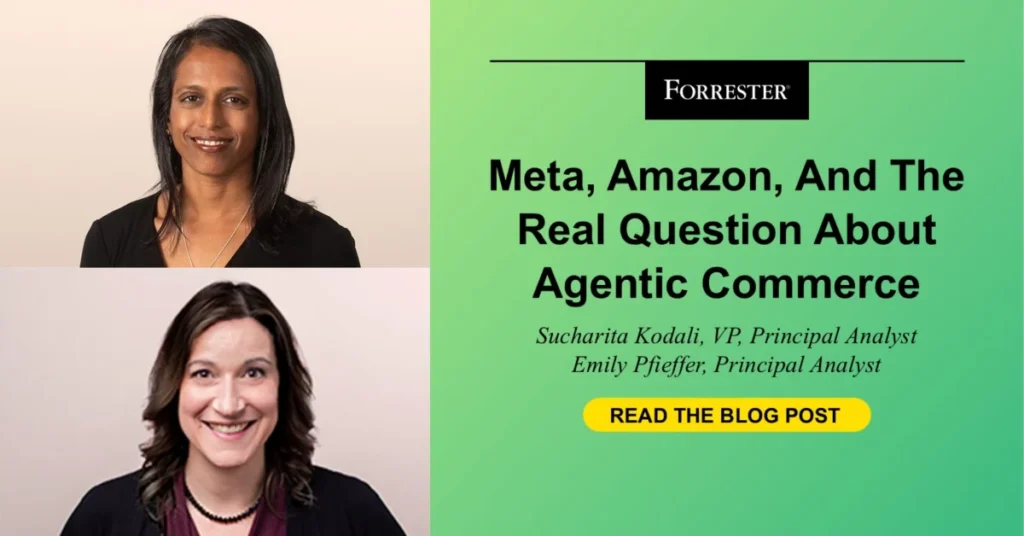
Prominent industry analysts, including Emily Pfeiffer and Chuck Gahun of Forrester, have consistently advised retailers and digital leaders to adopt a measured, strategic perspective when evaluating the rise of agentic commerce.
In recent publications and webinars examining the state of AI-driven retail, Pfeiffer and Gahun have emphasized a critical distinction that many brands overlook: in the near term, the strongest use case for AI agents is research, not purchasing.
While the media often fixates on the futuristic scenario of AI agents autonomously buying groceries, booking flights, and purchasing consumer goods without human intervention, the reality on the ground is far more nuanced. AI agents have proven exceptionally capable of helping consumers discover products, synthesize reviews, weigh technical specifications, and narrow down vast arrays of choices. However, converting those AI-generated recommendations into completed financial transactions remains a significant psychological and logistical leap for the average consumer.
"AI agents can help consumers discover products, compare options, and narrow choices," industry experts note. "Converting recommendations into transactions is still a much bigger leap for most consumers."
The Pragmatic View on Corporate Alliances
It is also vital to remember that relationships among major technology firms are rarely static or defined by permanent hostility. The tech landscape is littered with examples of bitter rivals striking lucrative commercial arrangements when mutual economic self-interest demands it.
For instance, Google pays Apple billions of dollars annually for prime real estate on iPhone screens, securing its position as the default search engine on iOS devices despite the companies competing fiercely in mobile operating systems, browsers, and artificial intelligence.
Given this precedent, industry watchers suggest it would not be surprising to see Amazon and Meta eventually forge some form of commercial partnership or interoperability agreement down the line—provided that agentic shopping gains undeniable, mainstream traction among consumers. If shoppers overwhelmingly demand the ability to use AI agents to compare prices and buy items across the entire web, platforms that stubbornly remain closed off risk alienating their user bases.
Strategic Implications: What Digital Leaders and Retailers Must Do Now
For retailers, brands, and digital commerce leaders watching the Amazon-Meta feud unfold from the sidelines, the situation offers several crucial lessons and strategic takeaways.
1. Separate Hype from Reality
Retail executives must resist the temptation to treat isolated corporate disputes as definitive prophecies about the trajectory of commerce. The clash between Amazon and Meta is a localized battle between two giants with distinct strategic agendas. It does not mean that agentic commerce is an absolute failure, nor does it mean that walled gardens are impregnable. Leaders must evaluate AI adoption based on actual consumer behavior rather than PR-driven headlines.
2. Prioritize AI-Enabled Product Discovery
Because the immediate, practical utility of AI agents lies in research and comparison rather than automated checkout, brands must optimize their digital presence for AI readability.
- Are your product catalogs structured in a way that large language models and shopping agents can easily parse, index, and understand?
- Is your brand messaging transparent, data-rich, and easily verifiable by third-party AI assistants?
If an AI agent cannot accurately understand your product features, pricing, and inventory status, it will never recommend your brand to a consumer during the research phase.
3. Maintain Omnichannel Flexibility
The Amazon-Meta standoff underscores the danger of relying too heavily on any single digital channel or walled garden. Retailers and direct-to-consumer brands must continue to diversify their digital real estate, ensuring they maintain direct relationships with their customers through owned channels (such as proprietary websites, email marketing, and loyalty apps) while participating wisely in third-party marketplaces and social commerce ecosystems.
4. Monitor the Evolution of Transaction Protocols
As agentic commerce matures, the industry will inevitably need to establish standardized protocols and security frameworks governing how autonomous software agents interact with merchant checkouts. Digital leaders should closely monitor developments in API standards, secure authentication for AI agents, and emerging regulatory frameworks regarding data privacy and consumer protection in automated transactions.
Conclusion: The Long War for the AI Consumer
The decision by Amazon to block Meta’s Muse AI agent from its marketplace is a dramatic chapter in the ongoing evolution of digital commerce, but it is by no means the final word.
At its core, this dispute reflects the clash between Amazon’s fiercely guarded ecosystem and Meta’s sweeping ambitions to turn social media into an all-encompassing shopping gateway. While these two tech titans spar over control of the customer relationship and the checkout funnel, retailers and digital leaders must keep their eyes fixed on the broader horizon.
In the near term, the true power of AI agents will be realized in the realm of product discovery, research, and comparison. Converting those AI-driven insights into seamless transactions will require time, trust, and technological standardization. As consumer expectations shift and the capabilities of autonomous agents continue to expand, the walls separating tech giants may eventually give way to new commercial partnerships.
For brands and retailers navigating this complex transition, the path forward requires a balanced approach: optimizing for AI-driven discovery, maintaining direct customer connections, and remaining agile in a digital landscape where the only constant is change.
