
The Algorithmic Newsroom: Decoding Global Engagement Trends in the Age of Social Video
In the contemporary digital landscape, news publishers are engaged in a multi-front war for audience attention. The challenge is no longer merely out-reporting competitors; it is about out-maneuvering the opaque, shifting requirements of algorithmic distribution. Success in the "News & Politics" vertical has become a highly technical discipline, where relevance, timing, and format precision dictate whether a story reaches millions or disappears into the digital ether.
New data from Tubular Intelligence, covering the period from November 2025 through February 2026, reveals a stark reality: audience behavior is deeply fragmented across regions. To win, media organizations must stop viewing social video as a monolithic distribution channel and start treating it as a series of distinct, nuance-driven ecosystems.
The Strategic Shift: Moving Beyond Volume
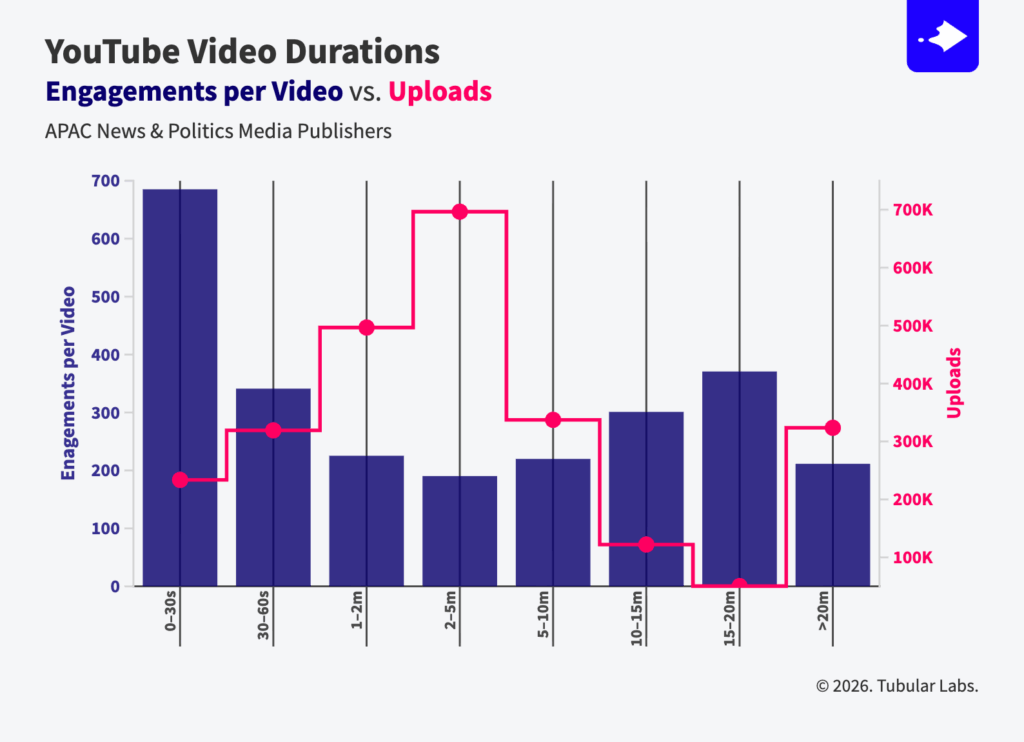
For years, the industry mantra was "more is better." Publishers flooded platforms with mid-length content, hoping to cast a wide net. However, recent performance patterns suggest that this "output-first" strategy is becoming increasingly inefficient. By analyzing upload volume against engagement-per-video (EpV) metrics, we can identify a significant decoupling of quantity and impact.
In the APAC region, for instance, the data indicates a "barbell" effect. Audiences are gravitating toward the extreme ends of the spectrum: ultra-short, punchy updates (0–30 seconds) that satisfy the need for instant awareness, and deep-dive, long-form explainers (15–20 minutes) that satisfy the desire for context and authority. The middle ground—videos between 2 and 5 minutes—accounts for the highest volume of uploads but significantly underperforms in terms of engagement. For newsrooms, this represents a massive opportunity cost. By over-investing in the "dead zone" of mid-length content, publishers are failing to capture the high-intensity engagement that both short and long-form formats currently command.
Chronology of a Data-Driven Revolution
The evolution of these insights has been accelerated by the rapid integration of AI-driven analytics in newsrooms over the past 18 months.

- Q4 2025: Initial data synthesis from Tubular Intelligence began to highlight a growing disconnect between publisher posting habits and actual audience activity.
- January 2026: Mid-quarter adjustments revealed that LATAM publishers were consistently missing the mark on timing, leading to the identification of the "early-morning surge."
- February 2026: Final analysis concluded that global search visibility is no longer purely organic but is heavily reliant on "hashtag architecture"—the deliberate use of specific, high-intent keywords to bridge the gap between niche political reporting and mass-market discoverability.
This timeline reflects a broader industry shift: moving from reactive reporting to proactive, data-informed distribution.
Supporting Data: Regional Nuances and Behavioral Patterns
To understand the global landscape, one must look at how geography fundamentally alters consumption.
The LATAM Timing Paradox
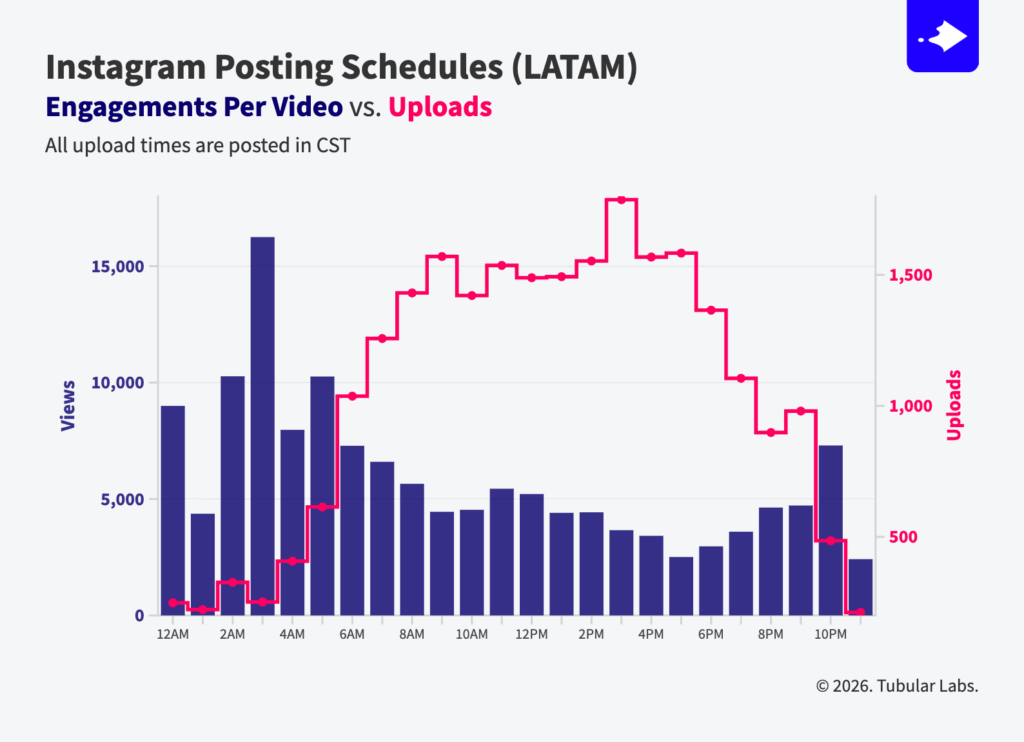
In the LATAM market, the data exposes a clear inefficiency in distribution. Most publishers have defaulted to an evening posting schedule, likely inherited from the era of traditional broadcast television. However, Instagram engagement data shows a consistent, massive spike between 3:00 and 3:59 AM CST.
While the majority of news organizations continue to flood the feed during the mid-afternoon (3:00–3:59 PM CST), the data suggests that these posts are essentially being "drowned out" by the sheer volume of competing content. The publishers who are successfully pivoting to early-morning windows are seeing higher engagement-per-video, likely because they are the first to populate the feed for early-rising users, effectively capturing the attention of their audience before the daily noise reaches its peak.
The EMEA Hashtag Strategy
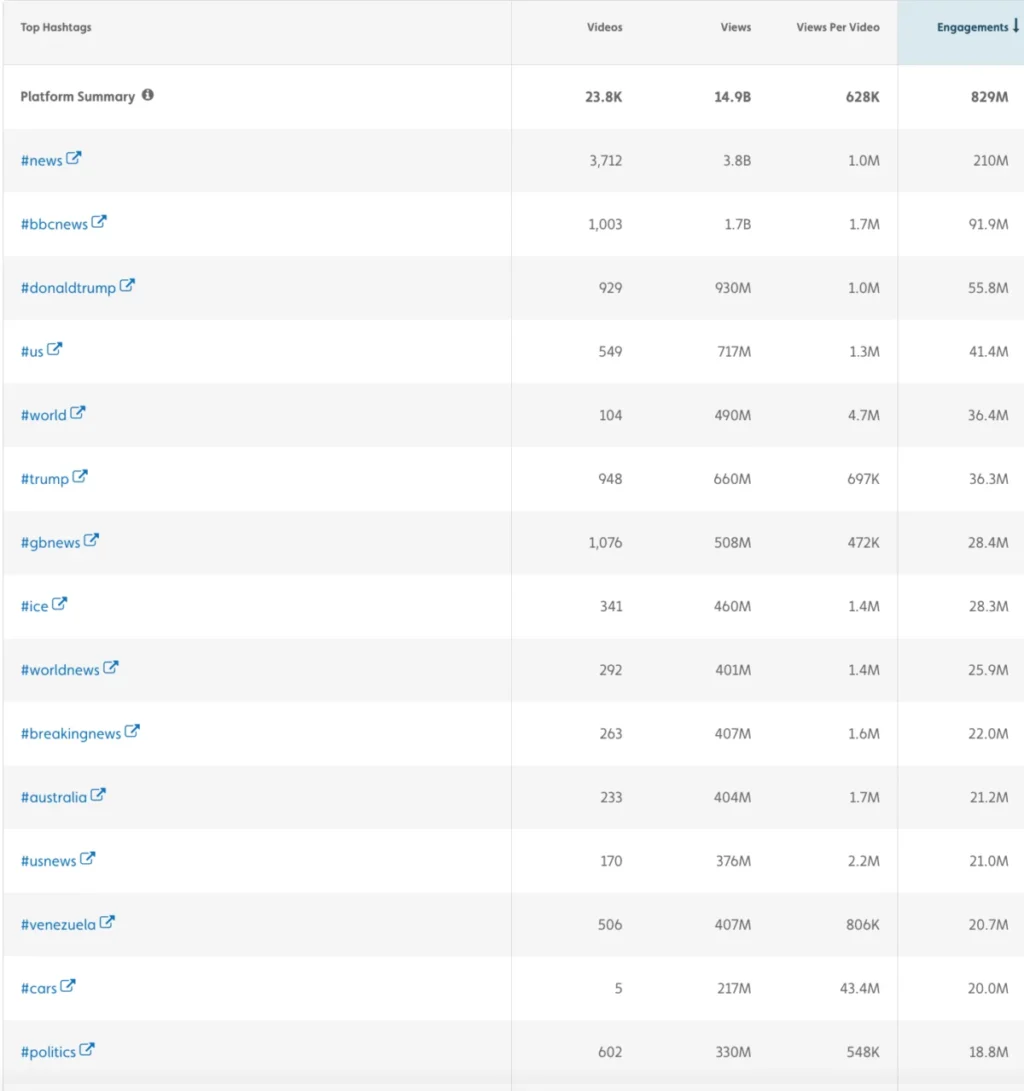
In Europe, the Middle East, and Africa (EMEA), the use of hashtags has evolved from a basic categorization tool into a sophisticated discovery engine. Analysis of top-performing content shows a "triangulation" strategy:
- Global Flashpoints: Using tags like #trump, #ICE, or #venezuela to tap into international discourse.
- Brand Anchoring: Utilizing established tags like #bbcnews to build institutional trust.
- Local Context: Employing country-specific identifiers to ground global events in local realities.
This three-pronged approach allows publishers to serve as a bridge, helping audiences understand how global trends impact their immediate, local environments.
Official Perspectives: The Institutional Challenge
Industry leaders and media analysts are increasingly vocal about the need for this strategic pivot. In recent industry briefings, editorial directors have acknowledged that the "gatekeeper" model of news is dead.
"We are no longer just reporting the news; we are competing with the algorithm for the right to inform," one executive noted. "The data clearly shows that we cannot simply repurpose a broadcast clip for a social feed. We have to understand the specific ‘grammar’ of the platform."
This shift is creating a divide between traditional outlets that struggle to adapt and "digital-native" publishers who are aggressively leveraging data to refine their editorial calendars. The pressure on newsrooms is twofold: they must maintain journalistic integrity while simultaneously satisfying the machine-learning requirements of platforms like TikTok, Instagram, and YouTube.
Implications: The Future of News Distribution
The most critical takeaway from the 2025-2026 analysis is that "hard news" is being redefined by audience interaction.
The Humor Factor
Perhaps the most surprising finding in the US market involves the intersection of high-stakes politics and comedy. The most viewed and engaged content on TikTok is not always the most serious. For example, a clip regarding a high-profile car crash involving a public figure might draw massive views, but it is often the "unexpected" emotional or humorous reaction to political events that drives the highest engagement.
When a man at a protest made a seemingly serious statement about his weapon choice, the public did not respond with the gravity the subject demanded; instead, they engaged through mockery and cultural commentary. This suggests that for Gen Z and Millennial audiences, political discourse is a participatory, often ironic, experience. Publishers who ignore this, or who try to enforce a rigid, overly formal tone, risk being perceived as out of touch.
A Call for "Smarter" Publication
The overarching implication for the industry is that the era of "spray and pray" content distribution is over. The data suggests that publishers should:
- Audit their content duration: If a video isn’t working, analyze if it falls into the "mid-length" trap.
- Align with regional windows: Don’t post when you are at your desk; post when the audience is active in their region.
- Humanize the algorithm: Use hashtags and topics that reflect how real people actually search, not just how newsrooms categorize stories.
Conclusion: The Path Forward
For media publishers, the path to survival is not found in increasing the sheer number of videos produced. It is found in precision. By aligning content strategy with real-world audience behavior—understanding that an early-morning post in LATAM or a humorous take on a serious US political event can outperform a standard breaking news report—publishers can finally break free from the algorithmic trap.
The newsroom of the future is not a place where reporters simply gather facts; it is a laboratory where data, creativity, and platform strategy converge to ensure that the most important stories of the day are actually seen, understood, and debated. Those who master this alignment will not just survive the current media landscape—they will define it.
