
The AI-CX Paradox: Why Faster Automation Is Breeding Higher Customer Dissatisfaction
By Constantine von Hoffman
Senior Editor, MarTech
For the better part of a decade, businesses have been sold a seductive promise: integrate artificial intelligence into customer experience (CX) and support workflows, and watch your bottom line soar while customer satisfaction climbs. Automation would handle the repetitive churn, free up human agents for complex problems, and deliver instant gratification to consumers accustomed to a frictionless digital world.
Yet, according to a striking new benchmark report, the reality on the ground looks remarkably different. Artificial intelligence is raising consumer expectations at a blistering pace—far faster than it is improving the actual customer experience.
The findings, published in Alchemer’s comprehensive 2026 AI & Customer Expectations Study, paint a complex picture of modern consumer sentiment. While companies race to implement automated tools to slash operational costs, they are inadvertently stepping into a psychological trap. The very presence of AI signals to customers that speed and efficiency should be absolute. When those automated systems stumble—as they frequently do on nuance, context, and basic comprehension—the resulting friction feels all the more infuriating to a consumer whose patience has already worn thin.
Main Facts: The Great Expectations Disconnect
At the heart of the Alchemer study lies a troubling paradox for marketers, customer service leaders, and digital strategists. Nearly six in 10 consumers (close to 60%) explicitly state that knowing a company uses artificial intelligence instantly raises their expectations for faster responses. They assume that silicon-based systems operate at the speed of light, and they adjust their timeline for brand responsiveness accordingly.
However, this elevation of expectations has severely outpaced performance. A staggering 89% of consumers report that AI has negatively impacted their experience with a company in at least one way.

This disconnect places marketing, product, and CX teams in an unenviable structural bind. The harder companies lean into back-end AI to streamline operations, reduce ticket volumes, and accelerate workflows, the more customers demand an experience that is radically faster and smoother. When automated systems fail to deliver seamless resolution, the backlash is immediate. Nearly half of all surveyed consumers (45%) note that general advancements in AI have permanently raised their baseline expectations for all companies across the board.
Furthermore, consumer tolerance for delays is evaporating. Nearly 30% of respondents expect brand feedback or inquiries to be formally acknowledged within 24 hours, while 16% demand immediate, real-time acknowledgment.
Yet, despite this heavy reliance on automation, consumers remain fiercely protective of human oversight. When automated troubleshooting hits a dead end, they expect a human being to be readily available to pick up the pieces—a core demand that frequently clashes with corporate goals of minimizing human involvement to cut costs.
Chronology: How the AI-CX Gold Rush Created a Trap
To understand how businesses arrived at this juncture, it is necessary to examine the timeline of AI integration in customer experience over recent years.
- 2022–2023: The Generative AI Explosion and Cost-Cutting Mandates. Following the mainstream breakout of generative large language models, enterprise leadership rushed to adopt conversational bots and automated ticketing systems. Driven largely by post-pandemic economic pressures and the mandate to protect profit margins, organizations deployed AI tools primarily to reduce headcount dependencies and lower support overhead.
- 2024: The Era of "Speed at All Costs." CX teams prioritized metrics like First-Response Time (FRT) and Containment Rates (the percentage of queries resolved entirely by bots without human escalation). Dashboards glowed green as bots answered chats in seconds, creating a false sense of security among executive stakeholders.
- 2025: The Rise of Consumer Fatigue. As automated interactions saturated the digital landscape, consumers began experiencing widespread "chatbot fatigue." Reports mounted of rigid prompt loops, repetitive conversational errors, and impenetrable gatekeeper bots designed specifically to prevent users from reaching a human representative.
- 2026: The Reckoning (Alchemer Study Findings). The release of Alchemer’s benchmark report formally codified what frontline workers had suspected: the quantitative gains in backend efficiency were coming at the direct expense of qualitative brand trust. Consumers stopped viewing AI as a delightful novelty and began evaluating it through a lens of critical skepticism.
Supporting Data: What the Numbers Tell Us
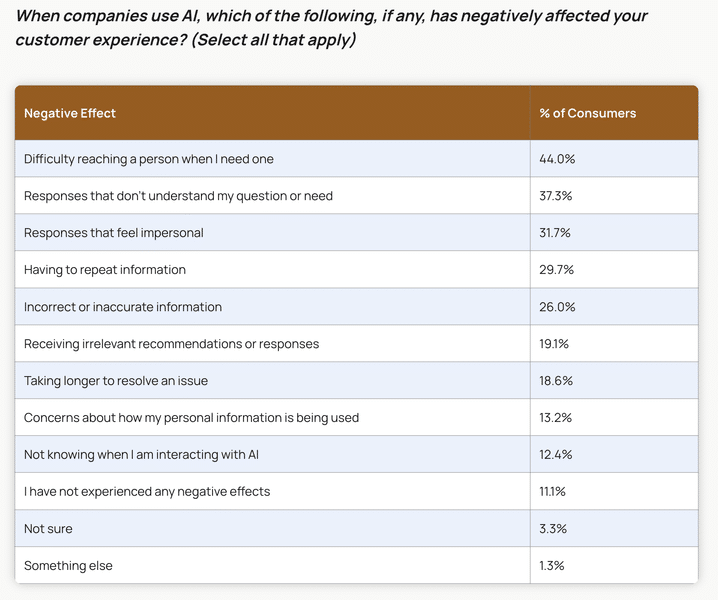
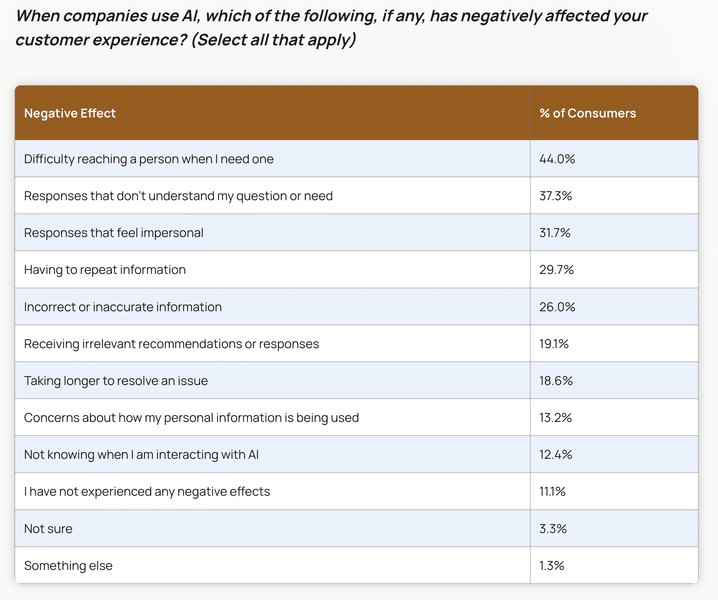
Alchemer’s survey of 2,009 U.S. consumers provides granular insight into what is breaking down in AI-driven customer journeys. When asked about their biggest frustrations regarding AI in customer service, respondents did not point to abstract worries about data privacy, security, or irrelevant product recommendations.
Instead, the winner—securing 44% of responses—was the sheer, frustrating difficulty of reaching a human being when an issue required real empathy or complex problem-solving.
The Anatomy of Consumer Frustrations
- 37% of consumers received AI responses that fundamentally failed to understand their question, intent, or core need.
- 30% reported being forced to repeat information they had already provided earlier in the interaction or through another channel.
- 26% received outright incorrect or misleading information from automated systems.
- 20% noted that AI-driven interactions actually made issue resolution take longer overall.
- 19% received irrelevant recommendations or canned responses completely detached from their context.
When asked what improvements they desire most, 38% pointed to faster issue resolution, while 34% asked for faster initial responses. Crucially, however, speed is no longer viewed as a standalone cure-all. Consumers explicitly want comprehension over mere velocity: 29% want AI to better understand their specific needs, and 24% want genuinely relevant, personalized experiences rather than generic scripts masquerading as bespoke service.
Official Responses and Industry Perspectives: The Expert Dilemma
Industry analysts and customer experience leaders are grappling with these findings, realizing that traditional metrics used to evaluate automation are fundamentally flawed.
For years, organizations have leaned heavily on First-Response Time and Containment Rates. A bot that answers a query in two seconds and closes a chat window registers as a massive operational success under legacy dashboards. However, as Alchemer’s data indicates, this metric creates a dangerous illusion. A customer who abandons an unhelpful chat bot out of sheer frustration—only to call a phone line or open an email ticket an hour later regarding the exact same unresolved problem—is logged as a "contained" success in the chatbot’s metrics, while actually representing a compounding customer failure.
Experts argue that organizations must pivot toward more holistic measurement frameworks. True visibility into the AI customer journey requires connecting disparate interactions across channels and tracking:
- Repeat contacts regarding the same issue.
- Reopen rates on closed automated tickets.
- True end-to-end time to resolution, accounting for channel-switching.
Furthermore, industry data highlights a fascinating split based on consumer familiarity. The consumers most frequently interacting with artificial intelligence—daily users—are paradoxically its harshest and most discerning critics.
According to the data, 40% of daily AI users report feeling that AI experiences are cold and impersonal, compared to just 22% of infrequent users. Daily users are also significantly more wary of AI hallucination, context collapse, and unwarranted leaps in logic.
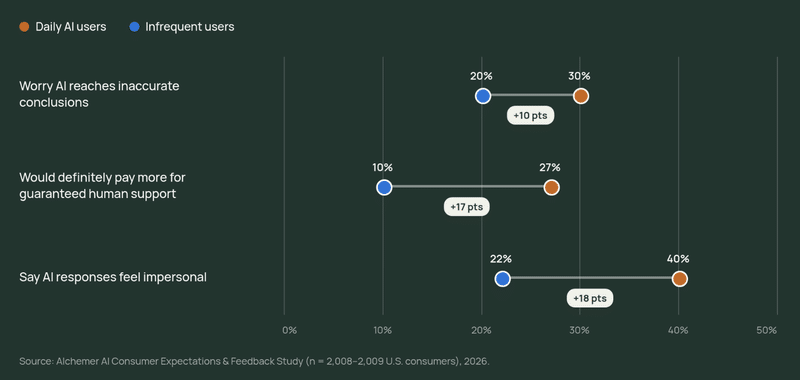
Perhaps most telling for corporate treasuries is the willingness of these power users to pay for an escape hatch. 27% of daily AI users state they would willingly pay extra for guaranteed human support, compared to just 10% of infrequent users. Across the entire survey pool, 43% of all consumers indicated they would pay more for a product or service that guarantees human access when needed.
While the prospect of monetizing human-assisted support introduces a novel revenue stream, CX veterans warn that charging customers to bypass broken automation is a dangerous path that risks weaponizing basic customer service as a luxury tier.
Implications: Strategic Takeaways for Marketers and CX Leaders
The Alchemer study serves as a loud wake-up call for enterprises deploying AI across the Go-To-Market (GTM) and customer support stack. Simply bolting a large language model onto a legacy knowledge base is no longer enough to satisfy modern consumers.
To bridge the gap between elevated expectations and actual experience, organizations must enact sweeping strategic changes:
1. Shift from Speed Metrics to Intent Metrics
Companies must stop celebrating bots that answer quickly if those answers do not solve the underlying problem. Implementing rigorous intent-recognition testing—ensuring systems understand what the customer is trying to achieve rather than just parsing keywords—is vital.
2. Implement Intelligent Escalation Rules
The inability to reach a human is the single greatest point of friction in modern CX. Brands must establish clear, frictionless confidence thresholds. When an AI system encounters ambiguity, emotional distress, or multi-layered complexity, it must route the user to a human agent seamlessly, without forcing the customer to re-explain their entire history.

3. Redefine Personalization Around Context, Not Data Volume
Adding more personal data attributes to an AI model does not automatically fix poor interactions. Consumers do not want creepy hyper-personalization; they want foundational comprehension. Contextual awareness—knowing where the customer is in their journey right now—trumps static profile data every time.
4. Respect the Human Safety Net
Rather than viewing human agents as a costly overhead to be eliminated entirely, forward-thinking brands are positioning human support as a premium differentiator. However, companies must be careful not to alienate baseline consumers by locking fundamental problem-solving behind paywalls.
Ultimately, artificial intelligence in customer experience cannot simply be a tool for corporate cost-cutting disguised as innovation. If brands continue to let automation outpace genuine understanding, they will find that the efficiency gains won on the balance sheet are rapidly eroded by the loss of customer trust in the marketplace.
