
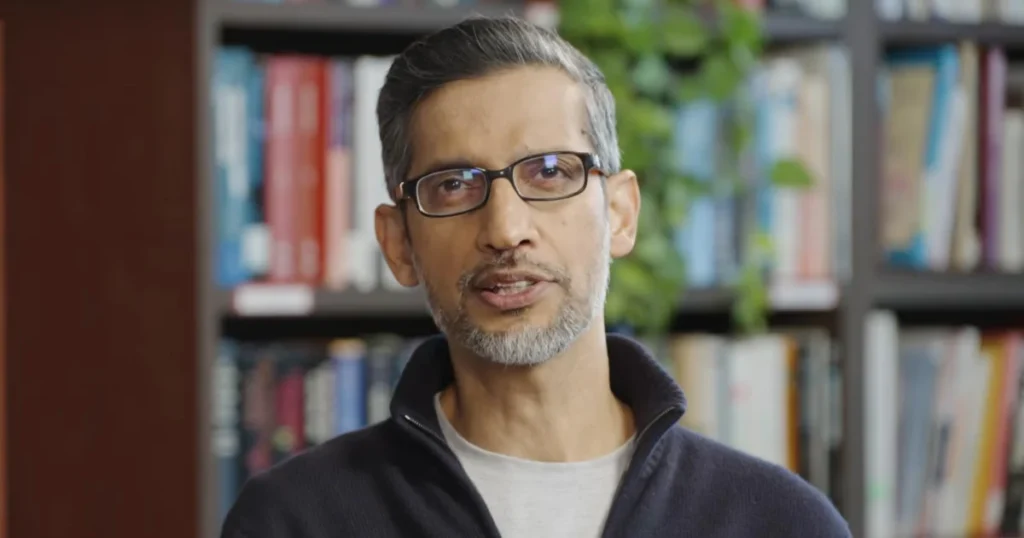
The Agentic Future: Sundar Pichai Outlines Google’s Vision for AI, Search, and the Next Era of Computing
By Tech & AI Industry Desk
In a wide-ranging and deeply revealing interview, Google CEO Sundar Pichai has laid out a transformative vision for the tech giant, signaling that the traditional boundaries separating web search, productivity applications, and artificial intelligence are rapidly dissolving. Speaking on the evolution of Google’s product ecosystem, Pichai detailed how the company is aggressively developing an "agentic layer"—an intelligent, always-on software architecture designed to unify user experiences across Search, Chrome, and Workspace rather than forcing a rigid merger of separate applications.
The discussion, which touched upon everything from enterprise-grade security micro-VMs to the shifting behavior of everyday internet users, offers a clear roadmap of where Google is heading. As artificial intelligence pivots from simple conversational chat interfaces to proactive execution, the implications for consumers, enterprises, and the entire digital publishing ecosystem are profound.
Main Facts
The core takeaways from Pichai’s recent statements center on a fundamental shift in how humans interact with technology:
- The Rise of the Agentic Layer: Rather than completely merging massive products like Google Search and Gemini into a single monolithic app, Google envisions an underlying "agentic layer." This cloud-based intelligence will orchestrate tasks across different products, maintaining continuous context on behalf of the user.
- Deep Integration with Search: Google is moving swiftly to embed advanced agentic capabilities directly into Search. Usage data indicates a steady, organic increase in complex, task-oriented queries where users expect the engine to execute tasks rather than merely return a list of blue links.
- Unified Infrastructure for Enterprise and Consumer: Google is utilizing the same core models, harnesses, and runtimes for both its business and consumer offerings. Enterprise-grade security—such as dedicated micro-virtual machines (VMs) running 24/7 with real-time monitoring and strict auditability—is trickling down to consumer-facing applications.
- Proactive and Personal Assistants: The overarching design philosophy for Gemini is shifting from a reactive chatbot to a proactive, highly personalized assistant capable of handling multi-step workflows across emails, documents, browsers, and the open web.
Chronology: The Evolution Toward Autonomous Agents
To understand how Google arrived at its current strategy, it is helpful to trace the technological milestones that have defined the company’s recent AI push:
Early Explorations: Conversational AI and the LLM Boom
Following the explosive public debut of generative AI tools, Google rushed to restructure its core offerings around its proprietary Gemini large language models. Initial iterations focused primarily on chat interfaces—answering questions, summarizing text, and assisting with coding. However, Google quickly recognized that text generation was merely a stepping stone toward genuine digital utility.
Google I/O and the Introduction of "Spark"
At a subsequent Google I/O developer conference, the company previewed early glimpses of its proactive agentic ecosystem, highlighting experimental concepts like Google Spark. Designed as a cloud-based personal agent tightly coupled with Search and Chrome, Spark demonstrated how AI could conduct background web research and bridge the gap between browsing and task completion.
Enterprise Deployment and Security Frameworks
Before rolling out advanced autonomous agents to billions of everyday consumers, Google focused heavily on the enterprise sector. Recognizing that businesses require strict data governance, privacy controls, and security, Google deployed robust agentic frameworks backed by isolated micro-VM architectures. This allowed enterprise users to grant agents workspace identities and access to sensitive corporate emails safely.
The Pivot to "One Box" and Consumer Rollouts
In his recent interview, Pichai revealed that the rigorous security and architectural lessons learned in the enterprise space are now being packaged for everyday consumers. With newer model rollouts—such as the advanced Argon models arriving via Ultra and Pro tiers—Google is systematically deploying chat-and-task capabilities into the hands of the general public, laying the groundwork for a unified "one box" experience.
Supporting Data and Technical Architecture
Pichai’s remarks were underpinned by empirical observations derived from Google’s vast telemetry and usage data.
Shifting Query Demographics
According to Google’s internal analytics, user behavior is undergoing a structural shift. The volume of "agentic queries"—searches or prompts that require multi-step reasoning, synthesis, and action rather than simple informational retrieval—has been steadily climbing. Users are no longer content with being sent to third-party web pages to piece together answers themselves; they increasingly expect the system to perform the legwork.
The Micro-VM Security Paradigm
A major hurdle for autonomous AI agents has been safety and control—specifically, preventing unauthorized data leakage or runaway execution. Google’s technical solution involves provisioning a dedicated, secure micro-virtual machine (VM) for every distinct task an agent undertakes. Operating 24/7 with real-time monitoring, these micro-VMs isolate user data and operational environments, ensuring that enterprise-level governance and auditability are maintained seamlessly across all tiers of service.
Official Responses and Key Excerpts
During the interview, interviewer Alex Heath pressed Pichai on the competitive landscape of personal AI agents (referencing emerging market competitors like Muse) and questioned whether Google’s massive, distinct properties—namely Gemini (with over a billion users) and Search (also serving billions)—would ever fully converge.
Pichai addressed the competitive landscape and Google’s architectural philosophy directly:
"It’s a huge area of focus. In fact, the goal we set out for Gemini, how we call it, we want it to be a personal, proactive, and powerful assistant. It’s a core part of what we are trying to do with Gemini… To be very clear between enterprise and consumer, it’s the same model, same harness, same runtime. It is just the context of what you have in a business or your personal context is different."
On the topic of product convergence and the role of the agentic layer, Pichai explained:
"I expect our agents to provide that unifying experience across these products. In fact, that agentic layer, rather than try to converge or think about different products and how they come together, I think the agentic layer naturally ends up doing that… Because your agents, they’re running in the cloud, they’re running 24/7, they have your context. And so they can pick up things where you left off. So you can start a task in some place. You go to the other place. Your agent has that context for you. So I think the agentic layer offers us a chance to bring a unified product experience better than ever before."
Highlighting the deep integration coming to Google Search, Pichai added:
"Empirically, when we look at what people are doing in Gemini, if you were to go back and classify it, we see the trend already. So the percentage of… queries, which are more agentic, has been steadily increasing over time. And we’re going to make all of that more widely available as we go through the next few months… So we are focused on it from search, and we are focused on it in a pretty deep way."
Industry Implications: What Happens to the Web?
While Pichai’s technical vision outlines an extraordinarily smooth, frictionless experience for end-users, it introduces profound questions for the broader digital economy.
For decades, the standard internet bargain has relied on human referral traffic: users type queries into a search engine, click through to publisher websites, consume content, and interact with advertisements or services. SEO professionals, content creators, and site owners have built entire digital business models around capturing human eyeballs on web pages.
However, if Google’s vision of the "agentic layer" and the "one box" fully materializes, a paradigm shift occurs:
- Disintermediation of the Web: If an AI agent executes tasks, aggregates research, and synthesizes answers entirely within the cloud ecosystem without sending the user to a source website, traditional web traffic models face severe disruption.
- The Evolution of Content Discovery: Publishers may need to optimize not for human-facing search engine result pages (SERPs), but for machine-readable APIs and agentic consumption, fundamentally altering how information is valued and monetized online.
- Redefining Brand Loyalty: When an autonomous assistant handles bookings, purchases, and research on behalf of a consumer, brand discovery shifts from visual marketing and direct web browsing to algorithmic recommendation by the AI harness.
Conclusion
Sundar Pichai’s revelations make one thing abundantly clear: the era of static web pages and isolated software applications is drawing to a close. By weaving advanced, secure, and proactive AI agents into the very fabric of Search, Chrome, and Workspace, Google is attempting to redefine computing as a continuous, ambient dialogue between human intent and machine execution. How the rest of the digital world adapts to this agentic transformation will define the next decade of technology.
