
The 2026 Latin American Newsroom Playbook: How Social Video Data is Redefining Journalism
MEXICO CITY — Across Latin America, the traditional morning paper left on the doorstep or the evening broadcast flickering on the living room television set has been firmly supplanted by the glowing screen of a smartphone. Social media platforms have rapidly evolved into the primary public square where news is discovered, debated, and distributed at scale across the region.
According to data compiled in the Reuters Institute Digital News Report 2025, roughly 58% to 64% of respondents in major Latin American markets—including Argentina, Chile, Colombia, Mexico, and Peru—now rely on social media as a primary source for news content. This seismic shift in consumer habits has created an urgent mandate for legacy publishers and digital-first media companies alike: adapt to audience consumption patterns or risk irrelevance.
As traditional media outlets race to capture shrinking attention spans, a new wave of social-first creators and agile publishers are outperforming legacy institutions. To understand what is truly driving views, engagement, and audience growth in the region, comprehensive data analytics from industry leaders Tubular Labs (covering performance insights from January 1 to July 31, 2025) and insights from Chartbeat provide a revealing roadmap.

By analyzing News & Politics content across major social platforms, media strategists now possess a clear, data-backed blueprint for what LATAM audiences demand as the industry looks ahead.
Main Facts: The Current Landscape of LATAM Social Video
The sheer volume of digital consumption in Latin America is staggering. Between January and July 2025, social video content across all categories and platforms in the region generated an astronomical 4.05 trillion views.
Yet, within this massive digital ecosystem, professional news organizations represent a remarkably small fraction of the total output. News & Politics content posted by established media companies accounted for 27.1 billion views spread across just 293,000 uploads.
This disparity highlights a significant structural reality: while consumer appetite for news is at an all-time high, the actual volume of professional journalistic content published to social video platforms remains surprisingly low. For legacy publishers, this represents a massive whitespace opportunity to capture market share, build brand loyalty, and meet audiences directly where they consume media.
Chronology and Evolution: From Long-Form Broadcasts to Bite-Sized Feeds
The transition of news consumption in Latin America did not happen overnight; it is the culmination of a decade-long shift in digital infrastructure, mobile penetration, and platform algorithms.
- Early 2010s: News organizations treated social media primarily as a distribution funnel—a digital billboard designed to drive traffic back to legacy publisher websites via static links and landscape-oriented video clips.
- Late 2010s: Mobile internet adoption surged across Latin America. Platforms like YouTube became ubiquitous, but newsrooms largely treated them as storage repositories for archived television broadcasts rather than native storytelling mediums.
- 2020–2023: The explosive rise of short-form video formats—pioneered by TikTok and quickly adopted by Instagram Reels and YouTube Shorts—fundamentally altered user behavior. Audiences, particularly younger demographics, began bypassing traditional news portals entirely in favor of algorithmically curated feeds.
- 2024–2025: A tipping point was reached. As confirmed by the Reuters Institute, social platforms became the dominant news discovery mechanism for nearly two-thirds of Latin Americans. Publishers began waking up to the reality that traditional metrics no longer applied.
- 2026 and Beyond: The current era is defined by data-driven optimization. Publishers are no longer asking if they should be on social media, but how precise metrics regarding video duration, publishing times, and cross-platform topic alignment can maximize their reach.
Supporting Data: YouTube and TikTok Performance Metrics
An analysis of platform-specific data reveals distinct trends that challenge long-held assumptions within traditional newsrooms.
YouTube Trends: Mobile Dominance and the Power of Shorts
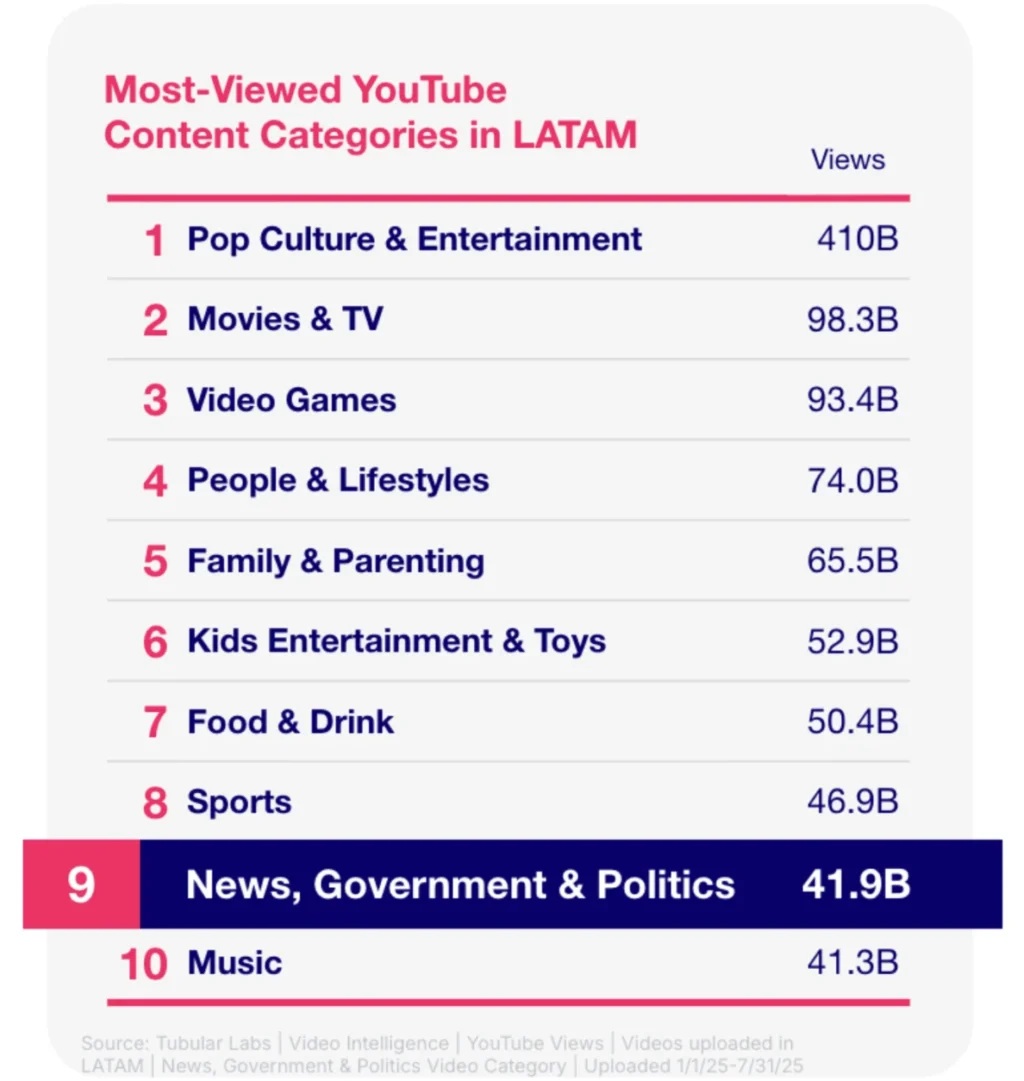
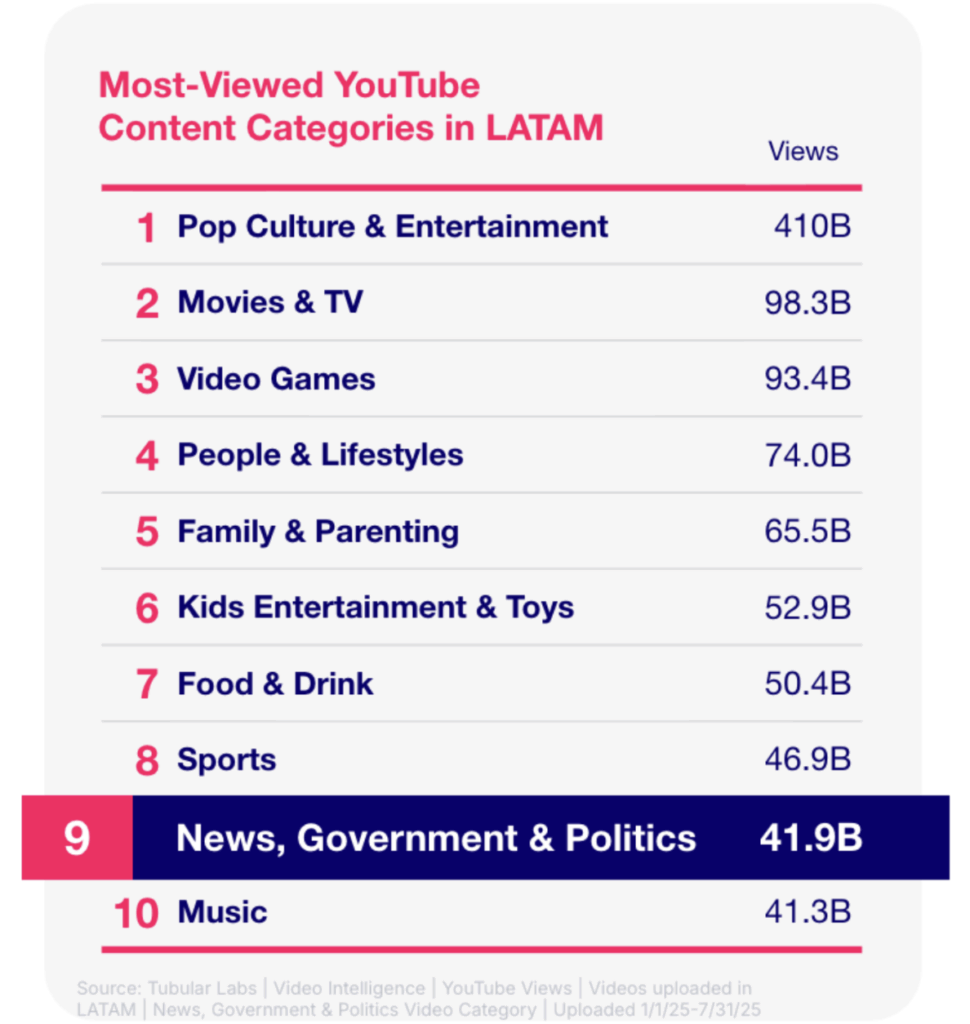
Despite heavy competition from entertainment and creator-led channels, News, Government & Politics ranked as the #9 most-viewed category on YouTube in LATAM, pulling in 41.9 billion views across publisher, influencer, and brand accounts combined. Notably, this placed the news category ahead of Music, despite significantly fewer total uploads.
However, how publishers utilize YouTube often contradicts how audiences actually consume it:
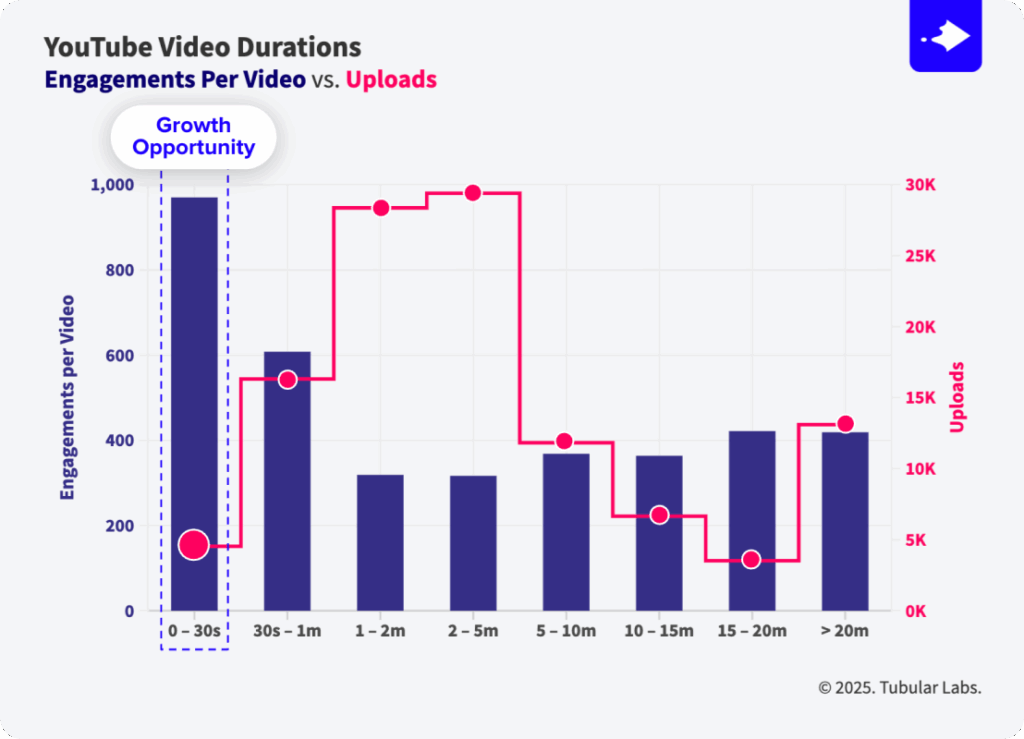
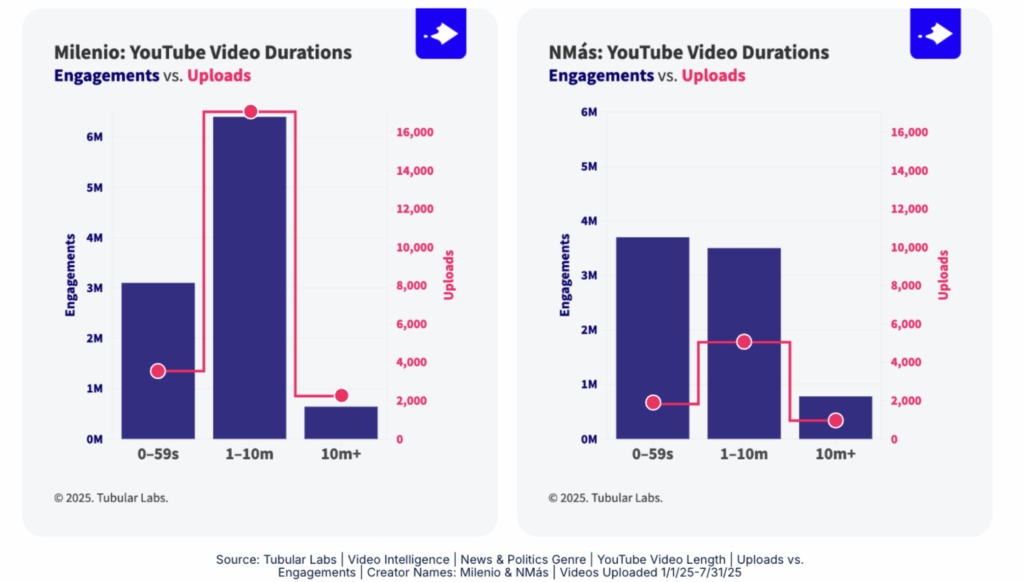
- The Duration Mismatch: Data shows that YouTube videos under 30 seconds deliver the highest engagement per video for News, Government & Politics content. Conversely, most publishers continue to upload mid-length videos ranging from 1 to 5 minutes, a format that actually yields the lowest engagements per video.
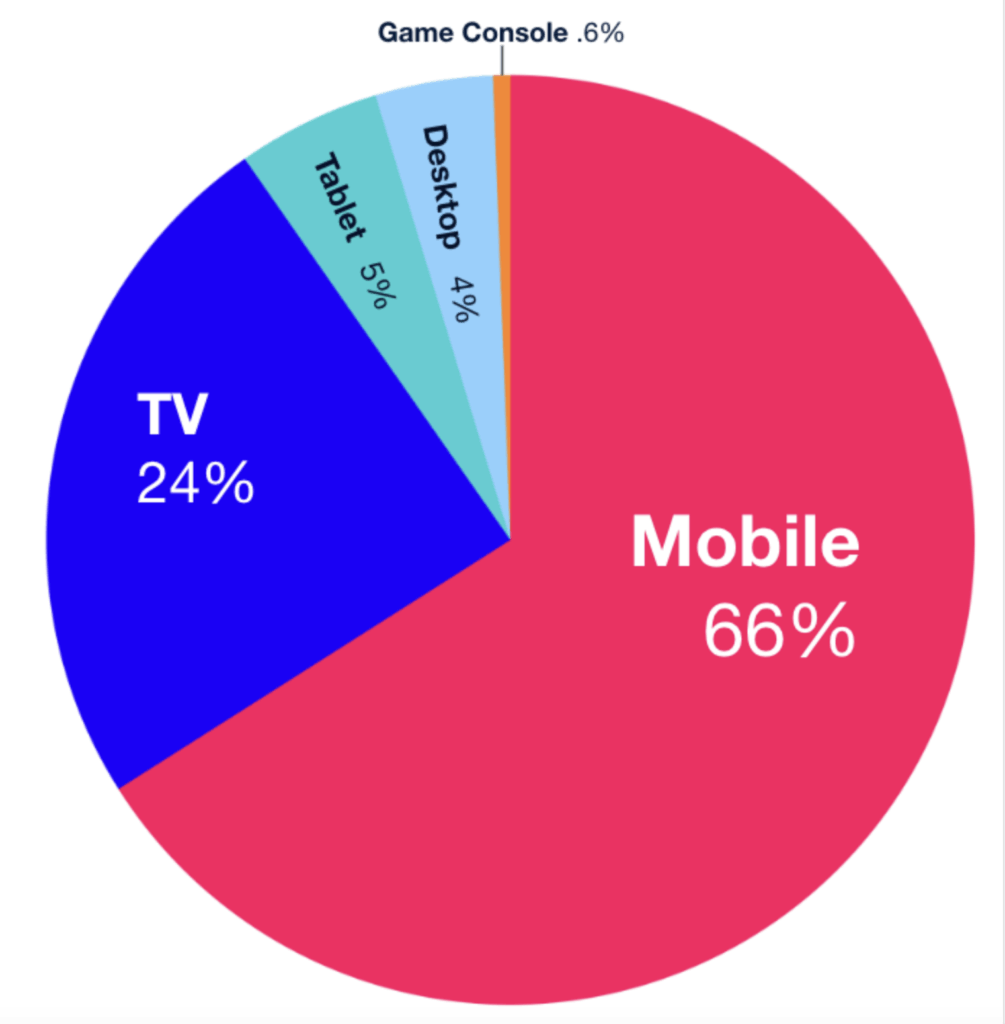
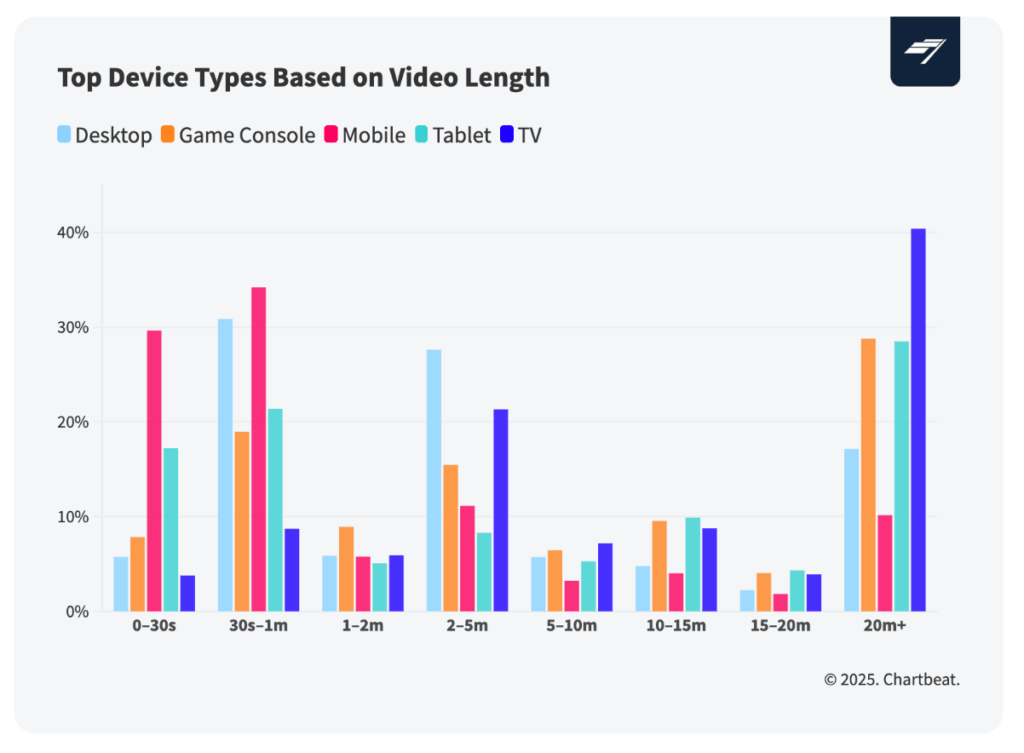
- Device Preferences: Mobile devices account for a dominant 66% of YouTube views for LATAM News & Politics publishers, compared to just 24% on television screens. (Chartbeat analytics further clarify that audiences watching on TVs, tablets, and game consoles prefer long-form content exceeding 20 minutes, whereas mobile and desktop users overwhelmingly favor videos under one minute).
- The Efficiency of Shorts: Leading publishers are already capitalizing on this trend. For instance, Milenio’s YouTube Shorts made up just 15% of their total uploads but drove a staggering 31% of their total cross-platform engagements. Similarly, NMás posted 2.8 times more mid-length videos yet earned nearly half of their total engagements exclusively from Shorts.
TikTok: The Ultimate Growth Engine
If YouTube is where LATAM audiences search for in-depth updates, TikTok is where viral engagement and rapid community building take place.
- Massive Interaction Share: Despite representing a smaller share of overall uploads compared to legacy platforms, TikTok drives 71% of all cross-platform social interactions with LATAM news media.
- Category Ranking: News, Government & Politics posted by media companies, brands, and influencers ranked as the #6 most-viewed TikTok category, accumulating 92.0 billion views.
- Explosive Growth: Viewership for the top 10 LATAM news publishers on TikTok grew by an impressive 55% year-over-year, proving that platform audiences actively seek out credible news updates.
- Case Study (C5N): Leading LATAM news publisher C5N found that TikTok content accounted for only 25% of their cross-platform uploads, yet generated an overwhelming 71% of their total engagements, cementing the platform as an indispensable growth engine.
Official Responses and Strategic Implications
Digital media strategists and industry experts emphasize that closing the gap between audience demand and publisher output requires an immediate pivot away from institutional habit and toward rigorous data alignment.
The Danger of Assumptions
“Too many legacy media organizations build their social strategies based on what they think audiences want, rather than analyzing hard behavioral data,” notes media strategy analysts reviewing the Tubular Labs findings. “When 0-30 second videos consistently outperform 1-to-5 minute clips on mobile, but newsrooms stubbornly continue to produce the latter, they are actively fighting consumer preference.”
Platform-Specific Topic Alignment
Data also reveals that LATAM audiences look to different platforms for different thematic content. Publishers must adopt a nuanced, platform-specific content strategy rather than blindly cross-posting identical assets everywhere.
- Content covering complex human rights issues—such as immigration or women’s rights—tends to perform exceptionally well when shared across Instagram and TikTok.
- Conversely, institutional topics such as law enforcement and public policy often see stronger baseline engagement when tailored for Facebook or YouTube.
Timing and Scheduling Nuances
Data insights further challenge standard 9-to-5 newsroom workflows. Across multiple metrics, videos uploaded on Sundays earned the highest engagement. Publishers who rely solely on active daytime staffing risk missing critical engagement windows, making automated advance-scheduling tools a necessity for modern newsrooms.
Implications for the Future of Journalism in Latin America
The implications of these findings for 2026 and beyond are clear. With the News & Politics category representing a mere 0.67% of total social video uploads in Latin America, the space is wide open for publishers willing to innovate.
The competitive advantage no longer belongs exclusively to those with the largest broadcast budgets, but to those who master short-form optimization, respect mobile-first viewing habits, and treat social platforms as native journalistic environments rather than afterthoughts.
For LATAM newsrooms, the path forward requires unlearning decades of traditional broadcast habits. By embracing data-backed video durations, leveraging short-form tools like YouTube Shorts and TikTok, and aligning content types with specific platform behaviors, publishers can secure their legacy and reclaim their audience in the digital age.
