
The 2026 B2B Outlook: Navigating the Era of Agentic Marketing
As the marketing landscape enters 2026, the industry stands at a critical inflection point. Jon Miller, co-founder of Marketo and a foundational architect of modern B2B marketing, has released his annual forecast, painting a picture of a sector undergoing a fundamental transition from software-driven workflows to agentic, intelligence-led operations.
For the fourth consecutive year, Miller has committed his strategic vision to the public record, offering a rigorous assessment of where B2B go-to-market (GTM) strategies are headed. This year’s analysis suggests that while the industry is poised for an "AI-first" future, the transition will be defined by hybrid experimentation rather than an overnight collapse of legacy systems.
Main Facts: The Rise of the AI Agent
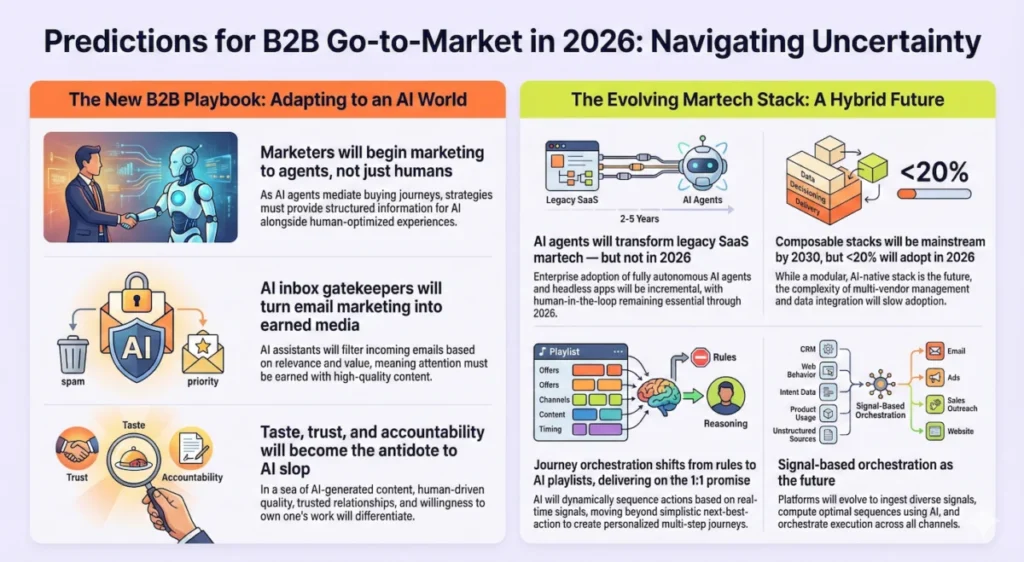
The defining narrative for 2026 is the emergence of the "AI Agent" as a legitimate participant in the buying committee. Unlike the generative tools of 2024 and 2025 that focused on content assistance, 2026 marks the year marketers must begin "marketing to agents."
As autonomous systems increasingly handle vendor research, technical evaluation, and initial procurement vetting, the traditional B2B sales funnel is being re-engineered. Miller posits that marketers must now provide two distinct interfaces: one for human stakeholders focused on emotional resonance and trust, and another for AI agents that require high-fidelity, structured data, pricing APIs, and machine-readable service layers.
Chronology: From SEO to AEO
The evolution of search and discovery has been swift. A retrospective of the last 24 months reveals a distinct timeline of adaptation:
- 2024: The era of "ChatGPT adoption," where marketers experimented with LLMs for basic content generation.
- 2025: The year of "Answer Engine Optimization" (AEO). Industry data indicates that 90% of B2B buyers utilized AI tools for research, prompting a mass shift in focus from traditional keywords to schema markup and structured data.
- 2026: The shift toward "Agentic Integration." The focus has moved from merely appearing in AI summaries to facilitating active dialogue with agents capable of "reasoning" through product specs and compliance requirements.
Supporting Data and Market Intelligence
Current metrics underscore the tension between the hype of a "SaaS-free" world and the reality of enterprise adoption. According to recent reports, while AI usage is skyrocketing, roughly 81% of implementations remain in an "assist-only" mode.
Furthermore, the "Silent Freeze"—a trend noted by industry observers—shows a decline in entry-level roles as companies leverage AI to maintain productivity without backfilling junior positions. Data from Pave confirms this: SDR (Sales Development Representative) roles have seen a significant contraction, dropping from nearly 2% of the workforce in 2023 to 1.45% by late 2025. This "hollowing out" of the entry-level tier presents a long-term risk to the professional development pipeline, potentially creating a "barbell economy" of highly specialized senior strategists and AI-proof tradespeople.
Official Perspectives: The "Hybrid" Reality
Despite the proliferation of "SaaS is dead" rhetoric, industry leaders emphasize that wholesale transformation will be a multi-year process. The prevailing sentiment is that 2026 will function as a year of "advanced driver assistance" for marketing.
Instead of full autonomy, enterprises are seeking AI-assisted campaign creation that maintains human-in-the-loop oversight. Scott Brinker, a leading authority on martech, describes this as the move "from martech to marketing to tech," where the goal is not to replace the human marketer but to provide "air traffic control" for complex, multi-channel initiatives.
The consensus among analysts is that the most successful companies will be those that build "composable lite" architectures—systems that utilize the data warehouse as a source of truth while keeping orchestration logic accessible enough for human teams to manage and audit.
Strategic Implications for 2026 and Beyond
1. The Death of "Static" Content Optimization
Miller offers a provocative take on AEO: tactics like stuffing FAQs with machine-readable markup may be a temporary "gimmick." As AI models grow more adept at parsing human-optimized content, the need for machine-specific "hacks" will fade. The long-term winners will be those who focus on "Headless Service Infrastructure"—APIs that provide agents with real-time data rather than static landing pages.
2. Context Engineering: The New Discipline
As "AI slop" floods the digital ecosystem, the ability to provide context becomes a competitive advantage. "Context Engineering" is emerging as the critical practice of documenting the reasoning behind business decisions. Because legacy CRM systems capture outcomes but not the "why" behind them, GTM teams must now build enablement layers that explain to AI agents the rationale behind specific account segments, webinar strategies, and pricing exceptions.
3. From Rules-Based to Reasoning-Based Automation
Legacy marketing automation is built on brittle, rules-based engines (e.g., "If X, then Y"). 2026 will see a migration toward "Reasoning AI," which can navigate ambiguity, weigh multiple signals simultaneously, and learn from feedback loops. This shift moves marketing toward "AI Playlists"—the dynamic sequencing of actions based on buyer behavior—rather than rigid, manually drawn workflow diagrams.
4. The Value of "Alpha" Signals
Public intent data (such as job changes or funding rounds) is becoming a commodity available to every firm. To gain a true advantage—or "alpha"—marketers must look toward proprietary signals. Whether derived from internal product usage patterns or unique third-party data combinations, the ability to identify buyer intent before competitors do is the new frontier of GTM success.
5. Accountability as a Trust Proxy
In an age where AI-generated content is indistinguishable from human work, the "source" becomes the primary proxy for value. Influencer marketing and "founder-led" content are shifting from secondary tactics to primary strategic pillars. Trust is the final barrier that AI cannot easily replicate; therefore, leaders who are willing to stake their reputation on their insights will command higher engagement than those relying on corporate-branded, AI-generated output.
Conclusion: Navigating the Uncertainty
The year 2026 will not be "predicted" so much as it will be "navigated." With the World Uncertainty Index at historical highs, leaders are cautioned against the temptation to freeze. Instead, the mandate is to build resilience through efficiency, upskill teams to work alongside agents, and prioritize human judgment in areas where trust and accountability are non-negotiable.
While the future of B2B marketing will undoubtedly be agentic, the immediate priority for 2026 is the cultivation of organizational adaptability. By focusing on high-quality data foundations, strategic context engineering, and the preservation of human-led relationships, firms can transform the current era of disruption into a platform for sustainable growth.
