
The 2026 B2B Marketing Frontier: Navigating the Era of Agentic AI and Structural Shifts
As the calendar turns to 2026, the B2B marketing landscape stands at a precarious, yet exhilarating, crossroads. Jon Miller—a titan of the industry, co-founder of Marketo, and a primary architect of modern Account-Based Marketing (ABM)—has released his annual forecast, painting a picture of a sector undergoing a fundamental metamorphosis.
This year’s outlook moves beyond the initial hype of generative AI, shifting focus toward "agentic" workflows, the erosion of legacy SaaS models, and the existential challenge of maintaining human trust in an era of automated content. Miller’s analysis, backed by emerging industry data, suggests that while the vision of AI-powered marketing is finally coming into focus, the reality for 2026 will be one of incremental transition rather than total revolution.
The Core Transformation: Marketing to Machines
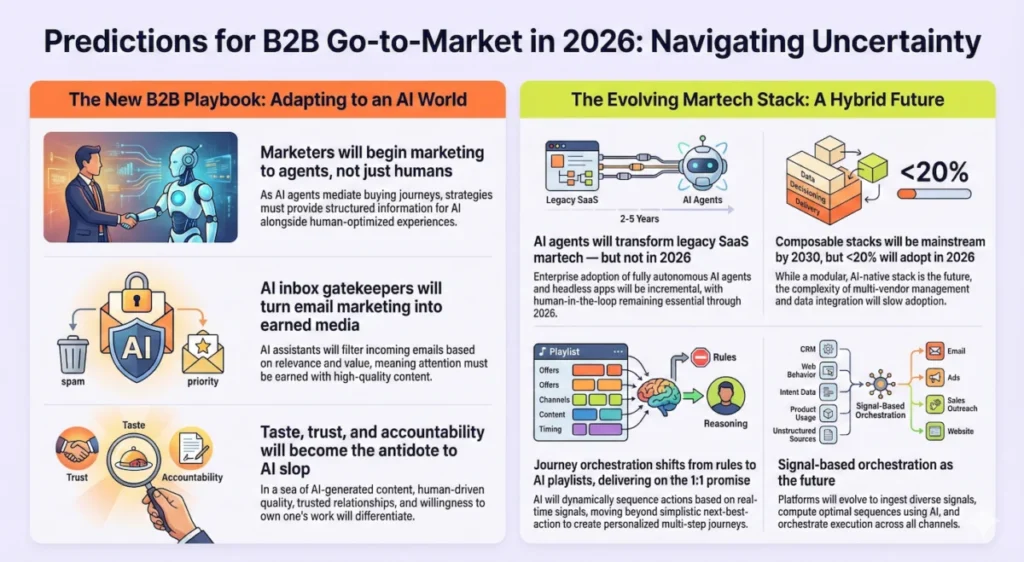
The most significant paradigm shift identified by Miller is the transition from marketing exclusively to humans to targeting AI agents. As purchasing processes become increasingly mediated by large language models (LLMs) and autonomous research agents, the traditional "human-to-human" sales funnel is being supplemented by a "machine-to-machine" handshake.
Key Drivers of Change
- Answer Engine Optimization (AEO): Following the surge in 2025, where 90% of B2B buyers leveraged AI for initial research, 2026 marks the year that how an AI "describes" your company becomes a primary product marketing KPI.
- Agent Identification: The industry is pivoting toward "agent deanonymization." Recognizing when an AI agent from a Fortune 500 company is evaluating your services against a competitor is no longer technical noise—it is a critical signal for high-value pipeline generation.
- Headless Content Architecture: To cater to both human emotional decision-makers and AI logic engines, marketers must adopt a "headless" model. This involves maintaining a foundational layer of structured, machine-readable data—such as pricing APIs—while preserving branded, emotionally resonant experiences for human stakeholders.
Chronology: The Evolution of the 2026 Stack
The trajectory of B2B marketing technology (martech) is moving away from monolithic, all-in-one platforms toward a "composable" future. However, Miller cautions that this shift is a marathon, not a sprint.
- 2023–2024: The "discovery phase," where generative AI tools were introduced, and initial experiments with ChatGPT for content creation began.
- 2025: The "optimization phase," defined by the rise of AEO and the initial realization that human buyers were relying heavily on AI summaries for vendor evaluation.
- 2026 (The Current Year): A period of "hybrid experimentation." Organizations are integrating AI into existing workflows, not yet replacing them. The focus is on "advanced driver assistance" for marketing: AI provides the guidance, but humans retain the steering wheel.
- 2027–2030: The projected era of mainstream composability, where modular, signal-driven stacks become the industry standard, moving past the limitations of traditional, brittle rules engines.
Supporting Data: Why Change is Incremental
Despite the frantic pace of technological development, enterprise adoption remains measured. Miller highlights several key data points from the Martech for 2026 report:
- The 81/10 Rule: As of late 2025, approximately 81% of AI usage in professional settings was "assist-only," while fewer than 10% of implementations allowed agents to act with full autonomy.
- The Human Constant: The 6sense Buyer Experience Report noted that B2B buyers averaged 16 vendor interactions in 2025—a figure that remained stagnant, proving that complex, high-stakes contracts still require human validation and trust.
- The "Silent Freeze": Data from Pave indicates a significant shift in labor demographics. Junior-level SDR positions have seen a decline in workforce share from 1.98% to 1.45% in two years, as companies use AI to maintain output without backfilling entry-level roles.
Official Industry Perspective: The "Reasoning" Revolution
A recurring theme in Miller’s 2026 forecast is the shift from "rules-based" to "reasoning-based" automation.
Why Rules-Based Logic is Failing
Legacy marketing platforms rely on deterministic "if-then" statements (e.g., if job title is VP, then add 10 points). These systems are fragile, prone to breakage when market conditions shift, and require constant, manual maintenance.
The Reasoning Advantage
Reasoning AI, by contrast, evaluates multiple signals simultaneously, understands context, and can test hypotheses. Miller predicts that 2026 will see the beginning of a wholesale replacement of these brittle rules engines with AI "playlists." Rather than programming every step of a customer journey in a static Visio diagram, marketers will set the strategic "mood" or "genre," and AI will dynamically sequence the actions necessary to move a buyer forward based on real-time engagement data.
Implications for the Modern CMO
The implications of these shifts are profound, requiring a complete rethink of team structure, skill sets, and operational accountability.
1. The Rise of "Context Engineering"
As AI becomes more integral, the "quality" of the data becomes secondary to the "context" of the data. Context engineering is emerging as a critical discipline—the practice of systematically capturing and structuring the tribal knowledge, internal decision logic, and operational nuances that allow an AI to act as a genuine extension of the business, rather than a generic generator of "AI slop."
2. Email as Earned Media
With AI-powered inbox gatekeepers—such as Outlook Copilot and Apple Mail’s group-summarization features—email marketing is shifting from "owned" to "earned" media. If your content is not genuinely helpful, AI gatekeepers will filter it out before it ever reaches a human eye. Relevance is now the only currency that guarantees inbox placement.
3. The Return to Taste and Trust
In a world where content creation is effectively free, "taste"—the ability to curate, discern, and create meaningful, emotionally resonant work—is becoming the ultimate competitive advantage. Miller emphasizes that "trust" is the antidote to AI-generated noise. This is why founder brands, executive influence, and influencer relations are seeing a massive surge in budget allocations for 2026.
4. Navigating the "Silent Freeze"
The most sobering implication of the 2026 outlook is the potential for a "hollowed-out middle class" in the labor market. As companies stop hiring for junior roles, the on-ramp to senior expertise is being dismantled. Miller warns that leaders must focus on upskilling their existing teams using AI as a coach, ensuring that the organization does not lose its ability to develop talent while it chases efficiency gains.
Conclusion: Navigating, Not Predicting
As Miller concludes, 2026 will not be a year that can be predicted with precision; it is a year that must be navigated with agility. The "World Uncertainty Index" has reached historic highs, driven by geopolitical instability, economic volatility, and the relentless, rolling disruption of AI.
For the B2B leader, the path forward is clear: Build resilience through efficiency. Organizations that run lean and prioritize the integration of AI-enabled, signal-driven workflows will be the ones that survive the coming shocks. The goal for 2026 is to build a foundation that is functional today but flexible enough to evolve into a fully agentic future.
As we move through the year, the winners will be those who recognize that while AI can handle the combinatorial math of marketing, it cannot replicate human judgment, emotional intelligence, or the willingness to stake a reputation on a point of view. In the end, the most advanced technology remains only as valuable as the human strategy directing it.
