
Teads Unveils CTV Ensemble: A Strategic Pivot Toward Full-Funnel Television Advertising
NEW YORK — On June 18, 2026, Teads Holding Co. (Nasdaq: TEAD) fundamentally altered the landscape of connected television (CTV) advertising with the global launch of CTV Ensemble. This comprehensive suite integrates the company’s diverse CTV assets—ranging from premium Smart TV home screen real estate to in-stream video—into a unified, AI-driven workflow within the Teads Ad Manager (TAM).
The launch represents more than just a product update; it is a calculated effort to transition CTV from a branding-heavy medium into a high-performance, full-funnel marketing channel. By combining "HomeScreen" and "InStream" inventory with advanced measurement, agentic targeting, and dynamic creative optimization (DCO), Teads is positioning itself to capture the massive shift in ad budgets currently migrating from traditional television to digital performance channels.
The Core Components of CTV Ensemble
Teads CTV Ensemble is built upon four structural pillars: premium supply, creative intelligence, data-driven targeting, and AI-powered performance measurement.
1. The Supply Layer: Bridging Discovery and Viewing
At the foundation of the suite is a powerful dual-supply strategy. Teads leverages its deep-rooted partnerships with major TV manufacturers—including Google TV, Samsung, LG, TCL, and Hisense—to dominate the "HomeScreen" real estate. This placement is the first thing a consumer sees upon turning on their television, making it a high-attention, zero-friction environment.
Alongside this, the suite incorporates "InStream" inventory, specifically utilizing non-disruptive formats like InPlay (advertising within content without interruption) and InPause (ads that appear only when a viewer pauses their stream). This combination allows advertisers to capture the consumer during the "passive discovery" phase at the home screen and the "active viewing" phase within streaming content, all through a single buy.
2. Creative Intelligence and Teads Studio
A standout feature of Ensemble is its application of Dynamic Creative Optimization (DCO) to the living room. By utilizing audience and content signals, the platform can personalize creative in real-time. A notable feature, "Localized Ads," allows national brands to swap in local store offers or regional messaging without needing to produce hundreds of individual video assets. Furthermore, Teads Studio for CTV brings web-based design efficiencies to the big screen, enabling the creation of high-impact 3D assets that have already proven successful in early campaigns, such as Cartier’s 12-million-impression initiative.
3. Agentic Targeting and Household Data
Moving beyond standard demographics, Ensemble introduces "Program-Level Agentic Targeting." Unlike traditional audience targeting, which tracks a user across different channels, agentic targeting uses autonomous systems to identify specific programs and viewing moments where a brand’s audience is most receptive. This is augmented by the Teads Omnichannel Graph, which connects web-based behavioral data with household-level characteristics, such as recent home moves or life-stage transitions, allowing for a seamless transition between online and offline intent.
4. CTV Performance: The Measurement Revolution
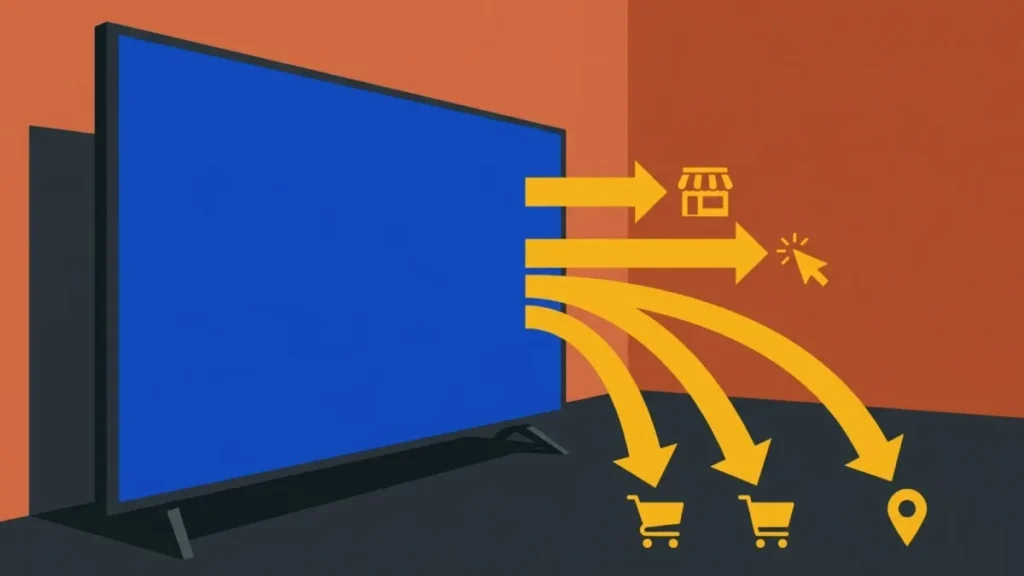
The crowning achievement of the Ensemble suite is the formal transition of "CTV Performance" from beta to general availability. This layer provides the technical infrastructure to track qualified site visits, conversions, in-store traffic, and offline sales directly from CTV exposure.
Chronology: A Path to Full-Funnel Maturity
The launch of CTV Ensemble is the culmination of nearly two years of aggressive R&D and strategic partnership building.
- Late 2023 – Early 2025: Teads begins building independent CTV capabilities, focusing on establishing supply partnerships with major TV OEMs.
- February 2025: The acquisition of Legacy Teads by Outbrain is finalized, creating the current entity under the ticker TEAD.
- October 2025: Teads launches the beta phase of "CTV Performance," testing the ability to attribute downstream sales to television exposure.
- February 2026: A landmark partnership with Google TV is announced, expanding Teads’ CTV reach to 500 million devices. By this time, the company reports over 4,000 global HomeScreen campaigns.
- May 2026: Teads cements its measurement strategy by expanding its partnership with Lumen Research to bring predictive, eye-tracking-based attention measurement to the HomeScreen globally.
- June 2026: Following nearly 40 beta campaigns across 14 countries, Teads officially launches CTV Ensemble, marking the end of the performance measurement beta and the integration of all components into a single workflow.
Supporting Data: Why Attention Matters
The effectiveness of the Ensemble suite is backed by a rigorous, neuroscience-led measurement stack. Teads has moved beyond traditional metrics to embrace "Attention Science," partnering with industry leaders:
- Lumen Research: Provides predictive, biometric-based eye-tracking models. Data indicates that Teads’ HomeScreen placements achieve a 48% attention rate, outpacing YouTube skippable pre-rolls by 16 percentage points.
- TVision: Contributes second-by-second, real-time attention data.
- Adelaide: Offers a cross-channel attention currency that allows advertisers to verify the quality of their impressions.
This multi-layered approach to measurement ensures that advertisers aren’t just paying for "reach," but for meaningful, attentive engagement—a metric that carries significant weight in the boardroom of modern CMOs.
Official Responses and Case Studies
The industry has been quick to react to the potential of CTV as a performance channel. Perhaps the most compelling evidence comes from the beta test conducted by Citroën UK.
Mark Lynch, Marketing Director at Citroën UK, noted: "Driving over 5,000 qualified conversions directly from CTV proves that with the right creative and targeting, the living room is now a performance channel."
This result serves as a critical proof point, challenging the long-held industry dogma that television is exclusively a branding vehicle. Remi Cackel, Chief Product Officer at Teads, emphasized the strategic shift: "With the launch of Teads CTV Ensemble, we aren’t just putting brands in the living room; we are transforming CTV into a high-velocity, AI-powered engine for omnichannel conversion."
Implications: The Shift in Market Dynamics
The "Full-Funnel" Imperative
The commercial logic behind CTV Ensemble is driven by the hunt for performance budgets. Performance marketing (search, social, programmatic direct response) represents a more consistent and larger pool of capital than discretionary branding budgets. By offering a platform that can prove ROI, Teads is effectively opening up new revenue streams that were previously unavailable to the CTV medium.
Operational Efficiency
Agencies have long struggled with the "fragmentation tax"—the operational friction of managing separate platforms for mobile, web, and TV. The integration of the Teads Ad Manager (TAM) and recent API deals, such as the integration with Havas Media Network’s Converged.AI, allow media planners to push audience definitions directly into the activation layer. This reduction in manual labor is a significant competitive advantage for Teads.
Financial Context
The launch comes at a pivot point for Teads. While the company reported a $352.1 million goodwill impairment in late 2025, its CTV division is a standout performer, growing over 50% year-over-year in Q1 2026. The company’s ability to convert this high-growth "awareness" revenue into "performance" revenue will likely be the primary determinant of its valuation in the coming fiscal years.
With 43% of total US TV budgets now allocated to CTV, the market is ready for a tool that treats the television as a digital asset. As the industry moves toward a post-cookie, privacy-centric future, Teads is betting that the combination of high-intent, home-screen-based advertising and granular, AI-powered attribution will define the next decade of media buying.
As independent advertisers begin to scale their own tests using the Ensemble suite, the industry will watch closely to see if the Citroën UK model of "performance television" can be replicated across categories—from retail and CPG to finance and technology. If it can, the very definition of a "television ad" may be permanently rewritten.
