
Regulatory Crackdown: Fitness Provider Fined Over Misleading NDIS Advertising Claims
In a move signaling the Australian Competition and Consumer Commission’s (ACCC) tightening grip on the National Disability Insurance Scheme (NDIS) marketplace, fitness support company WeFlex Pty Ltd has been forced to pay a $19,800 penalty. The fine follows an investigation into a sustained social media advertising campaign that the regulator deemed fundamentally misleading to participants and their families.
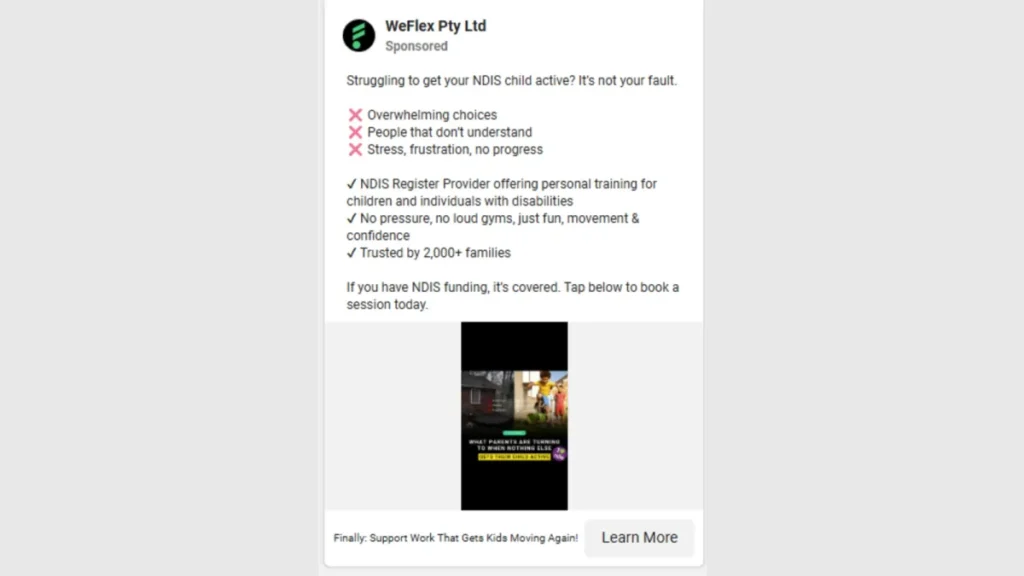
The core of the dispute centers on a series of Facebook and Instagram advertisements that ran for nearly three months, promising that personal training services were "covered" by NDIS funding. The ACCC has made it explicitly clear: such blanket assertions are not only inaccurate but represent a breach of the Australian Consumer Law (ACL), as they fail to account for the highly individualized nature of NDIS plan assessments.
The Anatomy of the Misleading Claim
Between 21 November 2025 and 12 February 2026, WeFlex deployed advertisements explicitly targeting parents and caregivers of children with disabilities. The promotional copy urged users to "get your NDIS child active" through the company’s personal training services. However, the regulatory red flag was raised by the inclusion of the phrase: "If you have NDIS funding, it’s covered."
For the ACCC, this sentence represents a dangerous oversimplification of complex bureaucratic architecture. NDIS funding is not a universal voucher system that applies to all services for all participants. Instead, the scheme operates on a model of "reasonable and necessary" support, where funding is strictly tied to the specific goals, needs, and approved plans of each individual.
"Businesses must not make general statements that their goods or services will be approved, funded, or endorsed by the NDIS," said ACCC Deputy Chair Catriona Lowe. "The NDIS does not automatically approve funding for products or services for all participants, nor does it endorse specific providers. Suitability is assessed based on the unique needs and goals of the individual."
Chronology of the Enforcement Action
The path to the June 19, 2026, infringement notice was paved by a period of strategic surveillance by the ACCC. The timeline of the case highlights both the duration of the misleading conduct and the speed of the regulatory response:
- 21 November 2025: WeFlex initiates its targeted social media advertising campaign on Facebook and Instagram.
- 21 November 2025 – 12 February 2026: The advertisement remains active for nearly three months, capturing the critical school holiday and early-year period when families are often adjusting their support and therapy schedules.
- February 2026: The ACCC releases a comprehensive report identifying systemic issues regarding deceptive advertising practices and unfair contract terms within the NDIS market.
- 19 June 2026: The ACCC formally issues an infringement notice to WeFlex, requiring a penalty payment of $19,800. The agency simultaneously publishes the details of the notice on its public register.
By paying the penalty, WeFlex has resolved the matter without formal court proceedings. However, while the payment does not constitute an admission of contravention, it establishes a public record of the conduct, which serves as a cautionary benchmark for other providers in the sector.
The Business Model and Compliance Obligations
WeFlex operates as a registered NDIS provider specializing in Exercise Physiology, physical wellbeing, and therapeutic supports. Its business model is designed to facilitate access by connecting consumers living with disabilities to personal trainers who operate under the WeFlex banner.
This structure is intended to be commercially practical; it allows trainers to deliver NDIS-supported services without the heavy administrative burden of navigating independent registration. However, the ACCC emphasizes that this convenience does not exempt the provider from the stringent requirements of the Australian Consumer Law.
As a registered provider, WeFlex sits at the intersection of two distinct regulatory regimes: the rules established by the NDIA regarding funding eligibility, and the broad consumer protection laws that apply to all commercial transactions in Australia. The ACCC’s position is that the latter applies regardless of the former, and providers who conflate the two in their marketing do so at their own peril.
The Real-World Consequences for Participants
The ACCC’s concern is not merely with the technical inaccuracy of the advertisement but with the tangible financial and emotional harm it can inflict on vulnerable Australians.
"Claims for non-eligible products and services can be rejected under the NDIS," Ms. Lowe explained. "This can leave participants with debts they cannot afford to pay. This is especially concerning if participants are already experiencing financial hardship or vulnerability."
When a participant signs up for a service under the false impression that it is "covered," they are often entering into a contract for which they may be personally liable if the NDIS rejects the claim. If a provider renders a service—such as a series of personal training sessions—and the NDIA later determines it does not meet the "reasonable and necessary" threshold, the provider may pursue the participant for payment. For families already navigating the complexities of disability support, such an unexpected debt can be devastating.
The Wider Regulatory Landscape
The WeFlex infringement notice is a single thread in a much larger tapestry of enforcement. Since the establishment of the NDIS (Fair Price and Australian Consumer Law) Taskforce in December 2023, the federal government has significantly ramped up its oversight.
The Taskforce—a collaborative body comprising the ACCC, the National Disability Insurance Agency (NDIA), and the NDIS Quality and Safeguards Commission—has fundamentally changed the oversight of the sector. By pooling intelligence, these three agencies can now track how marketing claims (ACCC jurisdiction) align with funding claims (NDIA jurisdiction) and provider behavior (Quality and Safeguards Commission jurisdiction).
This coordinated approach has resulted in a series of high-profile enforcement actions:
- Ausnew Home Care Service: Facing Federal Court proceedings for alleged ACL breaches.
- Bedshed and Thermomix: Paid infringement notices in May 2025 for implying NDIS endorsement of their products.
- Mable Technologies: Entered into a court-enforceable undertaking in June 2025 regarding the use of unfair contract terms.
- Aidacare: Provided a court-enforceable undertaking in March 2026 regarding misleading claims about consumer guarantee rights.
The Role of Targeted Social Media Advertising
The WeFlex case highlights the specific risks associated with modern digital advertising. By utilizing the granular targeting capabilities of platforms like Facebook and Instagram, advertisers can reach very specific demographics—in this case, parents and caregivers who have expressed an interest in disability support.
While this allows businesses to find their ideal audience efficiently, it also amplifies the impact of misleading content. An advertisement that is "broadcast" to the general public may be dismissed by many, but a highly targeted ad is designed to influence individuals who are already in the market for disability services and who are predisposed to trust promises of funding coverage.
The ACCC has made it clear that the platform’s infrastructure does not mitigate the advertiser’s responsibility. As evidenced by the regulator’s ongoing campaign against misleading influencer and testimonial-based advertising, the burden of ensuring that content complies with the law rests entirely with the business.
Implications for the Industry
For digital marketers and NDIS service providers, the WeFlex case serves as a definitive "line in the sand." The key takeaway is that absolute, guaranteed claims regarding government funding are legally indefensible in the current regulatory climate.
- Avoid Guaranteed Outcomes: Claims such as "it’s covered," "fully funded," or "NDIS approved" are inherently misleading because they ignore the individualized assessment process mandated by the NDIA.
- Understand the Dual-Compliance Burden: Providers must recognize that complying with NDIS operational rules does not grant immunity from the Australian Consumer Law.
- Transparency is Paramount: Marketing should focus on the service provided, not on the promise of government payment. Using language that encourages potential clients to check their individual plans with their support coordinators is the only compliant way to discuss funding.
- The Escalation Risk: The ACCC’s enforcement pattern indicates that it is not looking for a "one-off" correction. It is actively building a record of compliance issues to deter bad behavior across the entire sector.
The $19,800 penalty paid by WeFlex may seem modest compared to the scale of the NDIS market, but the reputational damage and the administrative burden of being placed on the ACCC’s public register are significant. As the ACCC continues to prioritize the NDIS sector through 2026 and 2027, providers who fail to refine their messaging can expect the regulator to shift from infringement notices to more severe court-based litigation.
For the advertising industry, the message is clear: when operating in sectors tied to government schemes, the promise of a "bureaucratic outcome" is a dangerous claim that no advertiser has the authority to make. As the regulatory spotlight intensifies, the cost of being wrong is only set to rise.
