
The AI Tipping Point: Why B2B Organizations Must Close the Growing "Operational Gap"
In the history of technological innovation, there is a recurring, definitive moment: the transition from "optional experiment" to "operational necessity." For the world of B2B marketing, that moment has arrived. According to the 2026 State of AI for Business Report, artificial intelligence has graduated from the peripheral toolkit of tech-savvy early adopters to a foundational requirement for professional success.
As the industry stands at this critical juncture, the data reveals a startling paradox. While individual marketing professionals have embraced AI as an essential component of their daily productivity, the organizations that employ them are struggling to keep pace. This widening disconnect between employee ambition and corporate infrastructure has become the defining challenge for B2B leaders in the mid-2020s.
The Main Facts: A Consensus on Necessity
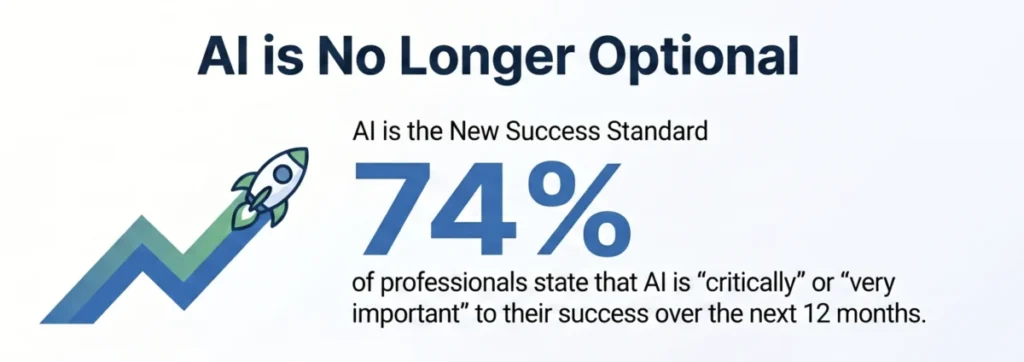
The 2026 State of AI for Business Report, which synthesized insights from over 2,100 professionals—84% of whom operate within the B2B sector—paints a clear picture of the current landscape. A staggering 74% of respondents classified AI as "critically important" or "very important" to their professional success over the next year.
"That’s nearing about as close to a consensus on a survey question as you can get," noted Taylor Radey, Director of Research at SmarterX, during the report’s unveiling.
This is not merely a trend driven by hype; it is a fundamental shift in the B2B marketing psyche. The days of treating AI as a "side-hustle" project or a novelty to be explored during downtime are over. Today, knowledge workers are building their workflows around intelligent automation, and leadership teams are increasingly making the use of these tools an expectation rather than an option.
The Chronology: From Novelty to Necessity
To understand where we are, we must look at how we arrived here.
2022–2023: The Era of Curiosity.
During this period, AI entered the B2B workspace largely as an individual experiment. Employees began testing Large Language Models (LLMs) to draft emails, summarize meetings, and generate creative copy. These pilots were often "shadow IT"—used without explicit corporate mandates or guidelines.
2024: The Era of Implementation.
As the technology matured, companies began to recognize the productivity gains. The conversation shifted from "What is this?" to "How do we implement this safely?" Marketing teams started vetting tools for data privacy and compliance, and the first wave of internal AI policies began to appear.
2025: The Crossover.
This was the year of integration. Companies began to move beyond isolated tools, looking for ways to weave AI into CRM systems, content management platforms, and marketing automation software.
2026: The Era of Expectation.
The current year marks the "crescendo" of the AI movement. As the 2026 State of AI for Business Report highlights, the sentiment has shifted from curiosity to expectation. AI is no longer a competitive edge; it is the baseline requirement for maintaining market relevance.
Supporting Data: The "Integration Gap"
The most concerning takeaway from the 2026 data is not the high adoption rate among individuals, but the stagnation at the organizational level. The report highlights a significant "Integration Gap."
- Individual Progress: 53% of professionals report that they are currently in the "Integration" or "Transformation" phases of AI adoption. They have successfully embedded these tools into their daily routines and are actively reimagining their roles to leverage machine intelligence.
- Organizational Lag: Despite this individual momentum, only 25% of the organizations surveyed have reached the "Scaling" phase—the point at which AI is institutionalized, governed, and deployed across the entire enterprise.
- The Pilot Trap: Perhaps most alarming is that 47% of companies remain stuck in "pilot mode." They are perpetually testing, debating, and experimenting without ever committing to a full-scale operational strategy.
As Radey aptly summarized, "This is not a knowledge gap. The people inside these organizations know what AI can do. But the organizations themselves haven’t built the infrastructure to operationalize AI and take full advantage of what their own employees are already doing on their own."
Official Responses and Perspectives
Industry leaders are sounding the alarm on the dangers of this organizational inertia. Paul Roetzer, CEO of SmarterX and the Marketing AI Institute, emphasizes that this is a shift in sentiment that cannot be ignored.
"You’re starting to see the sentiment shift," says Roetzer. "And these are AI-forward people, the people seeing the tools every day, who are realizing the impact. The disconnect isn’t that people don’t want to use AI; it’s that companies are failing to provide the environment, the guardrails, and the training necessary to move from individual effort to organizational transformation."
The consensus among analysts is that this gap creates a "shadow AI" environment. When employees realize they can do their jobs 30% faster with an AI tool, they will use it regardless of whether their IT or HR department has provided an approved version. This leads to fragmented data, security risks, and a lack of consistent branding—all of which could have been avoided with proper organizational leadership.
Implications for the Future of B2B Marketing
The implications for B2B marketing leaders are twofold: risk and opportunity.
The Risk of Inaction
Organizations that remain in the "pilot trap" risk losing their top talent. The modern marketer now expects to work in an environment where they are equipped with the best tools available. If a company denies them the ability to work with AI, they are essentially asking them to work with one hand tied behind their back. This leads to burnout, low morale, and a decline in competitive output.
The Opportunity of Alignment
Leaders who bridge this gap stand to gain massive efficiencies. By creating a formal roadmap, instituting governance, and providing training, companies can harness the energy of their employees and focus it on high-value strategy rather than manual tasks.
Bridging the Divide: A Roadmap for Leaders
For B2B marketers looking to lead their organizations out of the pilot phase, the path forward requires a shift from "playing with AI" to "building with AI."
1. Establish an AI Governance Framework
You cannot scale what you do not govern. Companies must move away from blanket bans and toward "permission-based innovation." This involves creating clear policies on data privacy, copyright, and ethical usage. When employees know the rules, they are more likely to innovate within them.
2. Move Beyond "Individual" to "Institutional"
AI should not just be a tool for the individual writer or analyst; it should be part of the marketing stack. Integrate AI-driven insights into your CRM, your content calendars, and your project management tools. When AI is baked into the software the team uses every day, adoption becomes frictionless.
3. Dedicated Training and Upskilling
The "knowledge gap" that Radey mentions may not be about what AI is, but about how to use it effectively at an enterprise scale. Companies should invest in formal training programs that teach prompt engineering, AI strategy, and critical analysis of AI-generated outputs.
4. Create an AI Roadmap
Stop the "random acts of AI." Every department should have a documented plan for how AI will impact their KPIs over the next 12 to 24 months. This roadmap should be reviewed quarterly to account for the rapid pace of technological change.
Conclusion: The Workplace Transition
The shift we are witnessing is less like a typical technology trend and more like a permanent workplace transition. Just as the arrival of the personal computer and the internet forced organizations to fundamentally alter their operational models, AI is demanding a total rethink of how B2B marketing is executed.
For the modern B2B marketer, the question is no longer "Will AI change how I do my job?" We have already passed that point. The question is whether our organizations will evolve fast enough to empower us, or if they will remain stalled in the pilot phase while the rest of the industry races ahead.
The data is clear: the individuals are ready. Now, it is time for the organizations to catch up.
To view the full 2026 State of AI for Business Report, visit stateofbusiness.ai. For further insights, register for the upcoming B2B AI Summit hosted by the Marketing AI Institute.
