
Peak Martech: Has the Great Software Expansion Finally Stalled?
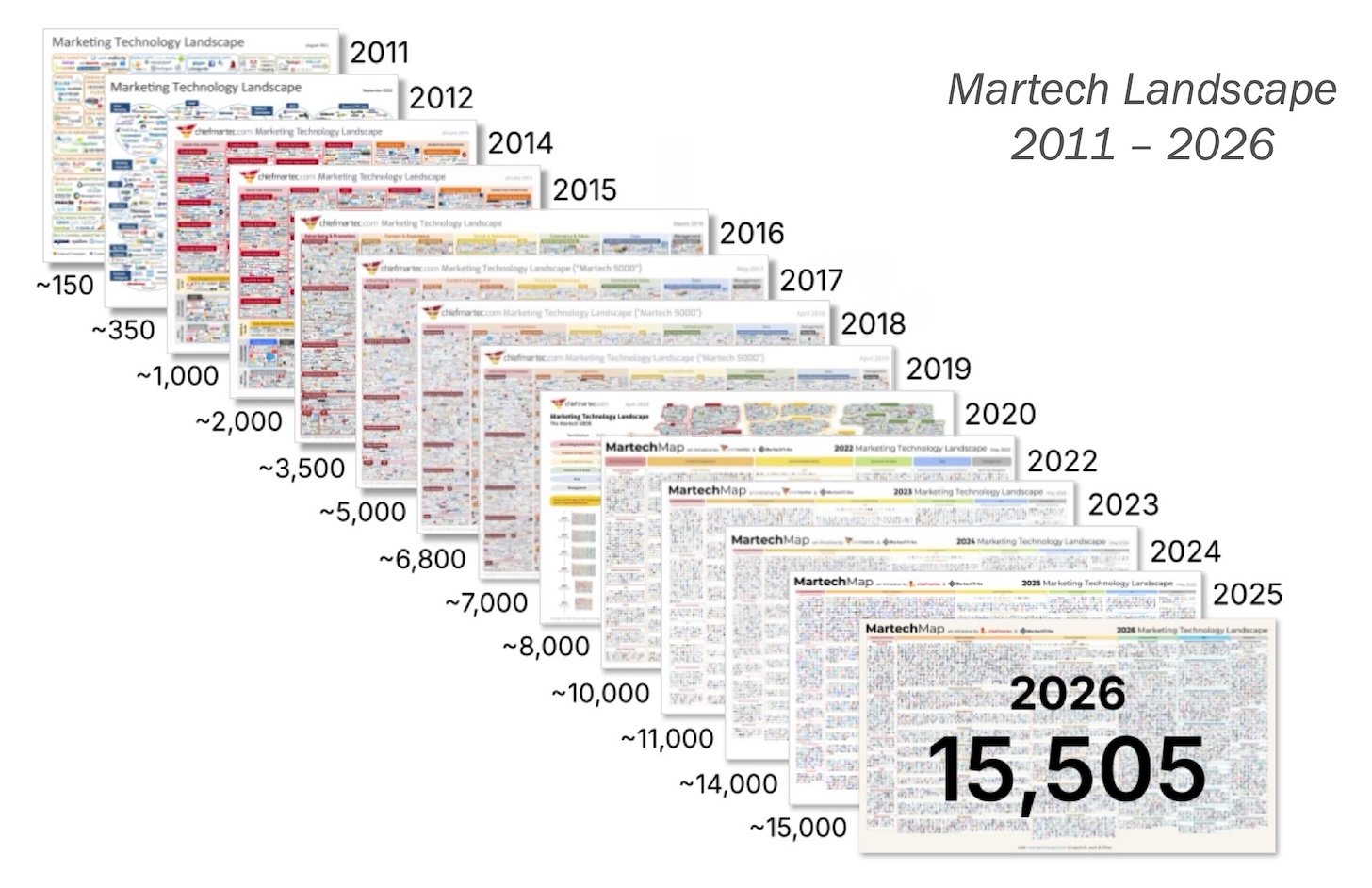
For fifteen years, the annual Marketing Technology Landscape—the definitive supergraphic of the industry—has been defined by one word: acceleration. Since its inception in 2011, when it featured a mere 150 companies, the landscape has expanded with the relentless momentum of a runaway freight train. Year after year, marketers braced themselves for the inevitable: a slide so dense with logos that it became a running joke in the industry.
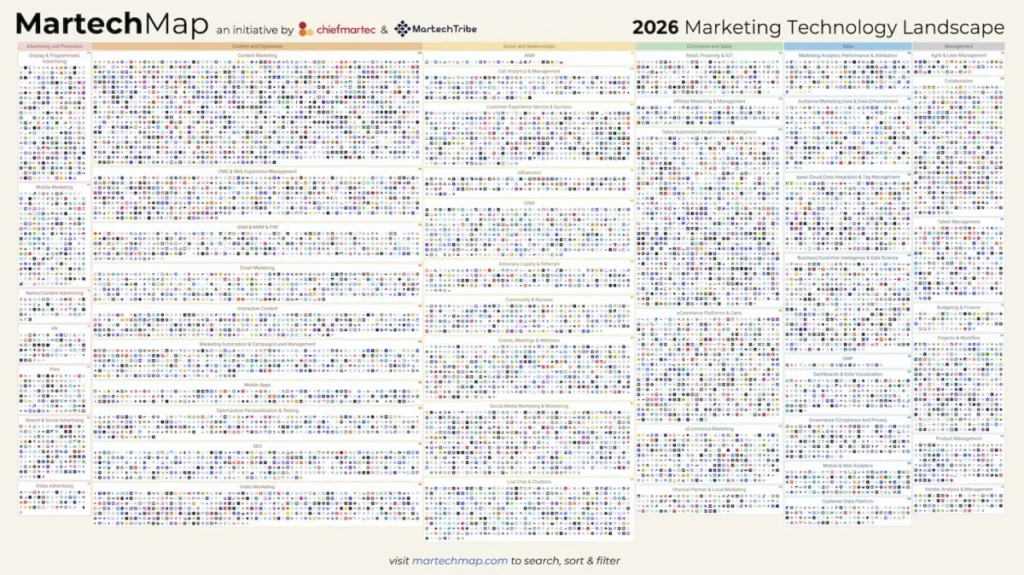
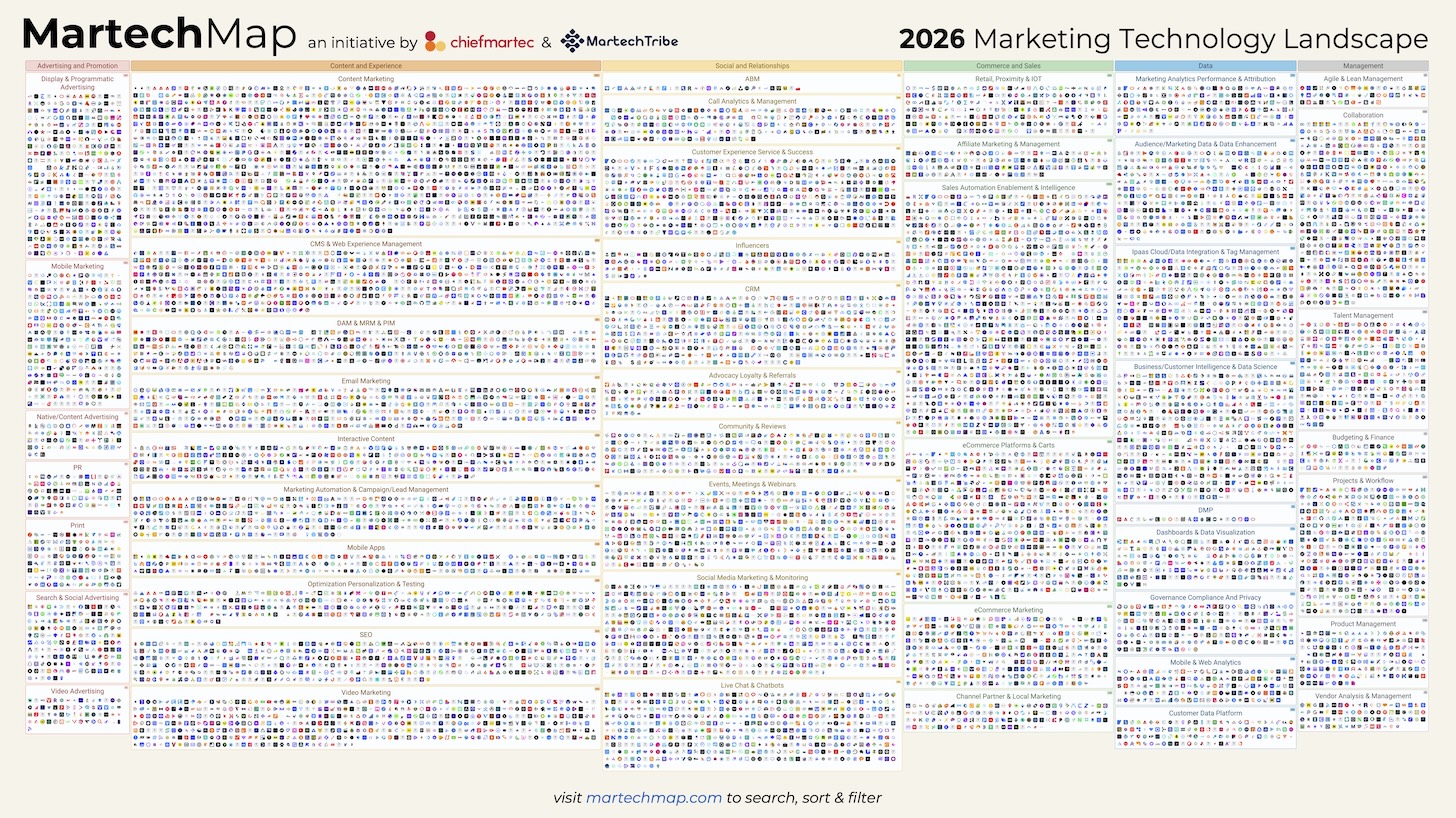
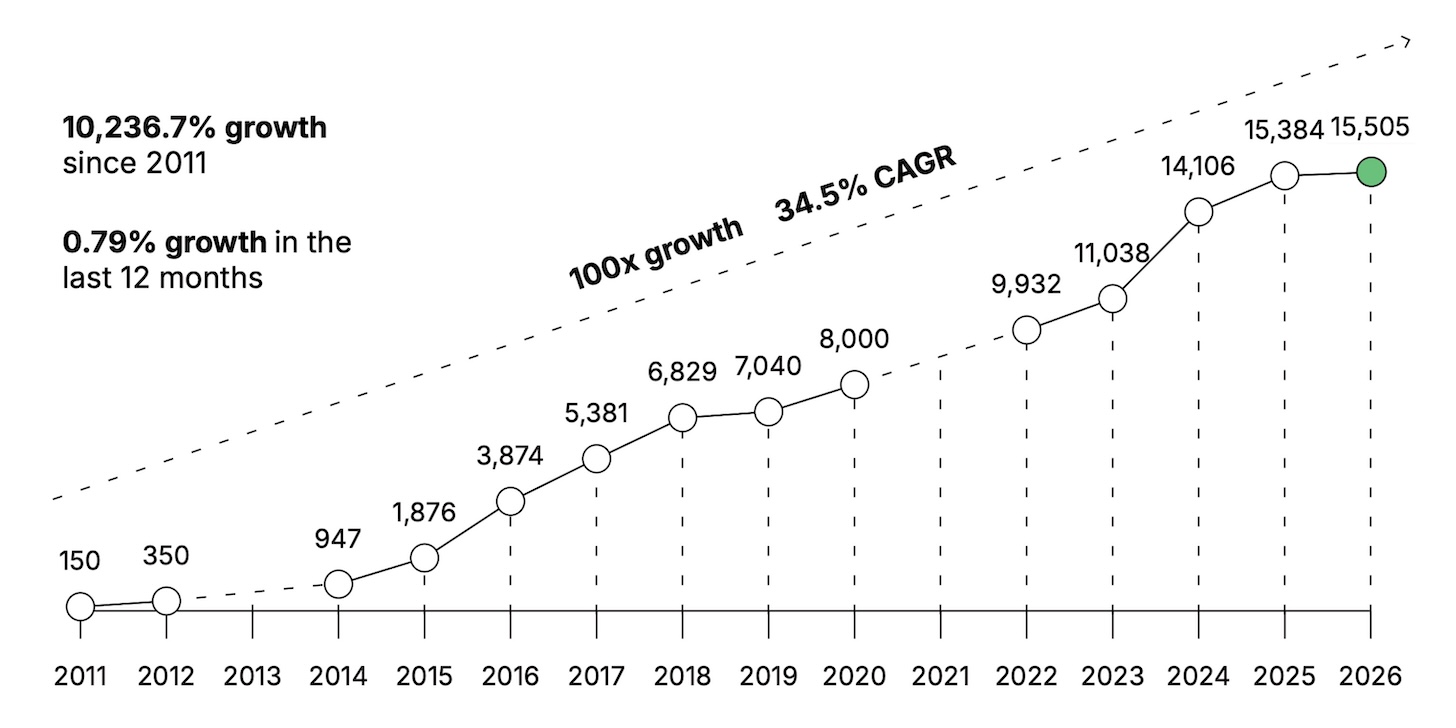
However, the 2026 edition of the Marketing Technology Landscape, released today, tells a radically different story. With 15,505 products now documented, the landscape has grown by a mere 0.79%—a net increase of just 121 products from the 2025 count of 15,384. After over a decade of exponential growth, the data suggests that the martech industry has reached a historic inflection point. We may have finally hit "Peak Martech."
The End of Unchecked Growth: A New Market Equilibrium
While the headline figure of 0.79% growth suggests a period of stagnation, the underlying data reveals a market that is anything but static. The martech ecosystem has shifted from a phase of unchecked proliferation to a period of intense, Darwinian churn.
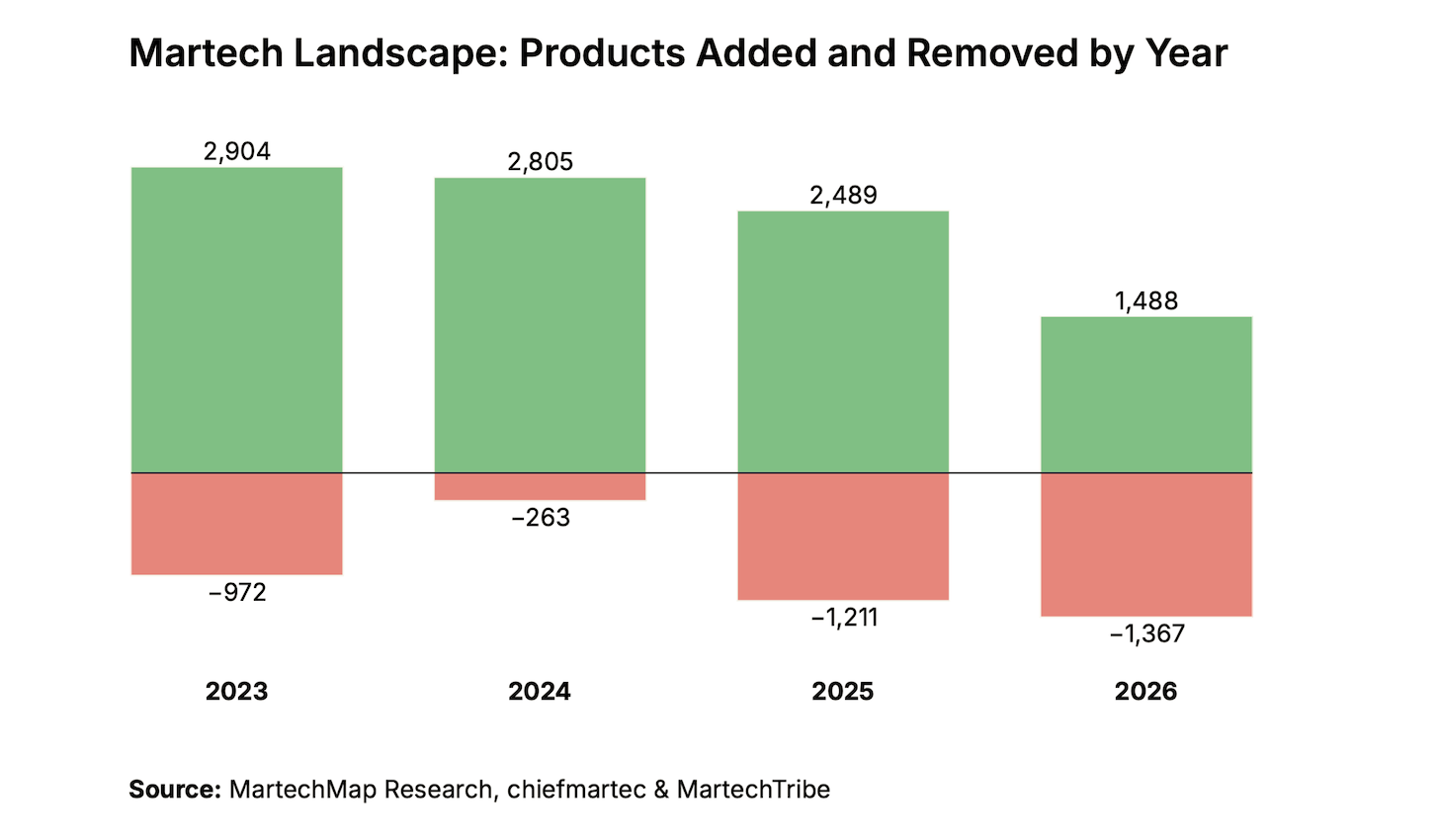
This year, 1,488 new products were added to the landscape, representing a 40% decline in new market entrants compared to the previous year. Simultaneously, 1,367 products were removed—a 13% increase in departures. The stagnation is not a result of inactivity, but rather a reflection of a market that has finally achieved a tense, fragile balance between innovation and attrition.
Chronology of the Expansion
To understand the significance of this plateau, one must look at the trajectory of the last decade:
- 2011–2015: The "Foundational Era," where the landscape grew from 150 to nearly 2,000 products as cloud SaaS adoption took off.
- 2016–2020: The "Explosion Era," characterized by the democratization of APIs and the rise of niche marketing point solutions, pushing the total toward 8,000.
- 2021–2025: The "AI Gold Rush," where the landscape surpassed 15,000 as developers scrambled to build AI-native wrappers and generative marketing tools.
- 2026: The "Equilibrium Era," marked by the first signs of consolidation and a shift toward structural efficiency.
The Anatomy of the Exit: Why Thousands of Companies Are Disappearing
The most striking aspect of the 2026 data is the demographic of the companies being pruned from the landscape. This is not merely a "bonfire of the vanities" involving failed AI startups; it is a systematic culling of the previous generation.
Over 51.7% of the products removed this year originated from the 2010–2019 SaaS wave. This indicates that the market is finally shedding the weight of "legacy" point solutions—tools that were once innovative but have since been rendered redundant by platform consolidation, AI-native competitors, or the "bundling" strategies of major incumbents.
The data reveals that the "middle class" of martech is currently under the most significant pressure. Among the exits:
- 45.5% of removed products were generating between $1M and $10M in annual revenue.
- 41.2% of removed products were small teams with 1–10 employees.
- 38.7% of removed products had teams of 11–50 employees.
These companies were successful enough to achieve initial traction but failed to reach the "inevitability" threshold. In a market where incumbents are embedding sophisticated AI capabilities directly into their core platforms, and where buyers are increasingly rationalizing their tech stacks to control costs, these mid-tier players are being squeezed from both sides.
The Hidden Growth: How AI is Reactivating Mature Categories
While the overall growth curve has flattened, specific sub-sectors of the landscape are experiencing a resurgence. Paradoxically, the most significant growth is not happening in "shiny new" categories, but in the bedrock of digital infrastructure.
The Rise of CMS and Ecommerce
CMS and Web Experience Management grew by 21.4% this year, reaching 612 products. Ecommerce platforms saw a similar surge, growing by 19.9% to 656 products.
This growth is fundamentally tied to the rise of the "machine audience." For twenty years, web design was a two-party negotiation between the human visitor and the search engine crawler. Today, a third participant has entered the room: the AI agent. Whether these are shopping bots, procurement agents, or answer engines, they are changing the requirements for web infrastructure. Businesses are upgrading their CMS and ecommerce platforms to ensure their data is structured, machine-readable, and accessible for AI-mediated interactions.
The "River, Not a Lake" Philosophy
The market is no longer a static lake of tools; it is a river of integrated data flows. Consequently, categories that facilitate these flows are seeing renewed vitality:
- iPaaS and Data Integration: Up 8.0%.
- Governance, Compliance, and Privacy: Up 7.1%.
- Marketing Automation: Up 5.9%.
These categories are being "reactivated" because, in an age of autonomous agents, the connective tissue between systems is as important as the systems themselves. Marketing automation is no longer about scheduling emails; it is about orchestrating complex agentic workflows across disparate data silos.
Implications: Navigating the Post-Peak Era
The transition to a plateau-based market carries profound implications for CMOs and technology buyers.
1. Context Engineering is the New Competitive Edge
The effectiveness of AI in marketing no longer depends solely on the underlying large language model (LLM). As the 2026 State of Martech report highlights, the value is shifting toward "context engineering." Companies that can provide their AI agents with the most relevant, accurate, and secure data—customer history, pricing policies, brand guidelines, and real-time inventory—will win. The technology landscape is reflecting this by prioritizing tools that specialize in data governance and semantic orchestration.
2. The Return to Rationalization
For years, the "best-of-breed" philosophy encouraged marketers to pile on hundreds of niche tools. As the market reaches maturity, the pendulum is swinging back toward consolidation. CIOs and CMOs are increasingly skeptical of "AI-wrapper" startups that solve only a single, narrow task. Instead, there is a clear preference for platforms that offer a unified data environment.
3. The Human-Machine Collaboration
The future of the web is shifting away from static page-view navigation and toward collaborative interfaces. The growth in ecommerce platforms is a testament to this; businesses are investing in "AI concierges" that can compare products, explain trade-offs, and handle complex queries. This is not just a UI change—it is a backend revolution that requires a new generation of sophisticated, data-rich infrastructure.
Conclusion: Still Waters Run Deep
While the martech landscape may have reached a numerical plateau, the technological evolution remains as rapid as ever. The 10,236.7% growth since 2011 is not just a statistical curiosity; it represents a total transformation of how businesses interact with their customers.
The era of "more logos, more noise" is ending, replaced by an era of "more integration, more context, and more intelligence." For those in the industry, the challenge for 2026 and beyond is no longer about adding more tools to the stack, but about ensuring that the existing tools are capable of powering the autonomous, agent-led future of marketing.
As the industry enters this mature phase, the survivors will be those who move beyond the excitement of the "AI Gold Rush" and focus on the unglamorous, critical work of building a robust, governed, and truly integrated technology ecosystem. The peak has been reached, but the vista from the top suggests that the most meaningful innovation is only just beginning.
For deeper insights, the full State of Martech 2026 report is available as an ungated, open-access resource. It includes comprehensive analysis of over 15,000 products and a deep dive into the 70 critical AI use cases currently reshaping the marketing landscape.
