
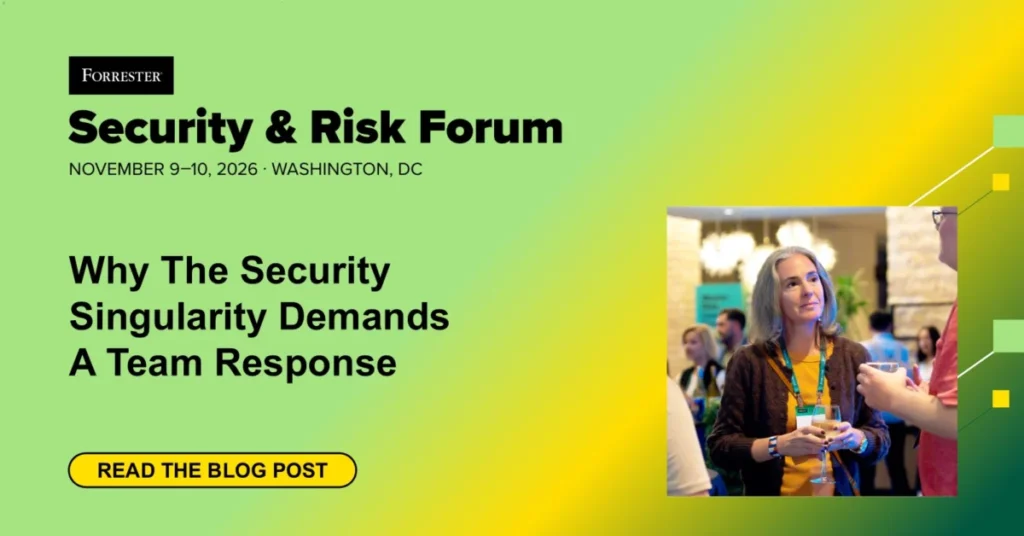
Navigating the Security Singularity: Why Cross-Functional Teams Are Essential for the AI Era
Main Facts: The New Paradigm of Cybersecurity Leadership
The cybersecurity landscape is undergoing a profound and irreversible transformation, often described by industry analysts as the "security singularity." This phenomenon represents a critical juncture where rapid technological acceleration—driven primarily by artificial intelligence, autonomous systems, AI agents, and frontier models—creates a complex web of challenges that traditional, siloed security operations can no longer address.
According to recent insights and foundational research from Forrester, these modern challenges span multiple vital business domains simultaneously: trust, governance, identity, resilience, operations, and culture. No single executive, whether it is the Chief Information Security Officer (CISO), the Chief Risk Officer, or the Head of Data Governance, possesses all the answers required to navigate this shifting frontier.
Consequently, leading organizations are radically changing their professional development and conference-attendance strategies. Rather than dispatching isolated delegates to major industry events, forward-thinking enterprises are sending multidisciplinary teams to major gatherings such as the upcoming Forrester Security & Risk Forum. This team-based approach ensures that organizations can cover diverse tracks, synthesize complex information, and return to their enterprises with a unified, synchronized strategy for digital trust and assurance.
Chronology of the Shift: From Perimeter Defense to Enterprise-Wide Trust
To understand why a collective approach to security is now mandatory, it is helpful to examine the evolution of the cybersecurity domain over the past decade:
- The Perimeter Era (Early 2010s): Cybersecurity was primarily a technical and isolated function. The primary objective was building high walls around corporate data centers and networks. CISOs reported to IT directors, and the mandate was straightforward: keep unauthorized users out.
- The Cloud and Mobility Transition (Mid-to-Late 2010s): As organizations migrated workloads to the cloud and embraced remote work, the traditional perimeter dissolved. Security expanded to encompass endpoint protection, identity management, and cloud access security brokers. However, security departments still operated largely as technical gatekeepers rather than strategic business partners.
- The Digital Transformation and Early AI Phase (2020–2023): The acceleration of digital business models brought security into early software development lifecycles (DevSecOps). Simultaneously, machine learning models began entering the enterprise, introducing early vulnerabilities regarding data privacy, model poisoning, and basic algorithmic bias.
- The Security Singularity and Agentic AI Era (Present Day): Today, organizations face autonomous AI agents, automated threat actors, quantum security concerns, and complex regulatory mandates regarding AI governance. Security is no longer just about protecting static data or systems; it is about governing how both humans and machines make decisions. Trust has become an enterprise-wide responsibility, forcing security out of the IT basement and into the boardroom.
Supporting Data and Research: The Imperative of Alignment
Forrester’s ongoing research into high-performing security organizations underscores a stark reality: technical controls alone are insufficient to guarantee security posture or build customer trust in an AI-driven economy.
Key data points and organizational findings highlight this reality:
- The Multidisciplinary Mandate: Modern security challenges are inherently cross-functional. A single threat vector can simultaneously implicate the CISO (focused on assurance), the legal and governance team (establishing AI policies), the identity team (preparing for non-human agentic architectures), and the security operations center (evaluating AI-driven detection and response tools).
- The Coverage Gap: At a major industry conference featuring multiple concurrent tracks, workshops, and deep-dive sessions, a solo attendee can realistically absorb only 20% to 25% of the total available specialized content. A team of five, however, can divide and conquer the agenda, capturing insights across governance, trust, AI defense, and fundamental security engineering.
- The ROI of Collaboration: Organizations that foster internal alignment across leadership, culture, governance, and technology consistently outperform their peers. They transition from being viewed as business "blockers" to trusted enablers of secure innovation. To facilitate this collaborative learning model, programs such as the Forrester Security & Risk Forum offer specialized group incentives—such as registering five attendees for the price of four—enabling entire departments to maximize their operational and strategic coverage.
Official Perspectives and Industry Responses
Industry analysts, risk management experts, and enterprise leaders are increasingly vocal about the need to break down organizational silos.
"The security singularity isn’t creating a single, isolated problem that can be solved with a new piece of software," notes enterprise risk advisory literature. "It is fundamentally rewriting the rulebook for leadership. When AI can write code, launch sophisticated social engineering attacks, and execute autonomous actions within corporate networks, our defense mechanisms must be equally integrated and coordinated."
Governance leaders emphasize that establishing guardrails for AI cannot be delegated solely to technical teams. Lawyers, compliance officers, HR representatives, and data scientists must sit at the same table to design policies that mitigate risk without stifling innovation.
Similarly, security operations practitioners stress that fighting AI with manual processes is a losing battle. The integration of AI into security operations (AI for security) requires close collaboration between IT infrastructure teams, data engineers, and security analysts to ensure that automated detection and response systems are reliable, transparent, and aligned with enterprise values.
Implications: Building the Security Organization of the Future
The shift toward collaborative, team-based security development has profound implications for corporate governance, talent retention, and long-term business resilience.
1. Breaking Down Silos Through Shared Learning
When cross-functional teams attend immersive industry events together—engaging in specialized tracks like Leading The Trust And Assurance Organization, Guardrails to Mitigate AI Risk, AI for Security, and Security Fundamentals—they break down the communication barriers that traditionally plague large enterprises. They share a common vocabulary, build mutual empathy for each other’s operational pressures, and return to the office with a unified vision rather than competing departmental agendas.
2. Moving from Idea Generation to Momentum
Conferences often suffer from the "notebook syndrome," where an individual attendee returns from a trip with pages of notes and inspiring ideas, only to find themselves isolated and unable to convince skeptical colleagues or executive leadership to fund new initiatives. When an entire team experiences the same thought leadership, case studies, and certification workshops together, the dynamic changes entirely. They do not just bring back notes; they bring back momentum, political capital, and a ready-to-execute roadmap.
3. Elevating Security to a Competitive Advantage
Ultimately, organizations that master the complexities of the AI era will distinguish themselves in the marketplace. Customers, partners, and regulators increasingly demand verifiable proof of digital trust and responsible AI usage. Companies that align their leadership, culture, governance, and technology will not only defend themselves more effectively against advanced threats—they will turn their security posture into a distinct competitive advantage.
Conclusion and Strategic Next Steps
The challenges of the AI era are too vast, too rapid, and too interconnected to be solved by any single individual or department. Addressing trust, governance, identity, and resilience requires a holistic, synchronized organizational response.
Organizations ready to take the next step in preparing their workforce for the future can explore specialized educational tracks, certification opportunities, and registration details by visiting the Forrester Security & Risk Forum. By leveraging team registration offers—such as securing five passes for the price of four—enterprises can ensure they have the right mix of stakeholders on hand to learn, align, and act together in the face of the security singularity.
